
 en
en  fra
fra  de
de  ru
ru  ara
ara  gle
gle  it
it  jp
jp  kor
kor  th
th  zh
zh Kiln Girth Gear: Cast vs Forged, and Which Grade to Specify
2026-09-18 16:50:04 hits:0
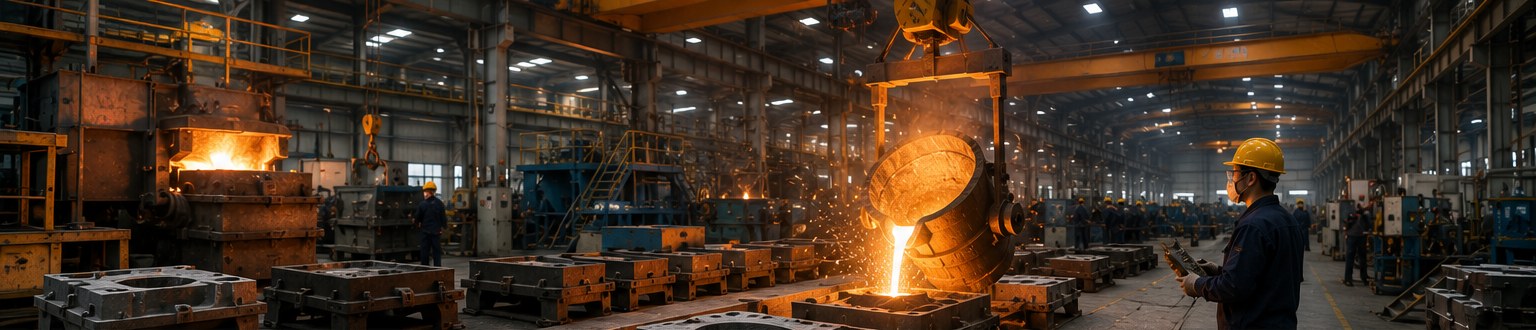
For most cement, lime, and mineral kilns, specify a cast girth gear — two halves at moderate diameter, segmented above that — in ZG42CrMo or ZG35SiMn (GB/T 11352), stress-relieved twice with the teeth cut after the second relief. Reserve forged rings for large-diameter, high-torque drives where material uniformity justifies the price. What decides whether the gear runs quietly is not cast versus forged — it is tooth accuracy grade, runout, and the order of heat treatment and tooth cutting.
What a Kiln Girth Gear Does — and Why It Fails
The girth gear is the large ring mounted on the kiln shell that takes drive torque from the pinion and turns the kiln. It runs hot, slowly, and under reversing load, and it is one of the most expensive single parts on the kiln. Tiegu supplies kiln girth gear castings to cement, lime, and mineral-processing plants worldwide, matching each order to a foundry that casts the gear, stress-relieves it, and coordinates tooth cutting and runout measurement against your drive drawing before export.
They fail in predictable ways: tooth pitting and breakage when the accuracy grade or the runout is off, so load concentrates on one tooth; a step at the split joint when the half faces are not match-fitted; distortion and runout growth when the teeth are cut before the final stress relief; and rim or web cracks when UT coverage on the heavy sections was never specified. None of these show up in a plain "gear, cast steel" purchase order.
Cast or Forged — and Which Grade?
Decide on diameter, drive torque, and how much downtime a failure costs. Cast gears dominate kiln service because they can be made in halves or segments, repaired, and re-cut; forged rings are a premium answer for the largest, most critical drives.
| Option | Best for | What you accept |
|---|---|---|
| Cast, two halves, ZG310-570 (GB/T 11352) | small kilns, moderate torque | lowest cost; coarser UT coverage and a lower tooth accuracy grade |
| Cast, two halves or segments, ZG42CrMo / ZG35SiMn (GB/T 11352, heat-treated) | most cement and lime kilns | the mainstream choice: strength, hardenability, and repairability at reasonable cost |
| Cast ZG34CrNiMo or forged 42CrMo4 ring | large diameter, high torque, critical drive | tighter material uniformity and fatigue resistance, at a much higher price and longer lead time |
Not sure whether your drive needs a cast or forged gear? Contact us at tieguexport.com →
What We Verify Before Shipment
Chemistry and mechanicals: we check C, Mn, Si, Cr, and Mo against the order on the material certificate (MTC), with tensile, yield, and elongation from the test coupon — the grade name alone does not prove the rim can carry the drive torque.
Soundness of rim and web: ultrasonic testing per EN 12680-1 on the rim, web, and bolt zone, plus magnetic-particle testing at the tooth roots after cutting. We reject linear indications in the rim regardless of their size.
Tooth accuracy and runout: the teeth are cut after the second stress relief, to the agreed GB/T 10095 accuracy grade, and radial and axial runout are measured on the finished gear and reported — this is the number that decides how the gear meshes.
Split-face fit and heat treatment records: the halves (or segments) are match-marked, the joint faces are checked for step and dowel fit, and both stress-relief cycles are documented. The blank is ordered to an agreed ISO 8062 tolerance class so the tooth blank has uniform machining allowance.
Tooth hardness: verified in the tooth zone, with the hardness band and the test location written into the PO.
Common Specifying Mistakes
Cutting the teeth before the final stress relief — the gear distorts after cutting, runout goes out of spec, and there is no rework on a large ring.
Writing "gear, cast steel" with no tooth accuracy grade or datum — the foundry delivers its own default, which is not what the kiln drive needs.
Ignoring the split-face fit — a joint step loads one tooth, and pitting starts there within one campaign.
Specifying a forged ring as a reflex — on a standard kiln it can double cost and lead time without changing campaign life; compare with the gear material trade-offs first.
Specification Checklist
[ ] Kiln diameter, drive torque, and pinion data confirmed
[ ] Cast or forged decided, with the reason recorded
[ ] Grade chosen (ZG310-570 / ZG42CrMo, ZG35SiMn / ZG34CrNiMo)
[ ] Tooth accuracy grade (GB/T 10095) and runout limits written into the PO
[ ] UT (EN 12680-1) on rim, web, and bolt zone + MT at tooth roots
[ ] Two stress-relief cycles documented; teeth cut after the second
[ ] Split-face fit and match marking agreed; tooth hardness verified
FAQ
1. Can a worn girth gear be repaired or re-cut?
Sometimes. A gear can be re-cut or the teeth built up and re-cut if the rim still has sound wall thickness and no crack indications — the decision needs a tooth-flank inspection plus UT on the rim. We confirm rim condition before advising, and buyers who choose a supplier that can report rim condition get a real answer instead of a quote.
2. What lead time should I plan for a cast girth gear?
Typically 20–30 weeks: pattern, casting of a multi-tonne ring, two stress-relief cycles, rough machining, tooth cutting after the second relief, runout measurement, and export packing. A new pattern adds time. Send the drive drawing and pinion data early and submit a clear RFQ so tooth accuracy and UT scope are agreed before quoting.
3. How do I verify the teeth before shipment?
Ask for three documents: the tooth accuracy and runout report, tooth-hardness results, and the UT/MT records for rim, web, and tooth roots. A first-article inspection on the first gear of a new pattern catches accuracy and joint-fit issues before the second half is finished.
Tiegu is a China-based casting supplier serving international buyers through a vetted network of qualified Chinese foundries. We supply castings under a single commercial contract, managing supplier selection, technical confirmation, quality inspection, and export delivery from order to shipment.