
 en
en  fra
fra  de
de  ru
ru  ara
ara  gle
gle  it
it  jp
jp  kor
kor  th
th  zh
zh Rolling Mill Housing Castings: Grade, UT Scope, and What Buyers Often Get Wrong
2026-09-21 16:43:34 hits:0
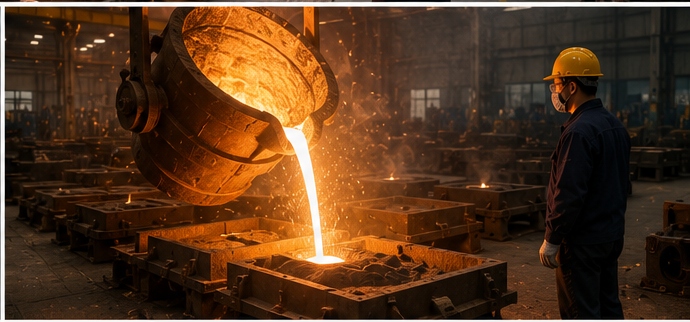
Specify a mill housing by stand type, roll separating force, and UT acceptance level — not by "cast steel". Use carbon cast steel (ZG270-500, GB/T 11352) for finishing and light section stands, manganese cast steel (ZG40Mn) for high-load roughing stands, and Cr-Mo cast steel (ZG35CrMo / ZG42CrMo) where fatigue strength matters. The housing that lasts is the one whose soundness and window geometry were specified before the pattern was made.
What a Rolling Mill Housing Does — and Why It Fails
The housing is the closed frame that carries the roll separating force and holds the roll gap. It is one of the heaviest single castings in a rolling line, with thick-to-thin section transitions at the window corners and the feet. Tiegu supplies rolling mill housing castings to steel mills and rolling-equipment builders worldwide, matching each order to a foundry that casts, heat-treats, and proof-machines the housing against your mill drawing before export.
They fail in predictable ways: shrinkage porosity in the heavy sections around the window and feet when the risering is not matched to the section modulus; window distortion and non-parallel faces that make roll change and pass alignment difficult; cracking at corners from residual stress after a hurried heat treatment; and rejections found only at final machining, weeks into the order. None of these show up in a plain "cast steel housing" purchase order.
Which Grade Should You Specify?
Match the grade to the stand and the load it carries. Roughing stands take the highest separating force; finishing stands are lighter but need dimensional stability.
| Grade (standard) | Load / duty | Typical hardness | Typical stand |
|---|---|---|---|
| ZG270-500 (GB/T 11352 carbon cast steel) | moderate separating force | HB 140–180 as-cast | finishing / light section stands |
| ZG40Mn (GB/T 11352 Mn cast steel) | high separating force, wear at fit faces | HB 180–220 | roughing stands, billet mills |
| ZG35CrMo / ZG42CrMo (GB/T 11352 Cr-Mo cast steel, heat-treated) | high load + fatigue resistance | HB 240–300 heat-treated | heavy plate / hot strip stands |
Not sure which grade and UT level your stand needs? Contact us at tieguexport.com →
What We Verify Before Shipment
Chemistry and mechanicals: we check C, Mn, Si, and any Cr/Mo addition against the order on the material certificate (MTC), together with tensile, yield, and elongation from the test coupon — a grade label alone does not prove the housing can take the rolling load.
Soundness in heavy sections: ultrasonic testing per EN 12680-1 at the window corners, feet, and thick flanges, at an acceptance level written into the PO. Housings are ordered with an agreed NDT scope, not with "UT if required".
Window geometry: window width, height, corner radii, and face parallelism are measured against the drawing — this decides whether the roll assembly fits and the pass line stays true, and it is checked to the agreed ISO 8062 tolerance class.
Machining allowance and weld repair: machining allowance, datum faces, and the foundry's weld-repair policy are agreed up front, and repair records are supplied. Unreported weld repair on a load-bearing section is a rejection item.
Common Specifying Mistakes
Writing "cast steel housing" with no UT acceptance level — porosity in a 200 mm section is found at final machining, not at the foundry gate.
Treating the window as a casting-tolerance feature — window parallelism and machined faces must be a machining requirement, not a casting-tolerance hope.
Cutting the heat treatment short to save time — residual stress releases in service, and the housing loses its geometry.
Not agreeing the weld-repair policy — hidden repairs on load-bearing sections are the most common late surprise.
Specification Checklist
[ ] Stand type, separating force, and duty cycle identified
[ ] Grade chosen (ZG270-500 / ZG40Mn / ZG35CrMo-ZG42CrMo)
[ ] Chemistry and mechanical properties required on the MTC
[ ] UT acceptance level agreed (EN 12680-1) for window, feet, and thick flanges
[ ] Window dimensions and parallelism specified as machined features
[ ] Machining allowance, datums, and weld-repair policy written into the PO
FAQ
1. How much lead time should I plan for a mill housing?
Typically 16–24 weeks: pattern, moulding of a 10–40 t casting, heat treatment, rough machining, UT, and export packing — plus first-piece qualification on a new pattern. Send the mill drawing and stand data early, and submit a clear RFQ so the foundry can size risers and the UT plan before quoting.
2. Can a housing be repaired if UT finds indications?
It depends where. An indication in a thick, non-critical section can be excavated and repaired to an agreed welding procedure with records; an indication across a window corner or a machined fit face usually means rejection and recast. Agree the repair policy before the order — buyers who choose a supplier on price alone often learn the policy after the casting is made.
3. How do I know the window will fit the roll assembly?
Specify the window as a machined requirement with a stated tolerance, and ask for a dimensional report including parallelism to the roll axis. A first-article inspection on the first housing catches window and face deviations before the rest of the order is cast.
Tiegu is a China-based casting supplier serving international buyers through a vetted network of qualified Chinese foundries. We supply castings under a single commercial contract, managing supplier selection, technical confirmation, quality inspection, and export delivery from order to shipment.
Previous: Kiln Girth Gear: Cast vs Forged, and Which Grade to Specify
Next: No More