
 en
en  fra
fra  de
de  ru
ru  ara
ara  gle
gle  it
it  jp
jp  kor
kor  th
th  zh
zh Crusher Frame Castings: Grade, Soundness, and What Buyers Often Get Wrong
2026-09-16 17:28:36 hits:0
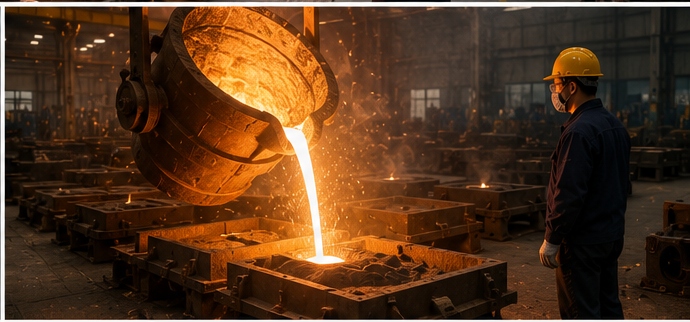
Specify a crusher frame by machine type and load, not by a generic "cast steel frame" label. Use carbon cast steel (ZG310-570) for jaw-crusher frames where weld repair is expected, and low-alloy cast steel (ZG35Mn / ZG35SiMn) for cone and gyratory frames where fatigue resistance matters. The frame that holds up is the one whose grade matches the crushing force — not the one that is simply "steel."
What Crusher Frame Castings Do — and Why They Fail
The frame is the load-bearing skeleton of a crusher: the base, side frames, and bearing housings that carry impact, vibration, and the full crushing force. Tiegu supplies crusher frame castings — bases, side frames, and jaw housings — to crusher OEMs and rebuild shops worldwide, matching each order to a foundry that casts and heat-treats the frame against your machine drawing before export.
They fail in predictable ways: cracking at the feet or ribs when shrinkage porosity there is not removed; cold shut at thick-to-thin rib transitions; and bearing-seat misalignment when the machining tolerance is loose — which then drives the whole machine into vibration and shaft failure. None of these show up in a plain "cast steel frame" purchase order.
Which Grade Should You Specify?
Match the grade to the machine and the dominant load. Jaw frames see moderate load but often need field weld repair; cone and gyratory frames see higher cyclic load and need fatigue resistance.
| Grade (standard) | Load mode | Key property | Use case |
|---|---|---|---|
| ZG270-500 / ZG310-570 (GB/T 11352 carbon cast steel) | moderate, impact | strength + weldability | jaw-crusher frames, bases needing weld repair |
| ZG35Mn / ZG35SiMn (GB/T 11352 low-alloy cast steel) | high cyclic | toughness + fatigue resistance | cone / gyratory frames, heavy duty |
| ZG20Mn (GB/T 11352 high-toughness cast steel) | high impact, low temp | impact toughness | small / high-impact frames |
Not sure which grade fits your crusher type and duty? Contact us at tieguexport.com →
What We Verify Before Shipment
Chemistry and grade: we check C, Mn, Si against the order on the material certificate (MTC) — the grade name alone does not prove the frame will carry the load.
Soundness at the feet and ribs: ultrasonic testing per EN 12680 on the foot and rib sections, where shrinkage porosity concentrates; we reject frames with linear indications at the load path.
Bearing seat and mounting face: magnetic-particle testing per EN 1369 at the seat, and dimensions checked to the agreed ISO 8062 tolerance class so the frame seats the shaft concentric.
Repair and stress relief: for carbon-steel frames we confirm any weld repair follows a documented WPS and is re-checked by PT; we verify the stress-relief or aging treatment record.
Common Specifying Mistakes
Ordering only "cast steel frame" with no grade — you get a frame too weak for a cone crusher, or one that cracks when welded for a jaw repair.
Skipping UT at the feet — shrinkage porosity there grows under load and the frame cracks after commissioning.
Loosening the bearing-seat tolerance — a misaligned seat puts the rotor out of true and breaks the shaft through vibration.
Specification Checklist
[ ] Machine type (jaw / cone / gyratory) and crushing force identified
[ ] Grade chosen (carbon / low-alloy / high-toughness cast steel)
[ ] UT (EN 12680) scope at feet and ribs agreed
[ ] Bearing-seat dimensions + MT (EN 1369) scope confirmed
[ ] Weld-repair WPS and stress-relief record required if carbon steel
FAQ
1. How do I pick the grade for a jaw versus a cone frame?
Jaw-crusher frames usually use carbon cast steel (ZG310-570) because they are large, thick, and often need field weld repair. Cone and gyratory frames run under higher cyclic load, so low-alloy cast steel (ZG35Mn) gives better fatigue life. Buyers who choose a supplier that asks for the machine type, not just a drawing, get a frame that outlasts the campaign.
2. How do you avoid foot cracking after start-up?
By removing shrinkage porosity before it loads: we UT the feet and ribs per EN 12680, control wall-thickness transitions in the pattern, and confirm stress relief. A first-article inspection on the first frame catches seat and soundness issues before a full machine order.
3. What lead time should I plan for a crusher frame?
Typically 16–28 weeks for a large frame — including pattern, risering, casting, weld repair, heat treatment, and NDT — longer for first-piece qualification. Send the machine drawing and duty early, and submit a clear RFQ so the foundry can match grade to load up front.
Tiegu is a China-based casting supplier serving international buyers through a vetted network of qualified Chinese foundries. We supply castings under a single commercial contract, managing supplier selection, technical confirmation, quality inspection, and export delivery from order to shipment.