
 en
en  fra
fra  de
de  ru
ru  ara
ara  gle
gle  it
it  jp
jp  kor
kor  th
th  zh
zh Blast Furnace Throat Armor: Grade, Profile, and What Buyers Often Get Wrong
2026-09-28 17:03:58 hits:0
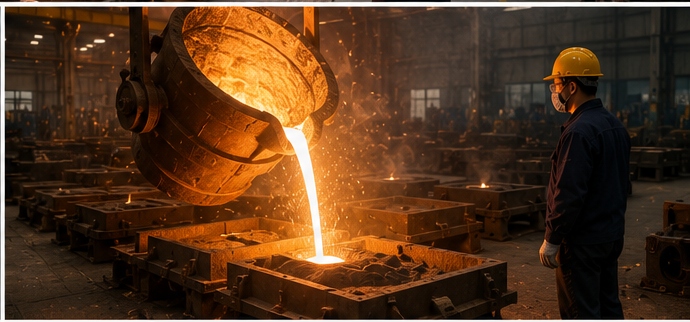
Specify throat armor by where the burden hits and how it wears, not by a generic "wear plate" label. Use high-Mn austenitic cast steel (ZGMn13Cr2, per GB/T 5680) in the impact zone where the charge lands, and high-chrome cast iron (KmTBCr20, per GB/T 8263) in the lower-abrasion zone. The grade that survives is the one matched to the local wear mode — not the one that is simply "hard."
What Blast Furnace Throat Armor Does — and Why It Fails
The throat armor is the cast lining that shields the furnace throat and upper stack from the burden as it drops from the skip or belt. It takes a double hit: heavy impact from the falling charge and sliding abrasion as material funnels down. Tiegu supplies blast furnace throat armor castings to iron and steel plants worldwide, matching each order to a foundry that casts and heat-treats the plates against your furnace drawing before export.
They fail in predictable ways: through-wear when the grade is too soft for the local abrasion; cracking and spalling when a brittle high-chrome plate is placed in the main impact zone; and detachment when the bolt interface or profile no longer matches the shell. None of these show up in a plain "wear-resistant plate" purchase order.
Which Grade Should You Specify?
Map the grade to the local wear mode at each height of the throat. The burden lands hard at the top and abrades more as it slides — so the top usually needs impact resistance, the lower zone needs abrasion resistance.
| Grade (standard) | Wear mode | Hardness | Use zone |
|---|---|---|---|
| ZGMn13Cr2 (GB/T 5680 hadfield Mn steel) | impact + abrasion, work-hardening | surface HB 450–550 after work-hardening | top impact zone, burden landing |
| ZG35CrMo (GB/T 11352 low-alloy Cr-Mo cast steel) | balanced wear + strength | HB 300–400 as-cast / heat-treated | mid-throat, mixed loading |
| KmTBCr20 (GB/T 8263 high-Cr iron) | high abrasion, low impact | HRC 58–64 | lower throat, sliding abrasion only |
Not sure which grade fits your furnace profile and burden? Contact us at tieguexport.com →
What We Verify Before Shipment
Chemistry and grade: we check Mn, Cr, C, and Mo against the order on the material certificate (MTC) — the grade name alone does not prove the plate will survive the impact zone.
Surface hardness: verified on the as-cast or work-hardened face; for Mn steel we confirm the work-hardening response, for high-Cr iron the HRC band (58–64).
Soundness and cracks: ultrasonic testing per EN 12680 on thick sections and magnetic-particle testing per EN 1369 at edges and bolt bosses — we reject plates with linear indications at the bolt zone.
Profile and fit: the armor contour, bolt-hole pattern, and shell interface are checked to the agreed ISO 8062 tolerance class so the plate seats against the furnace shell without gaps.
Common Specifying Mistakes
Ordering only "wear-resistant plate" with no grade — you get a plate matched to neither impact nor abrasion, and it wears through in a single campaign.
Putting a high-Cr iron plate in the top impact zone because it is "hardest" — it shatters under burden impact; reserve it for the lower, abrasion-only zone.
Treating the bolt interface as non-critical — a loose or mis-profiled plate detaches and can damage the shell underneath.
Specification Checklist
[ ] Throat height zones and local wear mode identified
[ ] Grade chosen per zone (Mn steel / Cr-Mo / high-Cr iron)
[ ] Chemistry and hardness band written into the PO
[ ] UT (EN 12680) + MT (EN 1369) scope agreed
[ ] Contour and bolt-hole pattern to ISO 8062 class confirmed
FAQ
1. Can a single grade line the whole throat?
Rarely well. Most furnaces need at least two grades — high-Mn steel at the top impact zone and high-Cr iron lower down. Buyers who choose a supplier that asks for the burden profile, not just a drawing, get longer campaign life.
2. How do you confirm the plate will not crack in service?
Through grade-appropriate placement plus NDT: we verify soundness by UT (EN 12680) and surface cracks by MT (EN 1369), then confirm the bolt zone is clean. A first-article inspection on the first set catches profile and hardness issues before a full campaign order.
3. What lead time should I plan for throat armor?
Typically 8–14 weeks including pattern, casting, heat treatment, and NDT — longer for first-piece qualification. Send the furnace drawing and burden description early, and submit a clear RFQ so the foundry can match grade to zone up front.
Tiegu is a China-based casting supplier serving international buyers through a vetted network of qualified Chinese foundries. We supply castings under a single commercial contract, managing supplier selection, technical confirmation, quality inspection, and export delivery from order to shipment.