
 en
en  fra
fra  de
de  ru
ru  ara
ara  gle
gle  it
it  jp
jp  kor
kor  th
th  zh
zh Ductile Iron vs Grey Iron for Automotive Applications: Which to Specify for Each Part
2026-08-05 16:18:44 hits:0
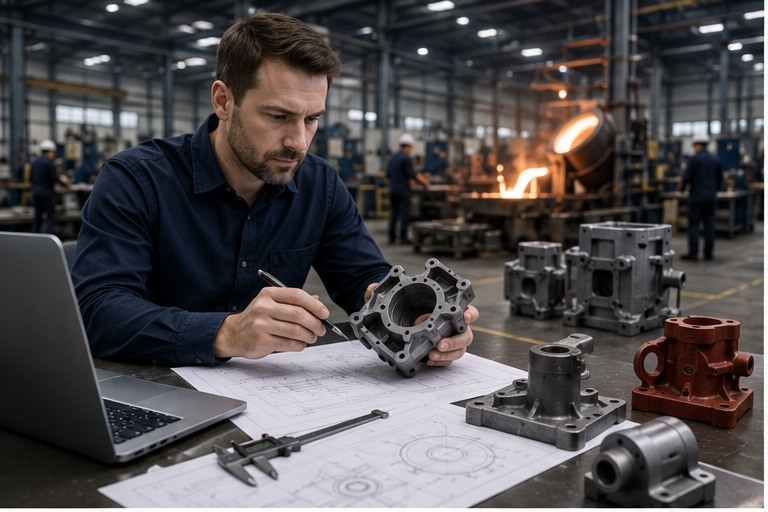
Grey iron and ductile iron end up in the same car. Not because engineers are indecisive — because each iron wins a different fight. Grey iron wins on damping, machinability, and cost. Ductile iron wins on strength and impact resistance. Specify the wrong one and you either overpay for properties you don't need, or ship a part that cracks under load. This guide maps the decision to the actual components on a vehicle.
1. Why Both Irons Still Sit in Every Vehicle
Grey iron's flake graphite makes it cheap, easy to machine, good at damping vibration, and good at moving heat. Those are exactly the properties you want in a static, heat-soaked part that just needs to sit there and not ring.
Ductile iron replaces those flakes with nodular graphite. That single change gives it tensile strength and impact resistance close to steel. You pay more per kilogram, but you get a part that survives bending and road shock.
The decision rule is simple: choose by failure mode, not by habit. A bracket that holds something still wants grey iron. An arm that sees road shock every cycle wants ductile iron. When buyers just write "cast iron" on the RFQ, they inherit both risks at once — over-cost on one part, under-safety on another.
2. Grey Iron Automotive Parts — and Why
Grey iron dominates the parts where the failure mode is thermal or vibrational, not impact. The graphite flakes that "weaken" it in tension are precisely what help it here.
Engine block and cylinder head. Grey iron's damping kills combustion vibration; its thermal conductivity pulls heat off the bores. This is the textbook application, and it is hard to beat on cost at volume.
Brake discs and drums. Grey iron's friction behavior, heat dissipation, and low cost at high volume make it the default. Our brake disc casting sourcing guide covers grade and supplier choices in detail.
Exhaust manifolds. They cycle through huge temperature swings; grey iron casts cleanly and tolerates that better than most alternatives at this price point.
Flywheels, pulleys, timing covers, clutch housings. These need mass, stiffness, and damping — not load. Grey iron is the economical fit.
The common thread: none of these parts carry bending shock as their primary failure mode. Upgrading them to ductile iron adds cost and machining difficulty with no real benefit.
3. Ductile Iron Automotive Parts — and Why
Ductile iron takes over exactly where grey iron is weakest: fatigue and impact. These are the parts where a crack is a safety event, not a noise complaint.
Steering knuckles and control arms. Safety-critical, loaded in bending and impact every single cycle. Ductile iron or nothing — grey iron here is a recall waiting to happen.
Subframes and suspension brackets. They absorb road shock and carry structural loads for the life of the car.
Differential carriers and housings. Internal gear loads plus external shock; ductile iron holds the geometry under both.
Brake calipers. Hydraulic pressure plus impact; the material has to be predictable under stress.
Light-duty wheel hubs. Where toughness matters more than raw stiffness, ductile grades earn their place.
For the grade details behind these parts, our ductile iron grades reference lists the common EN, GB, and SAE designations and what each is good for.
Not sure which iron grade fits your automotive part? Contact us at tieguexport.com →
4. A Part-by-Part Spec Table
Use this as a first-pass check before you write the RFQ. Grade examples use EN notation; GB, SAE, or ASTM equivalents map across directly.
| Component | Recommended iron | Grade example | Why |
|---|---|---|---|
| Engine block | Grey iron | EN-GJL-250 (GG25 / HT250) | Damping, thermal conductivity, cost at volume |
| Brake disc | Grey iron | EN-GJL-200 (GG20 / G2000) | Friction, heat dissipation, high-volume cost |
| Exhaust manifold | Grey iron | EN-GJL-200 (GG20 / HT200) | Heat cycling tolerance, castability |
| Flywheel | Grey iron | EN-GJL-250 (GG25) | Mass and damping, not load |
| Steering knuckle | Ductile iron | EN-GJS-400-15 (GGG40 / 60-40-18) | Impact resistance, safety-critical |
| Control arm | Ductile iron | EN-GJS-500-7 (GGG50 / 65-45-12) | Fatigue and bending under load |
| Differential carrier | Ductile iron | EN-GJS-450-10 (GGG45 / 70-50-05) | Shock and internal gear loads |
| Brake caliper | Ductile iron | EN-GJS-500-7 (GGG50) | Pressure plus impact, predictable stress |
The table is a starting point, not a rulebook. Thin walls, high temperatures, or unusual loads can shift a part into a different grade — or into compacted graphite iron, covered below.
5. How to Specify Without Overpaying
Most "wrong iron" problems start on the RFQ, not on the shop floor. A vague material line invites the supplier to quote what is convenient, not what is correct.
Write the standard grade, not the word "iron." State EN-GJL-250 or EN-GJS-500-7 — or the GB, SAE, or ASTM equivalent. The named grade also locks the right mechanical tests at incoming inspection.
Don't upgrade to ductile iron by reflex. A brake disc does not need ductile iron's toughness, and a manifold doesn't either. Paying for nodular graphite on a part that only needs damping is pure waste.
Use compacted graphite iron (CGI) only where it earns its place. CGI sits between grey and ductile: better strength and fatigue than grey, with retained damping and castability. You see it in cylinder blocks and heads of some turbocharged or downsized engines where walls got thinner. It is a narrow, specific call — not a default.
Demand IATF 16949 for production automotive castings. The certification is the baseline signal that a foundry runs controlled processes. Our supplier verification guide explains what to check beyond the certificate.
Build the shortlist and check design fit together. Start with our guide to finding reliable Chinese casting suppliers, then review part design with our design-for-manufacturability notes so wall thickness and gating don't fight the chosen grade.
FAQ
1. Why is the engine block grey iron and not ductile iron?
Because the block's failure mode is thermal and vibrational, not impact. Grey iron's flake graphite damps combustion shake and pulls heat off the cylinder bores better than ductile iron, at a lower cost per kilogram. Ductile iron would add machining difficulty and cost with no benefit for that specific part.
2. Can I substitute ductile iron for grey iron to make a part "stronger"?
Not blindly. In bending and impact, ductile iron wins clearly. But for a brake disc or exhaust manifold, ductile iron machines and dissipates heat differently, and it usually costs more without helping. Match the grade to the failure mode — don't just pick the material with the higher number on a datasheet.
3. Where is compacted graphite iron (CGI) used in cars?
CGI sits between grey and ductile iron: better strength and fatigue than grey, with retained damping and castability. You'll see it in cylinder blocks and heads of some turbocharged or downsized engines where thinner walls were needed to save weight. It is a specific, narrow upgrade — not a default material.
4. How do I write the right iron grade in my RFQ?
State the standard and grade explicitly: EN-GJL-250 for grey or EN-GJS-500-7 for ductile, or the GB, SAE, or ASTM equivalent. Add the application and the failure mode you are most worried about. Suppliers then quote and inspect against the named grade, which also locks in the correct mechanical tests instead of leaving them to interpretation.
Tiegu is a China-based casting supplier serving international buyers through a vetted network of qualified Chinese foundries. We supply castings under a single commercial contract, managing supplier selection, technical confirmation, quality inspection, and export delivery from order to shipment.
Get a material and supplier recommendation for your automotive casting →