
 en
en  fra
fra  de
de  ru
ru  ara
ara  gle
gle  it
it  jp
jp  kor
kor  th
th  zh
zh Ductile Iron Grades Explained: Complete Guide to GGG40, GGG50, GGG60, GGG70 for International Buyers
2026-03-30 10:35:54 hits:0
Quick Answer
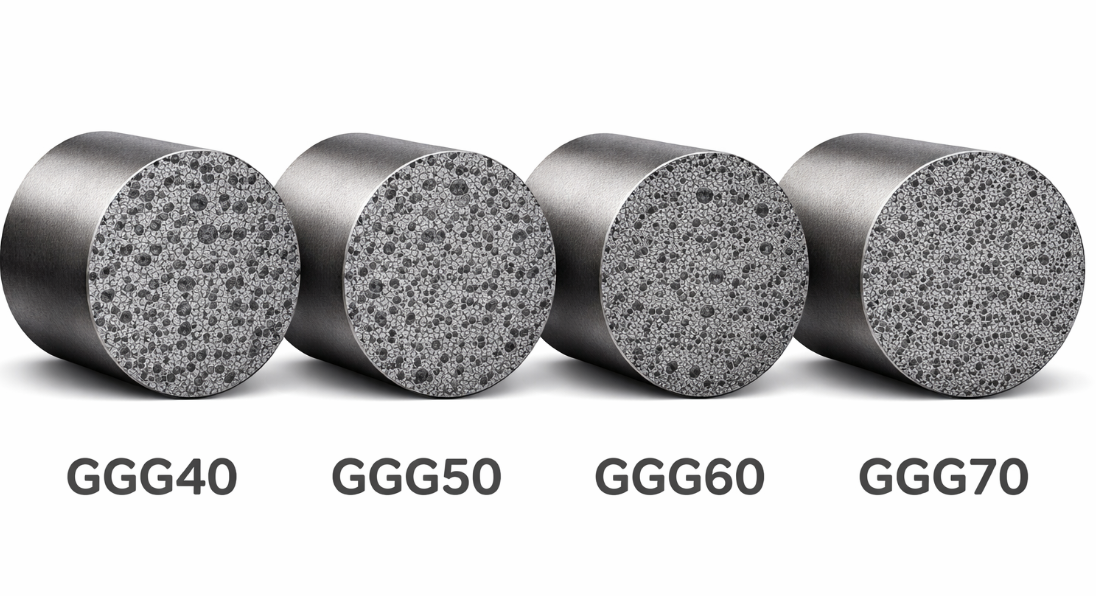
Ductile iron grades (GGG40, GGG50, GGG60, GGG70) indicate minimum tensile strength in MPa. GGG40 offers highest ductility (10-18% elongation) for impact applications; GGG50 balances strength and ductility (7-12% elongation) for general use; GGG60 provides higher strength (3-7% elongation) for pressure applications; GGG70 delivers maximum strength (2-5% elongation) for wear-resistant components. Selection depends on required tensile strength, ductility, and hardness for specific applications.
Overview: Why Grade Understanding Matters
Ductile iron grade selection directly affects component performance, service life, and cost. Choosing the wrong grade can result in premature failure, excessive wear, or unnecessary expense. Understanding grade differences enables informed material specification and supplier communication.
Grade selection impact:
| Selection Factor | Correct Grade | Wrong Grade Consequence |
|---|---|---|
| Ductility | Appropriate for service conditions | Brittle fracture or excessive deformation |
| Hardness | Matches wear requirements | Premature wear or machining difficulty |
| Cost | Optimized for application | Unnecessary material cost |
Key principle: Higher grade numbers indicate higher strength but lower ductility — selection requires balancing these properties for specific applications.
Ductile Iron Grade Designations
Understanding Grade Naming
Common designation systems:
| System | Format | Example | Meaning |
|---|---|---|---|
| EN (European) | EN-GJS-XXX-XX | EN-GJS-400-18 | Graphite Iron Spheroidal, 400 MPa, 18% elongation |
| ISO | ISO 1083 | ISO 1083/400-18 | International standard designation |
| ASTM (US) | ASTM A536 | 65-45-12 | 65 ksi tensile, 45 ksi yield, 12% elongation |
Grade number meaning:
GGG40 = Minimum tensile strength 400 MPa (40 kgf/mm² in old DIN system)
GGG50 = Minimum tensile strength 500 MPa
GGG60 = Minimum tensile strength 600 MPa
GGG70 = Minimum tensile strength 700 MPa
Complete Grade Comparison
Standard ductile iron grades:
| Grade (DIN) | Grade (EN) | Grade (ASTM) | Tensile Strength | Yield Strength | Elongation | Hardness (HB) |
|---|---|---|---|---|---|---|
| GGG40 | EN-GJS-400-15 | 60-40-15 | 400 MPa | 250 MPa | 15% | 140-190 |
| GGG50 | EN-GJS-500-7 | 70-50-05 | 500 MPa | 320 MPa | 7% | 170-230 |
| GGG50 | EN-GJS-500-7 | 70-50-05 | 500 MPa | 350 MPa | 7% | 180-240 |
| GGG60 | EN-GJS-600-3 | 80-60-03 | 600 MPa | 370 MPa | 3% | 200-260 |
| GGG70 | EN-GJS-700-2 | 100-70-03 | 700 MPa | 420 MPa | 2% | 230-290 |
| GGG80 | EN-GJS-800-2 | 120-90-02 | 800 MPa | 480 MPa | 2% | 250-320 |
Note: GGG40/50/60/70 are most common for general industrial applications.
Mechanical Properties by Grade
Tensile Strength
What tensile strength means:
Tensile strength indicates the maximum stress material can withstand while being stretched or pulled before breaking. Higher tensile strength enables thinner sections and higher load capacity.
Tensile strength by grade:
| Grade | Minimum Tensile Strength | Typical Applications |
|---|---|---|
| GGG50 | 500 MPa (72,500 psi) | General engineering, pump housings, valve bodies |
| GGG60 | 600 MPa (87,000 psi) | Pressure-containing parts, gears, crankshafts |
| GGG70 | 700 MPa (101,500 psi) | High-stress components, wear-resistant parts |
Elongation (Ductility)
What elongation means:
Elongation measures how much material can stretch before breaking, expressed as percentage of original length. Higher elongation indicates better ductility and impact resistance.
Elongation by grade:
| Grade | Minimum Elongation | Ductility Level | Best For |
|---|---|---|---|
| GGG50 | 7-12% | Moderate ductility | General applications, balanced properties |
| GGG60 | 3-7% | Limited ductility | Higher strength, moderate impact |
| GGG70 | 2-5% | Low ductility | Maximum strength, minimal impact |
Strength-Ductility Trade-off:
Higher Strength ←→ Higher Ductility
(GGG70, GGG80)    (GGG40)

You cannot maximize both simultaneously.
Selection requires prioritizing based on application needs.
Yield Strength
What yield strength means:
Yield strength indicates the stress at which material begins to deform permanently (plastically). Design stresses typically stay below yield strength to ensure elastic behavior.
Yield strength comparison:
| Grade | Minimum Yield Strength | Yield/Tensile Ratio |
|---|---|---|
| GGG50 | 320-350 MPa | 0.64-0.70 |
| GGG60 | 370 MPa | 0.62 |
| GGG70 | 420 MPa | 0.60 |
Hardness
What hardness means:
Hardness indicates resistance to surface indentation and wear. Higher hardness improves wear resistance but may reduce machinability.
Hardness ranges by grade:
| Grade | Brinell Hardness (HB) | Machinability | Wear Resistance |
|---|---|---|---|
| GGG50 | 170-240 HB | Good | Good |
| GGG60 | 200-260 HB | Fair | Very Good |
| GGG70 | 230-290 HB | Fair-Poor | Excellent |
| GGG80 | 250-320 HB | Poor | Outstanding |
Machinability note: GGG40-50 machine easily with standard tooling. GGG60-70 may require carbide tooling and reduced cutting speeds.
Grade Selection by Application
GGG40 Applications
Best suited for:
| Application | Rationale |
|---|---|
| Pipe fittings (low pressure) | Adequate strength, excellent ductility |
| Agricultural equipment parts | Impact loading from field operations |
| Hand tools and hardware | Toughness for occasional impact |
| Low-temperature applications | Maintains ductility at sub-zero temperatures |
| Components requiring cold forming | High elongation enables deformation |
Typical specifications:
Material: EN-GJS-400-18 per ISO 1083
Heat treatment: As-cast or annealed
Inspection: Visual, dimensional, hardness
GGG50 Applications
Best suited for:
| Application | Rationale |
|---|---|
| Valve bodies (medium pressure) | Good pressure containment |
| Gearbox housings | Adequate strength for most loads |
| Compressor parts | Balanced properties for dynamic loading |
| Machine tool components | Good machinability with adequate strength |
| General engineering castings | Versatile grade for varied applications |
Typical specifications:
Material: EN-GJS-500-7 per ISO 1083
Heat treatment: As-cast or normalized
Inspection: Visual, dimensional, hardness, chemical
GGG60 Applications
Best suited for:
| Application | Rationale |
|---|---|
| Gears and pinions | Surface hardness for wear resistance |
| Pressure vessels (higher pressure) | Enhanced strength for containment |
| Hydraulic components | Strength for high-pressure service |
| Rollers and rolls | Wear resistance for contact loading |
| Automotive suspension components | Strength for dynamic loads |
Typical specifications:
Material: EN-GJS-600-3 per ISO 1083
Heat treatment: Normalized or quenched & tempered
Inspection: Visual, dimensional, hardness, chemical, ultrasonic
GGG70 Applications
Best suited for:
| Application | Rationale |
|---|---|
| Heavy-duty gears | Surface durability for high loads |
| Cutting and forming tools | Hardness for tool applications |
| Mining equipment parts | Abrasion resistance |
| High-strength structural parts | Maximum load capacity |
| Brake discs and drums | Wear resistance for friction service |
Typical specifications:
Material: EN-GJS-700-2 per ISO 1083
Heat treatment: Quenched & tempered or austempered (ADI)
Inspection: Full inspection including NDT
Heat Treatment Effects on Grades
As-Cast Condition
Characteristics:
Lowest cost (no additional heat treatment)
Properties vary with section thickness
Suitable for GGG40-50 applications
Typical hardness: 170-230 HB
Annealing
Purpose: Improve ductility and machinability
| Grade | Typical Result |
|---|---|
| GGG50 | Elongation 10-12%, hardness 160-210 HB |
Applications: Components requiring cold forming or extensive machining.
Normalizing
Purpose: Increase strength and hardness
| Grade | Typical Result |
|---|---|
| GGG60 | Tensile 600-650 MPa, hardness 220-270 HB |
Applications: Components requiring higher strength without quenching.
Quench and Temper
Purpose: Maximum strength and hardness
| Grade | Typical Result |
|---|---|
| GGG70 | Tensile 750-850 MPa, hardness 280-350 HB |
Applications: High-stress, wear-resistant components.
Austempering (ADI)
Purpose: Create Austempered Ductile Iron with superior properties
ADI Grade Properties:
| ADI Grade | Tensile Strength | Elongation | Hardness |
|---|---|---|---|
| Grade 2 | 1050 MPa | 7% | 302-363 HB |
| Grade 3 | 1200 MPa | 4% | 341-401 HB |
| Grade 4 | 1400 MPa | 2% | 388-444 HB |
Applications: High-performance gears, crankshafts, wear parts.
Material Certification Requirements
Standard Certification
What to specify:
| Document | Content | Typical Requirement |
|---|---|---|
| Certificate of Compliance | Statement of specification compliance | All orders |
| Heat Treatment Record | Heat treatment parameters and results | When heat treated |
| Hardness Test Report | Hardness values and locations | Critical applications |
Testing Frequency
Standard testing per heat/batch:
| Test | Frequency | Standard |
|---|---|---|
| Tensile testing | Per batch (typically per day) | ISO 6892 |
| Hardness testing | Per batch or per heat | ISO 6506 |
| Microstructure | When specified | ISO 945 |
Additional Testing for Critical Applications
| Test | Application | Standard |
|---|---|---|
| Magnetic particle | Surface defect detection | ISO 9934 |
| Impact testing | Low-temperature service | ISO 148 |
| Metallography | Quality verification | ISO 945 |
Material Selection for Ductile Iron Applications
Material certification gaps cause more disputes than any other specification issue. Verifying grade capability before order placement prevents costly non-conformance and ensures mechanical properties match your application requirements. Tiegu provides visibility into actual supplier performance beyond certificates. We help international buyers navigate material selection with local expertise.
This helps buyers make informed sourcing decisions and reduces the risk of material-related failures.
---
📋 CTA - Submit Your Requirements
If you are unsure about material selection for your application, understanding the strength-ductility tradeoff is essential.
We help international buyers navigate China's casting supply chain with local expertise and structured sourcing processes.
You can contact Tiegu team to discuss your sourcing needs and get expert recommendations.
---
Summary: Key Takeaways
1. Grade numbers indicate tensile strength — GGG40 = 400 MPa, GGG50 = 500 MPa, etc.
2. Higher strength = lower ductility — Cannot maximize both simultaneously
3. GGG40 for impact applications — Highest ductility (15-18% elongation)
4. GGG50 for general use — Best balance of strength and ductility
5. GGG60-70 for high-stress/wear — Higher strength, lower ductility
6. Heat treatment affects properties — Annealing improves ductility, hardening increases strength
7. Specify certification requirements — MTRs and test reports verify grade compliance
Further reading topics:
Gray iron vs ductile iron: When to use each
Understanding casting tolerances and machining allowances
Heat treatment options for ductile iron castings
---
📋 发布检查清单
[ ] 标题已填写
[ ] 分类已选择(Industry news)
[ ] 关键词已填写(8 个关键词)
[ ] Meta Description 已填写(选 A/B/C 其一)
[ ] 正文已复制到编辑器
[ ] 已保存草稿/发布