
 en
en  fra
fra  de
de  ru
ru  ara
ara  gle
gle  it
it  jp
jp  kor
kor  th
th  zh
zh Brake Disc Castings: A Buyer's Guide to Grey Iron Grades and Sourcing
2026-07-23 16:23:03 hits:0
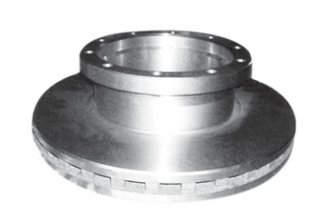
What You're Actually Buying — Casting vs Finished Brake Disc
Here's something that trips up a lot of first-time brake disc buyers: the casting and the finished brake disc are two different products, and they don't always come from the same factory.
The supply chain works in two layers. One foundry pours the grey iron and ships a raw casting — a rough disc with no machining, no balancing, no surface treatment. A separate machine shop then turns, mills, drills, and finishes it into a part that bolts onto a vehicle.
Some suppliers do both. Many don't. If you only deal with the machine shop, you have zero visibility into what's happening at the foundry level. And if a casting defect — porosity, hard spots, graphite type issues — makes it past both factories, it lands on your customer's vehicle. (For a full breakdown of common defects and their causes, see our casting defects guide.)
So before you send an RFQ, know which layer you're buying from. If you're a distributor importing by the container, an integrated casting-and-machining supplier or a casting supplier that manages both steps under one contract gives you better quality control and a single point of accountability. (Brake discs are one of several chassis components buyers often source together — see our automotive chassis castings overview.)
Need specification sheets and pricing for brake disc castings? Contact us at tieguexport.com →
The Material Alphabet: HT250, G3000, and GG25 Explained
If you've sourced brake discs from different countries, you've probably seen three different grade names for what is essentially the same material. Here's the translation table:
| Standard | Grade | Region |
|---|---|---|
| GB/T 9439 (China) | HT250 | China, Asia |
| SAE J431 (US) | G3000 / Class 30 | North America |
| EN 1561 (Europe) | EN-GJL-250 / GG25 | Europe |
All three describe pearlitic grey cast iron with a minimum tensile strength of 250 MPa. But the chemical window that achieves that strength matters more than the grade name.
The typical chemistry for a passenger vehicle brake disc:
| Element | Target Range | Why It Matters |
|---|---|---|
| Carbon (C) | 3.1–3.4% | Provides graphite for thermal conductivity and friction |
| Silicon (Si) | 1.9–2.3% | Controls graphite formation and ferrite stability |
| Manganese (Mn) | 0.6–0.9% | Pearlite stabilizer, combines with sulfur |
| Phosphorus (P) | <0.10% | Kept low to prevent embrittlement |
| Sulfur (S) | <0.12% | Controlled for machinability, not too high for cracking risk |
The single most important number on the certificate isn't any one element — it's carbon equivalent.
CE = C + 0.33(Si) + 0.33(P) − 0.027(Mn) + 0.4(S)
For brake discs, CE should fall between 3.90% and 4.15%. Below 3.90%, thermal cracking risk increases because the disc can't dissipate heat fast enough. Above 4.15%, you risk excessive graphite flotation and soft spots on the friction face.
Some foundries add small amounts of chromium (0.15–0.35%) or copper (0.3–0.6%) as micro-alloying to boost hardness uniformity and thermal stability. These are called "high-carbon" (HC) formulations. They cost more, but for discs used on heavy SUVs or commercial vehicles, they substantially extend service life.
Hardness should land between 187–241 HBS. A common mistake is thinking harder = better. Brake discs that test above 241 HBS produce noise, uneven pad wear, and in extreme cases, cracking under thermal cycling. You want consistent hardness across the friction ring, not high hardness at one spot. (For more on how casting tolerances affect final part performance, read our ISO 8062 tolerances guide.)
Microstructure requirements are equally specific:
Graphite type: Predominantly Type A (uniform flake), size 3–5 per ISO 945
Matrix: Pearlite ≥ 95%, ferrite < 5%
Carbides: None — any free carbide indicates poor inoculation or rapid cooling
Ferrite content above 5% softens the disc surface and produces lower friction coefficients. The brake pad then glazes instead of gripping, and stopping distance increases — something your customer will notice before any lab report does. (These microstructure targets don't happen by accident — they require the foundry to design the gating and cooling system around the part geometry. See our design for manufacturability in casting guide.)
What Goes into a Brake Disc RFQ
A good brake disc casting RFQ contains six things. Most RFQs contain three. The missing three are what cause expensive back-and-forth.
1. Application data. Vehicle make, model, OE part number. If you don't know the OE number, at minimum provide the disc dimensions: outer diameter × thickness × height (total height from hub face to friction face) × center bore × bolt holes × PCD (pitch circle diameter). A drawing is better. A drawing with tolerance annotations is best.
2. Material standard. Write "HT250 per GB/T 9439" or "G3000 per SAE J431" or "EN-GJL-250 per EN 1561." Don't write "grey iron." That's like ordering "metal" and hoping for the best.
3. Product form. Raw casting or fully machined? If machined, specify the surface finish on friction faces (typically Ra 1.6–3.2 μm), whether you need cross-drilled or slotted patterns, and surface treatment — phosphating, electrophoretic coating, or bare with anti-rust oil. Each adds a separate processing step and cost.
4. Certification requirement. For automotive applications, IATF 16949 is the baseline quality management standard. If the disc will be sold in Europe, add ECE R90 (UN Regulation No. 90) — this requires the supplier to submit samples to an accredited test lab for friction performance, thermal stability, and dynamic durability testing.
5. Volumes. Annual estimated volume and first order quantity. This determines tooling amortization. A typical brake disc casting mold (pattern plate) costs $3,000–$8,000 for a passenger vehicle disc. Most foundries amortize tooling over the first year's volume. If your annual volume is 10,000 pieces, that adds $0.30–$0.80 per part. If it's 1,000 pieces, it adds $3–$8 per part — a meaningful difference.
6. Quality inspection plan. Specify that every disc must undergo dynamic balancing (single-plane unbalance ≤ 500 g·cm), that chemical analysis is reported per heat, and that hardness is tested at multiple points on the friction face — not just one reading in a convenient corner.
Quality Checks Specific to Brake Disc Castings
Brake discs fail in ways that general casting inspection won't catch. Here's what to add beyond the standard dimensional and material checks.
Dynamic balancing — 100%, not a sample. A disc spinning at 1,500 RPM with 500 g·cm of unbalance creates vibration through the steering wheel and the brake pedal. Balancing is done by removing a small amount of material from the outer rim. Every single disc needs this test. If your supplier's quotation doesn't include it, expect another $1–2 per piece when you find out later. (For a deeper look at quality protocols for automotive castings, see our automotive casting quality control guide.)
Hardness mapping, not a single reading. Take at least four measurements around the friction ring — not on the hub or outer edge. If the spread between the highest and lowest reading exceeds 20 HBS, material uniformity is poor. This usually traces back to inconsistent cooling rates in the mold.
Metallography is not optional. It takes 20 minutes to mount, polish, and etch a sample. It's also the only way to confirm graphite type and pearlite content. If your supplier says "we guarantee the mechanical properties so we don't need metallography," find another supplier. Mechanical properties can pass while graphite is suboptimal — and it's the graphite that does the braking.
Carbon equivalent per heat. Not per day, not per week — per heat. A foundry running three heats a day can drift outside the CE window by the third heat if charge materials vary. This is one of the most common and most overlooked brake disc quality failures.
Common shortcuts that buyers miss:
Substituting CE with hardness. A low-CE disc can be hardened to hit 200 HBS but will crack under the first mountain descent.
Skipping dynamic balancing entirely. The disc looks right on a gauge but creates vibration the customer feels immediately.
Using ferrite-rich returns in the charge, pushing the pearlite content below 95%. Hardness checks won't flag this; only metallography will.
For European market distribution, the supplier must also provide E-Mark certification and the ECE R90 test report from an accredited laboratory. This is not a factory self-declaration — it's a third-party test on the specific disc model you're importing.
Choosing the Right Supplier: Foundry, Machine Shop, or Integrated
There are three sourcing models for brake discs. Each works for a different buyer profile.
| Model | What You Get | Best For |
|---|---|---|
| Pure foundry | Raw castings only | Buyers with in-house machining or a trusted machine shop partner |
| Pure machine shop | Buys raw castings, delivers finished discs | Buyers who need finished parts but don't do machining |
| Integrated factory | Casting + machining under one roof | Buyers who want single-point responsibility |
| Casting supplier | Manages foundry + machining partners, one contract | Buyers who want an integrated result without integrating it themselves |
The integrated factory and casting supplier models are closest in practice. The difference: an integrated factory owns both processes; a casting supplier manages a network of qualified foundries and machine shops, but signs a single commercial contract that covers casting, machining, balancing, surface treatment, and export delivery.
How to verify a supplier actually does what they claim for brake discs:
Check the IATF 16949 scope. The certificate lists the processes covered. If it says "manufacturing of grey iron castings" but doesn't mention machining, you're talking to a foundry, not an integrated supplier.
Ask for the balancing machine specification. If they can't tell you the make, model, and balance grade they achieve, they probably outsource balancing — or skip it.
Request a sample metallography report. Not a brochure — an actual report from a recent production batch with photomicrographs. If they can't produce one within a day, their quality lab is under-resourced.
FAQ
1. What's the difference between HT250 and G3000 for brake discs?
They're functionally equivalent — both are pearlitic grey iron with minimum 250 MPa / 30,000 psi tensile strength. HT250 follows Chinese GB/T 9439, G3000 follows US SAE J431. The chemical windows overlap almost completely. For procurement purposes, specify whichever standard your target market recognizes. European buyers should request EN-GJL-250 (GG25).
2. Do I need IATF 16949 certification from my brake disc supplier?
For automotive OEM and Tier 1 supply, yes — it's mandatory. For aftermarket distribution, it's not a legal requirement but is the strongest signal that a foundry operates a real quality management system. Foundries without IATF 16949 often lack the process control for consistent chemistry and balancing.
3. How much should I expect to pay for brake disc casting tooling?
A pattern plate for a passenger vehicle brake disc typically costs $3,000–$8,000. The range depends on disc diameter, pattern complexity (vented vs solid), and whether the pattern is single or multi-cavity. Most foundries amortize tooling cost into the per-piece price over a guaranteed first-year volume.
4. What does ECE R90 mean and when do I need it?
ECE R90 is the European regulation that requires aftermarket brake discs to match OE performance within ±15% on friction coefficient, thermal stability, and structural durability. Testing is done by an accredited laboratory (e.g., TÜV, IDIADA) and is specific to each disc model. You need it for any disc sold in the EU, UK, and many non-EU countries that recognize ECE regulations.
5. Should I buy raw castings or fully machined brake discs?
If you own or have a reliable machining partner, raw castings give you control over the final product at lower upfront cost. If you're a distributor without machining capability, buy fully machined — the margin you save on raw castings gets eaten by the cost of finding, qualifying, and managing a separate machine shop.
Tiegu is a China-based casting supplier serving international buyers through a vetted network of qualified Chinese foundries. We supply castings under a single commercial contract, managing supplier selection, technical confirmation, quality inspection, and export delivery from order to shipment.