
 en
en  fra
fra  de
de  ru
ru  ara
ara  gle
gle  it
it  jp
jp  kor
kor  th
th  zh
zh Automotive Casting Quality Control: A Complete Guide for International Buyers Sourcing from China
2026-07-08 14:30:05 hits:0
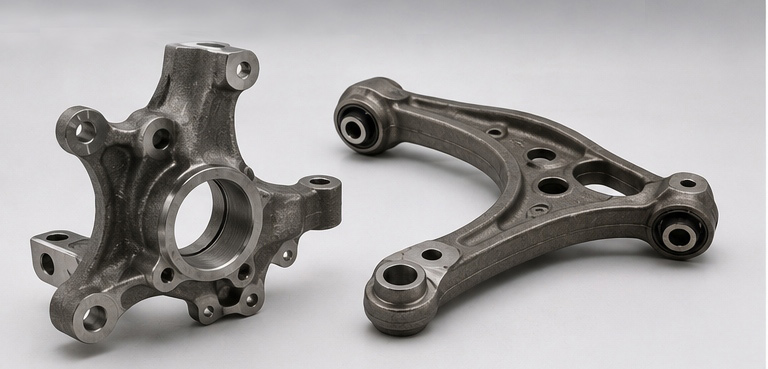
Automotive casting quality control is the system of standards, processes, and inspection methods used to verify that cast components meet the dimensional, material, and performance requirements of the automotive supply chain — from raw material incoming inspection through to pre-shipment verification. For international buyers sourcing cast components from China, understanding this system is not optional: it is the foundation of every procurement decision that determines whether parts perform in service or fail in the field.
What standards should you require, what documentation should you demand, and how do you identify a supplier whose quality claims are backed by real process controls rather than just a certificate on the wall? This guide covers the full picture.
Tiegu is a China-based casting supplier serving international buyers through a vetted network of qualified Chinese foundries. We supply automotive castings under a single supply contract, managing supplier selection, technical confirmation, quality inspection coordination, and export delivery from order to shipment.
Why Quality Control Is Non-Negotiable in Automotive Casting
Automotive castings are not interchangeable with general industrial castings. A steering knuckle, control arm, brake caliper housing, or wheel hub is a safety-critical component — one whose failure mode under stress is not a warranty claim but a road incident. The consequence of a casting defect reaching an assembled vehicle is measured in liability, recall cost, and human risk, not just scrap rates.
This is why the automotive supply chain has developed one of the most structured quality assurance frameworks in manufacturing. A casting supplier that holds ISO 9001 and considers that sufficient for automotive supply is not qualified for the job. The standards, documentation requirements, and inspection obligations in automotive casting are substantially more demanding than general industrial casting — and a buyer who does not understand the difference will eventually discover it through a failed shipment, a production line stop, or worse.
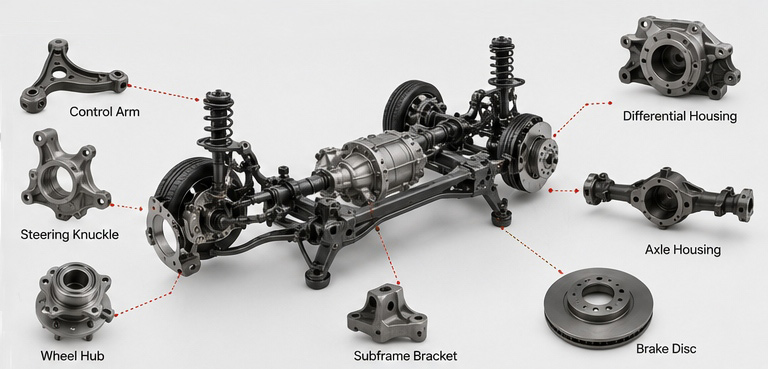
The Automotive Casting Quality Standards Framework
Quality requirements in automotive casting are organized in a hierarchy. Understanding each level tells you what to require from a supplier at each stage of a project.
Level 1 — IATF 16949: The Quality Management System
IATF 16949 is the international quality management standard specific to the automotive supply chain, replacing and superseding the earlier QS-9000 and TS 16949 standards. It covers process control, risk management, traceability, measurement system analysis, and continuous improvement across the supplier's entire manufacturing system. Any foundry supplying automotive castings at OEM or Tier 1 level must hold active IATF 16949 certification.
When verifying a supplier's IATF 16949 certificate, check three things: validity dates (certificates expire and must be renewed), the scope of certification (which processes and facilities are covered), and the certifying body (must be an IATF-recognized certification body). A certificate that has lapsed or excludes the casting process you are purchasing is not valid.
Level 2 — APQP: Planning Before Production Starts
Advanced Product Quality Planning (APQP) is the structured process used to plan and develop the quality systems for a new automotive component before full production begins. APQP covers design verification, process flow development, control plans, failure mode and effects analysis (FMEA), and measurement system analysis. It is not a document — it is a collaborative process between buyer and supplier that produces a documented quality plan for each new part.
For buyers sourcing custom automotive castings from China, APQP means you should expect and participate in a structured review before tooling approval — not just a quotation and a purchase order. Suppliers who skip APQP and go straight to production are cutting a corner that will surface during first article inspection or, worse, in production.
Level 3 — PPAP: Approval Before Mass Production
Production Part Approval Process (PPAP) is the formal submission that proves a supplier's process can consistently produce parts that meet all engineering requirements before mass production is authorized. A full PPAP submission includes design records, engineering change documentation, the FMEA, process flow diagrams, control plans, measurement system analysis, dimensional results, material and performance test results, initial process capability studies, and production sample parts.
PPAP is required by OEMs and most Tier 1 buyers before approving a new casting source. The level of PPAP submission required (Level 1 through Level 5) is specified by the customer. Buyers sourcing automotive castings from China for OEM or Tier 1 programs should specify the required PPAP level in the purchase order before tooling is approved.
Level 4 — Part-Specific Requirements
Below the system-level standards, each part has its own quality requirements: dimensional tolerances per the engineering drawing, material grade per the applicable ASTM or EN standard, surface finish specification, heat treatment requirements, and any NDT inspection scope. These part-level requirements must be communicated clearly on the drawing and confirmed in writing by the supplier before production begins.
Quality Control Stages in Automotive Casting Production
Effective quality control in automotive casting is not a single inspection at the end of the process — it is a series of checkpoints embedded throughout production. As a buyer, understanding these stages helps you ask the right questions and know which records to request.
Stage 1 — Incoming Material Control
Before a single kilogram of metal is melted, the raw materials — pig iron, steel scrap, ferro-alloys, and foundry returns — must be verified against specification. Incoming material control includes review of the supplier's mill test certificate for the incoming material and independent spectrometer verification of chemical composition. A foundry that cannot provide incoming material records for its charge materials cannot trace a casting defect back to a specific melt heat — which means traceability, a core requirement of IATF 16949, is absent.
Stage 2 — In-Process Control
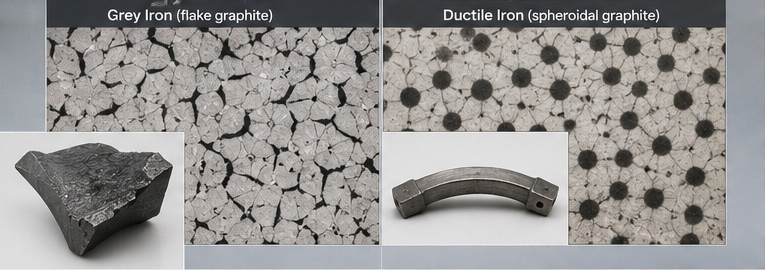
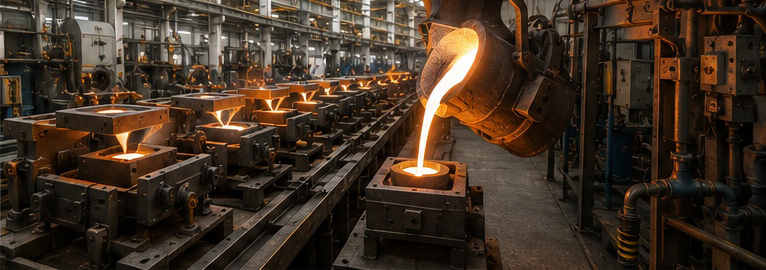
During melting and pouring, process parameters must be monitored and recorded: melt temperature, pouring temperature, mold temperature (for die casting and shell mold processes), and for ductile iron castings, magnesium treatment records and nodularity verification from metallographic examination. These in-process records are the evidence that the production conditions that produce acceptable castings were actually maintained during the production run.
First Article Inspection (FAI) — a full dimensional and material verification of the first pieces produced from a production run — should be completed and approved before the full batch is poured. Buyers who waive FAI to save time consistently find problems at the shipping stage instead.
Stage 3 — Post-Cast Inspection
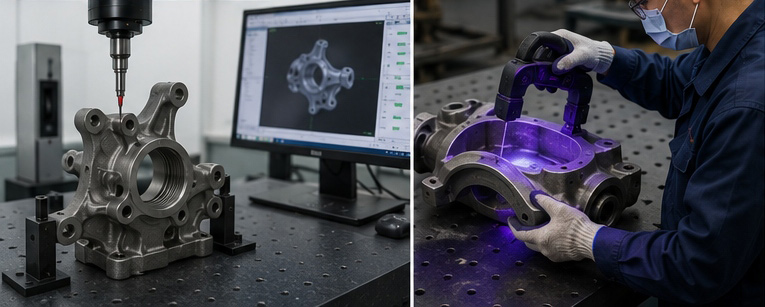
After casting, cleaning, and any heat treatment, parts undergo dimensional inspection against drawing, visual and surface inspection, and where specified, NDT. CMM (coordinate measuring machine) reports documenting critical dimensions provide objective evidence of dimensional conformance. Visual inspection per an agreed acceptance criteria standard (such as MSS SP-55 for valves or customer-specific visual standards) covers surface finish, appearance, and identification marking.
Stage 4 — Final Quality Documentation Package
Before shipment, a complete quality documentation package should be assembled for the batch. For automotive castings, this package is not optional paperwork — it is the evidence that the quality obligations of the supply contract were fulfilled. What this package must contain is covered in detail in the next section.
Common Automotive Casting Defects and Their Consequences for Buyers
Understanding casting defects from a buyer's perspective — not just their technical definition but their impact on part performance — is essential for evaluating supplier quality claims and interpreting inspection results.
Porosity (gas porosity and shrinkage porosity) is the most common casting defect family. Gas porosity results from dissolved gases forming bubbles during solidification; shrinkage porosity results from insufficient liquid metal feeding a contracting casting. For buyers, porosity in a structural chassis component reduces fatigue life and load-bearing capacity. In a pressure-containing part — a pump casing or hydraulic body — porosity creates leak paths that may not be visible externally but will fail under hydrostatic test or in service.
Cold shuts occur when two streams of molten metal meet but do not fuse completely, leaving a seam or line on the casting surface. Cold shuts are surface-breaking defects that reduce tensile strength and create initiation points for fatigue cracks. In safety-critical automotive components, cold shuts are cause for rejection regardless of location.
Shrinkage cavities (distinct from shrinkage porosity) are larger internal voids caused by inadequate riser or feeding system design. They are not visible on the surface and require radiographic or ultrasonic testing to detect. A steering knuckle or control arm with a significant internal shrinkage cavity will have unpredictable load-bearing behavior — its actual load capacity may be far below the specified minimum.
Inclusions are non-metallic particles — slag, sand, oxide films, or refractory material — trapped in the casting during pouring. Inclusions reduce local strength and cause unpredictable failure during machining or in service. A casting with slag inclusions near a precision bore will chip the cutting tool during machining, causing surface finish failure and dimensional rejection.
Dimensional deviation from drawing tolerance is not technically a metallurgical defect but is among the most commercially costly quality failures. Dimensional out-of-tolerance parts that are not detected at the foundry create problems during machining, assembly, or end-use — at a stage where the cost of correction is much higher than at the foundry level.
| Defect | Detection Method | Buyer Consequence |
|---|---|---|
| Porosity | RT, UT, hydrostatic test | Leak failure, reduced fatigue life |
| Cold shut | Visual, FPI | Crack initiation, rejection |
| Shrinkage cavity | RT, UT | Unpredictable load capacity |
| Inclusions | Visual, MPI, FPI, RT | Machining damage, local weakness |
| Dimensional deviation | CMM, gauging | Assembly rejection, rework cost |
| Low nodularity (ductile iron) | Metallographic examination | Brittle fracture risk |
NDT Methods: What to Specify and When
Non-destructive testing (NDT) is the primary tool for detecting casting defects without destroying the part. As a buyer, knowing which NDT method to specify for which application is part of writing an effective procurement specification.
Magnetic Particle Inspection (MPI) detects surface and near-surface cracks and discontinuities in ferromagnetic materials (carbon steel, alloy steel, grey iron, ductile iron). It is the standard surface NDT method for iron and carbon steel automotive castings and should be specified for any safety-critical structural casting in these materials.
Liquid Penetrant Inspection (LPI) / Fluorescent Penetrant Inspection (FPI) detects surface-breaking defects on any material, including non-ferromagnetic materials like stainless steel and aluminum. FPI uses fluorescent dye under UV light for enhanced sensitivity. Specify for stainless steel investment castings, aluminum castings, and any casting where surface integrity is a specification requirement.
Ultrasonic Testing (UT) uses high-frequency sound waves to detect internal defects — porosity, shrinkage cavities, inclusions — in solid sections. UT is the preferred method for thick-walled castings and safety-critical components where radiography is impractical. Calibration blocks and operator qualification are critical; request the UT procedure and operator certification records.
Radiographic Testing (RT / X-ray) produces a film or digital image of the internal structure, making it the most comprehensive internal defect detection method. RT is required for pressure-containing castings (pump bodies, valve bodies, hydraulic components) and is the standard inspection method for investment castings in aerospace and critical industrial service. Specify RT acceptance criteria by reference to ASTM E446 (steel) or equivalent standard.
CMM Dimensional Inspection is not strictly NDT but is the standard method for verifying dimensional conformance. For automotive castings, CMM reports should cover all critical dimensions on the engineering drawing, with actual measured values and tolerances clearly documented.
Hydrostatic Pressure Testing verifies pressure integrity of hollow castings (pump casings, valve bodies, pipe fittings) by filling with water or oil and pressurizing to a specified test pressure. Specify test pressure, duration, and acceptance criteria (no visible leakage) in the purchase order for any pressure-containing component.
Not sure which NDT scope is appropriate for your casting application? Contact Tiegu — we'll review your drawing and quality requirements and confirm which foundries in our network have the inspection capability to match.
Quality Documentation Checklist: What to Demand from a Chinese Foundry
The following documents should accompany every shipment of automotive castings from a qualified Chinese foundry. Use this checklist before accepting a shipment or making final payment:
☐ Batch-specific Mill Test Certificate (MTC) — chemical composition from spectrometer analysis, referencing the specific heat number of the production batch
☐ Mechanical property test report — tensile strength, yield strength, elongation tested on bars cast from the same melt as the production batch
☐ Nodularity and graphite form report — for ductile iron castings, metallographic examination confirming nodularity percentage and graphite type
☐ Heat treatment records — time, temperature, and quench/cool parameters for any required heat treatment cycle
☐ CMM dimensional report — full layout against drawing for first article; statistical sample report for production batches
☐ NDT reports — MPI, FPI, UT, or RT as specified, with operator qualification records and applicable acceptance standard referenced
☐ Hydrostatic test records — for pressure-containing parts
☐ First Article Inspection (FAI) report — for new part numbers or after any tooling modification
☐ PPAP submission — for OEM or Tier 1 supply, at the agreed submission level
☐ Valid IATF 16949 certificate — with current dates and scope covering the casting process and facility
A supplier who cannot provide this package — or who provides generic, undated documents rather than batch-specific records — has not fulfilled their quality obligations, regardless of what their quotation promised.
Red Flags: Signs a Supplier's Quality Claims Are Unreliable
Experience in automotive casting sourcing reveals consistent patterns in how quality failures are preceded by supplier behavior. Watch for these warning signs before placing a production order:
"Typical analysis" instead of batch-specific MTC. A typical analysis shows average historical chemistry, not the actual composition of your order. If a supplier cannot or will not provide a batch-specific MTC with a heat number traceable to your shipment, there is no chemical traceability — which means you cannot verify the material you received.
IATF 16949 certificate that is lapsed, limited in scope, or from an unrecognized body. Ask for the certificate, check the expiry date, and verify the certification body against the IATF recognized list. A foundry that references IATF certification in marketing materials but cannot produce a current certificate is misrepresenting its status.
Resistance to third-party pre-shipment inspection. Reputable export foundries accept SGS, Bureau Veritas, or equivalent third-party inspection as a standard condition. A supplier who adds conditions to third-party inspection access — requesting advance notice, limiting inspector access to production records, or declining without explanation — is concealing something.
First article samples that are significantly better than production batches. This pattern — careful production of samples, followed by quality shortcuts at scale — is one of the most common failure modes in Chinese foundry sourcing. Require that FAI parts are taken from actual production conditions, not specially prepared pieces. Third-party inspection at production should verify consistency with approved samples.
Inability to provide inspection records from comparable previous orders. A foundry that has genuinely been producing IATF-qualified automotive castings for export will have records. If a supplier cannot provide sample MTCs, CMM reports, or NDT records from previous comparable orders on request, they have not previously operated at the quality level they are claiming.
Extremely low quotation with no explanation of how the specification is met. A price that is 40–60% below comparable suppliers for the same specification is not a competitive advantage — it is a signal that the specification is not being met in full. The cost of IATF 16949 compliance, batch testing, NDT, and documented heat treatment is real and is reflected in price.
How Tiegu Coordinates Quality Control for International Buyers
For international buyers sourcing automotive castings from China without in-country audit resources, the practical challenge of quality control is not knowing what to require — it is having the on-the-ground relationships and leverage to enforce it.
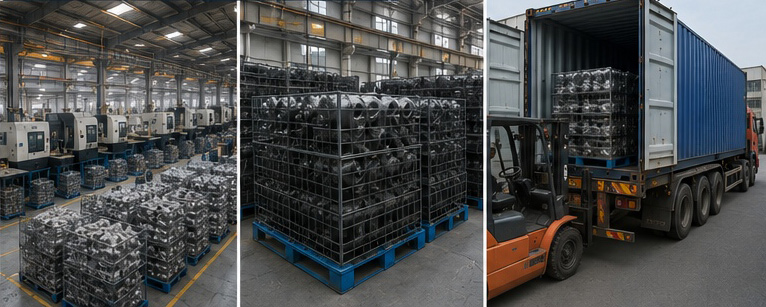
Tiegu's role as a casting supplier goes beyond order placement. We screen foundries in our network for IATF 16949 certification status and process capability relevant to each buyer's component type before recommending a source. We review drawings with the foundry at the technical confirmation stage to identify quality risks before tooling is cut. We track FAI results and escalate non-conformances before production is released. We coordinate third-party pre-shipment inspection on behalf of buyers and consolidate quality documentation — MTC, mechanical test reports, NDT certificates, and dimensional reports — into a single package matched to each shipment.
Buyers get one accountable partner managing quality across the supply chain, rather than attempting to manage a Chinese foundry's quality system remotely from a different time zone and language.
Frequently Asked Questions
What is IATF 16949 and why does it matter for automotive casting suppliers?
IATF 16949 is the international quality management standard specific to the automotive supply chain. It requires suppliers to implement documented process controls, traceability systems, measurement system analysis, and continuous improvement programs that go significantly beyond the baseline requirements of ISO 9001. For automotive casting suppliers, IATF 16949 certification means the foundry's quality system has been audited by an accredited third party and verified to meet the automotive industry's minimum requirements. Buyers sourcing components for OEM or Tier 1 programs should require active IATF 16949 certification as a non-negotiable qualification criterion.
What is APQP in automotive casting and what does it require from buyers?
Advanced Product Quality Planning (APQP) is the structured process used to develop quality plans for new automotive components before production begins. For casting procurement, APQP involves collaborative development between buyer and supplier of a process flow diagram, FMEA, control plan, and measurement system analysis before tooling is approved. Buyers who simply send a drawing and request a price — without participating in APQP — are skipping the quality planning stage that prevents production problems. APQP is required for OEM supply and recommended for any safety-critical automotive casting.
What is PPAP and when is it required for automotive casting suppliers?
Production Part Approval Process (PPAP) is the formal submission that proves a supplier's process can consistently produce conforming parts before mass production authorization. A PPAP submission includes dimensional results, material test reports, process capability studies, FMEA, control plans, and production sample parts. PPAP is required by OEMs and most Tier 1 automotive manufacturers before approving a new casting source or any significant process change at an existing source. Buyers sourcing automotive castings from China for OEM programs should specify the required PPAP level in the purchase order and confirm the supplier's capability to complete the required submission.
What are the most common defects in automotive castings?
The most common defects in automotive castings are porosity (gas and shrinkage), cold shuts, shrinkage cavities, inclusions, dimensional deviations, and — specifically for ductile iron components — insufficient nodularity. Porosity and shrinkage cavities are particularly significant for safety-critical structural components because they reduce fatigue life and load capacity in ways that are not visible externally and require NDT to detect. Dimensional deviations are the most commercially costly defect type because they are often not discovered until the machining or assembly stage.
What NDT methods should I specify for safety-critical automotive castings?
For safety-critical automotive castings in iron and carbon steel (steering knuckles, control arms, brake components): specify Magnetic Particle Inspection (MPI) for surface defects as standard. For pressure-containing components (pump bodies, valve bodies, hydraulic castings): add Radiographic Testing (RT) or Ultrasonic Testing (UT) for internal defects, plus hydrostatic pressure testing. For stainless steel castings: replace MPI with Liquid Penetrant Inspection (FPI). Always reference the applicable acceptance standard (ASTM E446 for RT, MSS SP-53 for MPI on valves) rather than leaving acceptance criteria undefined.
What quality documents should a Chinese foundry provide with every shipment of automotive castings?
At minimum: a batch-specific mill test certificate (MTC) with heat number; mechanical property test report from bars cast from the same melt; nodularity report for ductile iron components; heat treatment records; CMM dimensional report; and NDT reports as specified. For new part numbers, a first article inspection (FAI) report should precede production approval. For OEM supply, PPAP documentation is additionally required. A valid IATF 16949 certificate should be on file. Generic or undated documents without heat number traceability are not acceptable substitutes for batch-specific records.
How do I verify a Chinese foundry's quality without visiting the factory?
Remote quality verification options include: requesting batch-specific inspection records from previous comparable orders (not sample documents); conducting a virtual factory audit via video call with live walkthrough of production and QC areas; engaging a third-party audit service (SGS, Bureau Veritas, TÜV) to conduct an in-person supplier quality audit; specifying third-party pre-shipment inspection as a standard contract condition; and working with a casting supplier who maintains on-the-ground relationships with vetted foundries and can provide independent quality oversight on your behalf. The most reliable approach for new supplier relationships is a combination of third-party audit before first order and pre-shipment inspection for initial production batches.
What is the difference between QA and QC in automotive casting?
Quality Assurance (QA) is the proactive system of processes, standards, and planning designed to prevent defects from occurring — IATF 16949, APQP, FMEA, and control plans are all QA tools. Quality Control (QC) is the reactive inspection activity that detects defects after they occur — dimensional inspection, NDT, and hydrostatic testing are QC activities. Effective automotive casting quality management requires both: QA systems prevent the majority of defects through process control, while QC inspection catches the defects that process variation produces. A supplier that relies only on final inspection (QC without QA) will produce inconsistent quality and high reject rates; a supplier that implements only QA without rigorous QC inspection cannot catch the defects that inevitably occur despite good processes.
Tiegu is a China-based casting supplier serving international buyers through a vetted network of qualified Chinese foundries. We supply automotive castings under a single supply contract, managing supplier selection, technical confirmation, quality inspection coordination, and export delivery from order to shipment.
Submit Your Automotive Casting Requirements for a Quality-Verified Quote
Share your part drawing, material specification, quality standard requirements (IATF 16949, PPAP level, NDT scope), and annual volume. Tiegu will confirm foundry qualification, coordinate inspection planning, and provide a complete quotation covering unit price, tooling, and lead time.
Submit Your Requirements → Contact Tiegu