
 en
en  fra
fra  de
de  ru
ru  ara
ara  gle
gle  it
it  jp
jp  kor
kor  th
th  zh
zh Automotive Chassis Castings: Components, Materials, Processes & Global Sourcing Guide
2026-07-02 16:30:16 hits:0

Automotive chassis castings are metal components produced by pouring molten iron or aluminum alloy into molds to form the structural and safety-critical parts that make up a vehicle's chassis system — including steering knuckles, control arms, wheel hubs, brake discs, differential carriers, and axle housings. These components must absorb road loads, survive high-cycle fatigue, and in safety-critical applications, never fail without warning — which is why material selection and casting quality are non-negotiable decisions, not cost variables.
So which chassis components are made by casting, which material is right for each application, and how do you source automotive chassis castings reliably from China? This guide covers the full picture.
Tiegu works with IATF 16949-certified Chinese foundries supplying ductile iron, grey iron, and aluminum chassis castings — both cast blanks and semi-finished machined components — to automotive manufacturers, Tier 1 suppliers, and aftermarket distributors worldwide.Submit Your Inquiry → Contact Tiegu

What Chassis Components Are Made by Casting?
Casting dominates chassis manufacturing wherever component geometry is complex, wall thickness varies, or the material's inherent properties — damping, thermal mass, impact resistance — matter as much as the final shape. The following components are routinely supplied as automotive chassis castings from Chinese foundries:
Suspension system components carry the vehicle's weight and manage road inputs. Steering knuckles (also called wheel carriers or upright castings) are the pivot point between the suspension and the wheel — one of the most safety-critical castings on the vehicle. Control arms (upper and lower, front and rear) connect the wheel hub to the vehicle subframe and must absorb both vertical and lateral loads throughout their service life. Wheel hub carriers and spindles complete the suspension assembly and directly interface with the brake system.
Brake system components manage kinetic energy through repeated high-temperature cycles. Brake discs (rotors) and brake drums are among the highest-volume chassis castings globally. Brake caliper housings and anchor brackets are smaller but equally precision-dependent castings requiring tight dimensional accuracy and pressure integrity.
Drivetrain and axle components transmit torque and manage load transfer between engine and wheels. Differential carriers and differential cases house the gear sets that allow wheels to rotate at different speeds. Axle housings (both front and rear) enclose the axle shafts and must handle torsional and bending loads simultaneously. Wheel hubs are the interface between the rotating axle and the stationary brake assembly.
Subframe and structural components provide the mounting points for suspension, engine, and drivetrain assemblies. Subframe brackets, cross-member housings, engine mount brackets, and torque rod brackets are cast in medium-to-high volumes and are increasingly specified in ductile iron for improved strength without the weight penalty of solid steel fabrications.
Tiegu supplies all of the above as automotive chassis cast blanks or semi-finished castings with machined reference surfaces, depending on buyer requirements. Buyers who need fully machined, ready-to-assemble components can also be accommodated through our foundry partners' integrated machining lines.

Material Selection: Grey Iron, Ductile Iron, ADI, or Aluminum?
The material decision for automotive chassis castings is a safety engineering question before it is a cost question. The wrong material in a steering knuckle or control arm does not produce a warranty claim — it produces a sudden failure. Here is how the four principal chassis casting materials map to application requirements:
Grey Cast Iron
Grey iron is the standard material for brake discs, brake drums, and flywheel assemblies — components where compressive strength, thermal mass, vibration damping, and wear resistance matter more than tensile toughness. The flake graphite microstructure that gives grey iron its excellent machinability and damping properties also makes it inherently brittle under tensile stress. This is why grey iron is appropriate for brake components that operate predominantly under compression and thermal load, but is not appropriate for suspension components that experience dynamic tensile and bending loads in service.
Best for: Brake discs, brake drums, caliper housings, flywheel housings. Not recommended for steering knuckles, control arms, or any suspension component subject to impact or fatigue loading.
Ductile Iron (Nodular / SG Iron)
Ductile iron is the dominant material for automotive chassis castings requiring both strength and toughness — steering knuckles, control arms, wheel hubs, differential carriers, and axle housings. The key difference from grey iron is microstructural: magnesium treatment during melting causes graphite to form as spheres (nodules) rather than flakes. These spherical nodules do not act as stress concentration points the way graphite flakes do, giving ductile iron tensile strength of 400–900 MPa and elongation of 6–18% depending on grade — properties that allow the material to deform before fracturing rather than failing catastrophically.
For safety-critical chassis components, this distinction is decisive. A grey iron steering knuckle that reaches its stress limit fractures suddenly with no prior deformation. A ductile iron steering knuckle deforms visibly before failure, providing warning and maintaining some load-carrying capacity through the deformation phase.
The most widely specified ductile iron grades for chassis castings are:
Grade 400-18 / EN-GJS-400-18 — high elongation, maximum ductility, subframe brackets, non-critical mounts
Grade 500-7 / EN-GJS-500-7 — balanced strength and ductility, control arms, differential cases
Grade 600-3 / EN-GJS-600-3 — higher strength, reduced elongation, wheel hubs, steering knuckles in standard applications
Grade 700-2 / EN-GJS-700-2 — high strength, used in heavy-duty truck and commercial vehicle chassis components
Best for: Steering knuckles, control arms, wheel hubs, differential carriers, axle housings, subframe brackets. The default chassis casting material for any component subject to impact, fatigue, or dynamic loading.
Austempered Ductile Iron (ADI)
ADI is ductile iron that has undergone a specialized heat treatment — austenitizing followed by austempering — to produce a unique microstructure called ausferrite that combines exceptionally high strength with toughness that neither conventional ductile iron nor steel castings can match at comparable cost. ADI tensile strength ranges from 800 MPa to over 1400 MPa depending on grade, with elongation up to 10% — performance that approaches high-strength steel at approximately 10% lower weight.
In chassis applications, ADI is specified where standard ductile iron grades reach their limits: high-performance suspension components for premium passenger vehicles, commercial vehicle driveline components subject to extreme shock loading, and lightweight chassis redesigns where ADI allows section thickness (and therefore weight) to be reduced while maintaining or improving load capacity.
Best for: High-performance steering knuckles and control arms, commercial vehicle differential components, lightweight chassis redesigns, any application where maximum strength-to-weight ratio is required and the cost premium of ADI over standard ductile iron is justified by weight savings or performance gains.
Aluminum Alloy
Aluminum chassis castings are primarily driven by lightweighting requirements in premium passenger vehicles and electric vehicles. Aluminum's density (approximately one-third of iron) allows significant weight reduction in structural chassis components — subframe assemblies, suspension towers, and crossmembers. However, aluminum does not match ductile iron's performance in high-stress, high-cycle fatigue applications at comparable cost, and is not typically used for steering knuckles or control arms in volume production vehicles outside the premium segment.
Best for: Subframe structural components, suspension towers, and lightweight brackets in premium or electric vehicle applications where weight reduction justifies the material cost premium over ductile iron.
Material Selection at a Glance
| Material | Tensile Strength | Elongation | Impact Resistance | Weight | Typical Chassis Parts | Cost |
|---|---|---|---|---|---|---|
| Grey Iron | 150–350 MPa | ~0% | Poor | Heavy | Brake discs, drums | Low |
| Ductile Iron | 400–900 MPa | 6–18% | Good–Excellent | Heavy | Knuckles, arms, hubs | Medium |
| ADI | 800–1400 MPa | 1–10% | Excellent | Heavy | High-perf suspension, driveline | Medium-High |
| Aluminum Alloy | 150–350 MPa | 2–10% | Moderate | Light | Subframes, EV structural parts | High |

Casting Processes for Chassis Components
The process selected determines surface finish, dimensional accuracy, internal soundness, and production cost. Chinese foundries producing automotive chassis castings commonly work with four processes:
Green Sand Casting
Green sand casting uses a compacted moist sand mold formed around a pattern of the desired part. It is the most economical process for medium-to-large chassis castings and is the standard process for brake drums, axle housings, differential carriers, and larger subframe components. For buyers sourcing large-volume chassis castings from China, green sand casting offers the lowest tooling cost and widest range of part sizes.
Shell Mold Casting
Shell mold casting uses a thin resin-bonded sand shell that delivers significantly better surface finish and tighter dimensional tolerances than green sand — critical for chassis components with precision mounting surfaces and bore dimensions. Steering knuckles, control arms, and wheel hubs are commonly produced by shell mold casting in Chinese foundries serving global automotive customers, because the improved dimensional consistency reduces downstream machining time and scrap.
Lost Foam Casting
Lost foam casting vaporizes a polystyrene foam pattern as molten metal fills the mold cavity, allowing complex internal geometries without sand cores. For chassis components with internal passages or complex intersecting walls — certain differential housings and axle housing designs — lost foam casting reduces the number of cores required and the associated assembly and cleaning steps.
Low-Pressure Die Casting
Low-pressure die casting fills the mold from below under controlled gas pressure, producing denser, more soundness-consistent aluminum castings than gravity methods. This process is standard for aluminum alloy suspension components in premium and electric vehicles — wheel hub carriers, suspension uprights, and subframe sections — where porosity-free, pressure-tight castings with good mechanical properties are required.
| Process | Materials | Surface Finish | Accuracy | Volume | Best For |
|---|---|---|---|---|---|
| Green Sand Casting | Grey iron, ductile iron, ADI | Moderate | ±1–3mm | Medium–High | Brake drums, axle housings, diff carriers |
| Shell Mold Casting | Ductile iron, grey iron | Good | ±0.5–1mm | Medium–High | Steering knuckles, control arms, wheel hubs |
| Lost Foam Casting | Ductile iron, grey iron | Moderate–Good | ±0.5–1.5mm | Medium | Complex housing geometries |
| Low-Pressure Die Casting | Aluminum alloy | Excellent | ±0.2–0.5mm | High | Aluminum suspension and structural parts |
Quality Standards for Automotive Chassis Castings
Chassis castings are safety-critical components. The quality verification framework for sourcing them from China must cover material, process, and dimensional requirements simultaneously.
IATF 16949 is the mandatory quality management standard for any foundry supplying the automotive supply chain at OEM or Tier 1 level. It governs process control, traceability, FMEA, measurement system analysis, and Production Part Approval Process (PPAP) documentation. Verify active IATF 16949 certification — with current validity dates — before qualifying any chassis casting supplier.
View: Automotive Part Manufacturing Guide
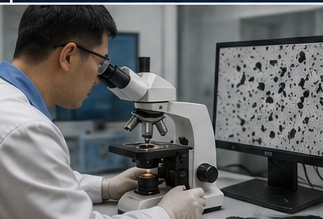
Nodularity testing is the critical quality check specific to ductile iron chassis castings. Nodularity (the percentage of graphite present as spheres rather than flakes) must typically exceed 80% to achieve the mechanical properties specified for safety-critical components. Reputable Chinese foundries conduct metallographic examination on test bars from each melt and document nodularity percentage in the production records.
Mechanical property testing — tensile strength, yield strength, and elongation — must be performed on test bars cast from the same melt as the production parts, not on separately cast reference bars. Batch-specific mechanical test reports should accompany every shipment of chassis castings.
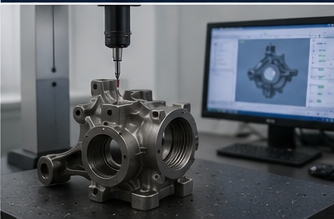
Dimensional inspection with CMM (coordinate measuring machine) verifies that critical dimensions — bore diameters, mounting hole positions, and mating surface profiles — fall within the tolerance bands specified on the drawing. For chassis castings, CMM reports from the first article inspection (FAI) and periodic production audits are standard requirements.
NDT (non-destructive testing) — magnetic particle inspection (MPI) for surface defects on iron castings, and ultrasonic testing (UT) for subsurface porosity — is required for safety-critical chassis components in most OEM supply chains.
Not sure which quality requirements apply to your specific chassis casting? Talk to Tiegu — we review drawings, confirm material and process specifications, and coordinate IATF-certified foundry qualification and inspection on your behalf.
Why Global Buyers Source Chassis Castings from China
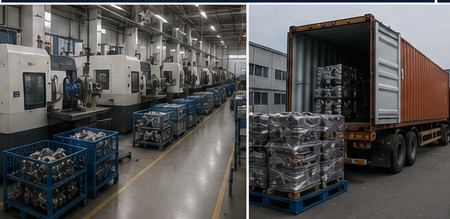
China is the world's largest producer of ductile iron castings, and Chinese foundries collectively hold the process depth, certification infrastructure, and export logistics experience to supply automotive chassis castings to buyers in North America, Europe, the Middle East, and Asia-Pacific. The global automotive ductile iron castings market was valued at approximately USD 14.3 billion in 2024 and is projected to reach USD 19.5 billion by 2032, with Chinese foundries contributing a dominant share of global output.
Material and process coverage. A vetted Chinese foundry network covers grey iron, ductile iron, ADI, and aluminum chassis castings across green sand, shell mold, lost foam, and die casting processes — allowing buyers to consolidate a complex chassis casting bill of materials with fewer supplier relationships.
International standard compliance. Established Chinese export foundries produce to ASTM, EN, DIN, and JIS material specifications and issue the chemical, mechanical, and dimensional documentation that global automotive buyers require. IATF 16949-certified foundries in China have been qualifying to OEM and Tier 1 requirements for over two decades.
Integrated post-casting capability. Heat treatment, CNC machining, CMM inspection, NDT, and surface treatment (painting, shot blasting, phosphating) are available within integrated supply chains in China, reducing the number of vendor handoffs between raw casting and finished component.
Supply flexibility through a trading agent. Working with an experienced Chinese export trading agent rather than approaching foundries directly gives buyers access to a pre-qualified, multi-foundry network — enabling mixed-grade orders, split shipments, and the ability to shift capacity across foundry partners when production demands change. The agent maintains commercial accountability for quality and delivery across the supply chain.
Frequently Asked Questions
What are automotive chassis castings?
Automotive chassis castings are iron or aluminum components produced by casting processes — including sand casting, shell mold casting, and die casting — that form the structural and safety-critical parts of a vehicle's chassis. Common examples include steering knuckles, control arms, wheel hubs, brake discs, differential carriers, and axle housings. These components are typically made from grey iron, ductile iron, austempered ductile iron (ADI), or aluminum alloy depending on their mechanical requirements.
What is the most common material for automotive chassis castings?
Ductile iron (also called nodular iron or SG iron) is the dominant material for automotive chassis castings that are subject to dynamic loading, impact, and fatigue — including steering knuckles, control arms, wheel hubs, and differential carriers. Grey iron is used specifically for brake discs and drums, where compressive strength and thermal properties matter more than impact resistance. Aluminum alloy is used in premium and electric vehicle chassis applications where weight reduction is the primary requirement.
Why is ductile iron used for steering knuckles and control arms instead of grey iron?
Steering knuckles and control arms are safety-critical components that experience dynamic tensile and bending loads throughout their service life. Grey iron is brittle under tensile stress and fails suddenly without prior deformation — an unacceptable failure mode in a steering or suspension component. Ductile iron's spheroidal graphite microstructure gives it elongation of 6–18% and high impact resistance, meaning it deforms visibly before reaching failure — providing warning and maintaining some load capacity through the deformation phase. This ductile failure mode is the fundamental reason steering knuckles and control arms are specified in ductile iron, not grey iron.
What is ADI and when is it used in chassis castings?
ADI (Austempered Ductile Iron) is ductile iron that has undergone specialized heat treatment to produce a microstructure with tensile strength of 800–1400 MPa and elongation up to 10% — approaching high-strength steel performance at lower weight. In chassis applications, ADI is used for high-performance suspension components in premium vehicles, heavy-duty commercial vehicle driveline components, and lightweight chassis redesigns where maximum strength-to-weight ratio justifies the additional heat treatment cost.
What quality certifications should a chassis casting supplier in China hold?
At minimum, IATF 16949 certification for automotive supply chain quality management, and ISO 9001 as the baseline. Additionally, verify that the foundry conducts nodularity testing on ductile iron production batches, provides batch-specific mechanical test reports (tensile, yield, elongation), performs CMM dimensional inspection and issues first article inspection (FAI) reports, and accepts third-party pre-shipment inspection by SGS or Bureau Veritas.
How much do automotive chassis castings cost when sourced from China?
Cost depends on material grade (grey iron is the most economical; ADI and aluminum carry premiums), casting weight and complexity, required dimensional tolerances, post-casting requirements (heat treatment, machining, NDT, surface treatment), and annual order volume. Ductile iron shell mold castings for steering knuckles and control arms are competitively priced from Chinese foundries relative to equivalent Western production, particularly at annual volumes above a few hundred tonnes. The most accurate approach is to submit a drawing with material specification and target volume for a factory-matched quotation.
How do I source automotive chassis castings from China?
Effective chassis casting sourcing from China requires verifying IATF 16949 certification, confirming the foundry has documented experience producing your specific component type and material grade, reviewing nodularity and mechanical test records from comparable production, specifying CMM inspection and NDT requirements at the drawing stage, and arranging third-party pre-shipment inspection for new supplier relationships. Working with an experienced export trading agent who maintains a vetted foundry network reduces qualification effort significantly and provides commercial accountability for quality and delivery across multiple factory partners.
Tiegu sources grey iron, ductile iron, ADI, and aluminum automotive chassis castings — including cast blanks and semi-finished components — from a vetted network of IATF 16949-certified Chinese foundries. We manage supplier qualification, nodularity and mechanical testing verification, CMM inspection coordination, and export documentation on behalf of automotive buyers worldwide. Because we work across multiple foundry partners, we can cover diverse component types, casting processes, and order volumes within a single supply relationship.
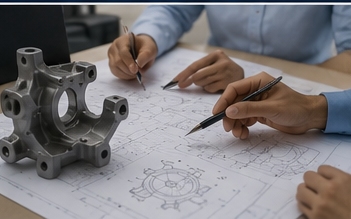
Send Your Chassis Casting Drawing for a Free Supplier Match
Share your component drawing, material grade, annual volume, and required standards. Tiegu will identify the right IATF-certified Chinese foundry for your application and coordinate quality verification before production begins.
Submit Your Inquiry → Contact Tiegu