
 en
en  fra
fra  de
de  ru
ru  ara
ara  gle
gle  it
it  jp
jp  kor
kor  th
th  zh
zh Continuous Casting Rolls: Grade, NDT, and What Buyers Often Get Wrong
2026-09-17 16:57:19 hits:0
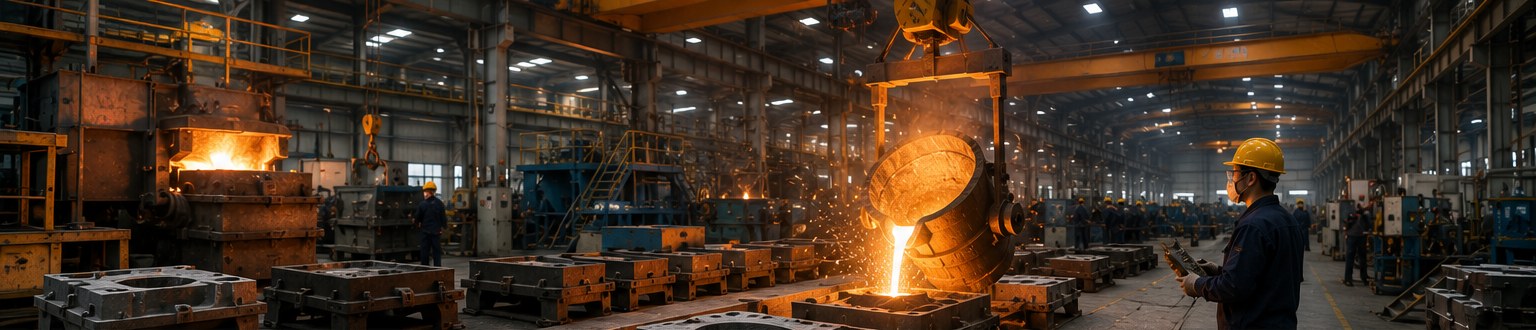
Specify a caster roll by where it sits and how it wears, not by a generic "cast steel roll" label. Use low-alloy cast steel (ZG35CrMo / ZG42CrMo) in the bending and segment zones where load dominates, and high-CrMo or composite (centrifugal high-Cr iron cladding) rolls in the straightening zone where abrasion dominates. The roll that survives is the one matched to its position — not the one that is simply "hard."
What Continuous Casting Rolls Do — and Why They Fail
Caster rolls carry the solidifying strand through the bending, segment, and straightening zones of a continuous caster. They run under heavy, repeated load with heat, spray water, and sliding abrasion. Tiegu supplies continuous caster roll castings to steel mills worldwide, matching each order to a foundry that casts, heat-treats, and — for composite rolls — clads the roll against your mill drawing before export.
They fail in predictable ways: surface spalling when the hardness band or cladding is wrong for the wear mode; internal looseness or shell separation on composite rolls when the bond interface is not verified; and fatigue cracking at the necks when the grade is too low for the bending load. None of these show up in a plain "cast steel roll" purchase order.
Which Grade Should You Specify?
Map the grade to the roll position and the dominant wear. The bending and segment zones need strength and fatigue resistance; the straightening and lower zones need abrasion resistance.
| Grade (standard) | Wear mode | Hardness | Use zone |
|---|---|---|---|
| ZG35CrMo / ZG42CrMo (GB/T 11352 low-alloy cast steel) | load + moderate abrasion | HRC 35–45 (heat-treated) | bending / segment zones |
| 70Cr3NiMo / ZG70Cr (high-CrMo cast steel) | high abrasion, straightening | HRC 50–58 | straightening / lower zones |
| Composite (centrifugal high-Cr iron cladding on steel core) | severe abrasion, long campaign | cladding HRC 55–65 | high-wear straightening zone |
Not sure which grade fits your caster position and campaign? Contact us at tieguexport.com →
What We Verify Before Shipment
Chemistry and grade: we check Cr, Mo, Ni against the order on the material certificate (MTC) — the grade name alone does not prove the roll fits the load.
Surface hardness and depth: verified on the roll body with the HRC band and hardened-layer depth written into the PO; for composite rolls we confirm the cladding hardness separately.
Soundness and bond: ultrasonic testing per EN 10228-3 on the body and necks, and magnetic-particle testing per EN 1369 at the necks; on composite rolls we add UT at the cladding interface to reject poor bond.
Geometry: roll roundness, concentricity, and bearing-seat diameter are checked to the agreed ISO 8062 tolerance class so the roll seats in the caster without runout.
Common Specifying Mistakes
Ordering only "cast steel roll" with no grade — you get a roll too soft for the straightening zone, and it wears out in one campaign.
Using a solid roll where a composite roll is needed — the single-alloy body cannot match the cladding wear life, and you pay for more changeouts.
Ignoring neck NDT — fatigue cracks start at the neck; without UT/MT there the roll can fail in service.
Specification Checklist
[ ] Roll position (bending / segment / straightening) and load identified
[ ] Grade chosen (low-alloy CrMo / high-CrMo / composite)
[ ] Hardness band + hardened-layer depth written into the PO
[ ] UT (EN 10228-3) + MT (EN 1369) scope, including composite bond UT
[ ] Roundness, concentricity, bearing-seat to ISO 8062 class confirmed
FAQ
1. How do I choose between a solid and a composite caster roll?
Use a solid low-alloy CrMo roll in the bending and segment zones where load dominates. In the straightening and lower zones where abrasion dominates, a composite roll with a centrifugal high-Cr iron cladding lasts far longer. Buyers who choose a supplier that asks for the roll position, not just a drawing, get fewer changeouts.
2. How do you confirm the roll will not spall early?
By grade-appropriate selection plus NDT: we verify the hardness band and hardened depth, check soundness by UT (EN 10228-3) and surface cracks by MT (EN 1369), and on composite rolls add UT at the cladding interface. A first-article inspection on the first roll catches hardness and bond issues before a full caster order.
3. What lead time should I plan for caster rolls?
Typically 12–20 weeks including pattern, casting, heat treatment, cladding (if composite), and NDT — longer for first-piece qualification. Send the mill drawing and roll schedule early, and submit a clear RFQ so the foundry can match grade to position up front.
Tiegu is a China-based casting supplier serving international buyers through a vetted network of qualified Chinese foundries. We supply castings under a single commercial contract, managing supplier selection, technical confirmation, quality inspection, and export delivery from order to shipment.