
 en
en  fra
fra  de
de  ru
ru  ara
ara  gle
gle  it
it  jp
jp  kor
kor  th
th  zh
zh Steering Knuckle Castings: Materials, Processes & How to Source Safety-Critical Parts from China
2026-07-20 17:13:24 hits:0
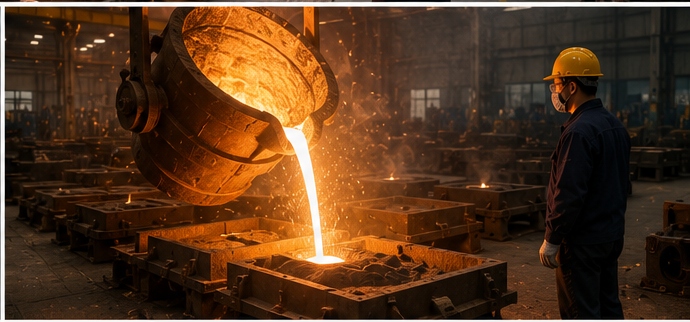
Steering knuckles are safety-critical suspension components that connect the wheel assembly to the vehicle chassis. Most steering knuckles are manufactured from ductile iron, commonly grades such as GJS-500-7 or GJS-600-3, using shell mold casting or green sand casting processes. Because failure can directly affect vehicle control, buyers sourcing steering knuckle castings from China should verify material properties, nodularity results, dimensional accuracy, and supplier quality systems such as IATF 16949 before production approval.
Why Steering Knuckles Are Safety-Critical — And Why That Changes Everything
A steering knuckle is one of the most important components in a vehicle suspension system. It connects several critical parts, including the wheel hub, steering system, brake assembly, and suspension links.
During operation, the steering knuckle experiences continuous loads from:
Vehicle weight
Braking forces
Cornering forces
Road impact loads
Suspension movement
Unlike non-structural castings, a steering knuckle failure can directly affect steering control and vehicle stability. This makes it a safety-critical automotive component.
For buyers, this changes the sourcing standard completely.
When purchasing ordinary industrial castings, price, lead time, and basic dimensional requirements may dominate the decision. However, for steering knuckle castings, the priority should be:
Material reliability
Mechanical performance
Process stability
Traceable quality documentation
Supplier quality management system
A supplier that can produce a visually acceptable casting is not necessarily qualified to produce safety-critical automotive components.
The key question is not:
"Can this foundry make a steering knuckle?"
The real question is:
"Can this supplier consistently produce steering knuckles that meet automotive safety requirements?"
Material Selection: Ductile Iron, Aluminum, or Forged Steel?
The material choice directly affects steering knuckle performance, weight, cost, and manufacturing process.
Although aluminum and forged steel are used in certain applications, ductile iron remains the most widely adopted material for conventional steering knuckle production because it provides the best balance between strength, toughness, manufacturability, and cost.
| Property | Ductile Iron | Aluminum | Forged Steel |
|---|---|---|---|
| Strength | High | Medium | Highest |
| Weight | Heavy | Lightweight | Heavy |
| Cost | Low | Medium-High | Medium |
| Machinability | Good | Good | More difficult |
| Ductility | High | Medium | Highest |
| Typical Application | Passenger vehicles, commercial vehicles | Lightweight vehicles, EV applications | Racing, extreme-duty vehicles |
Ductile Iron Steering Knuckles
Ductile iron is the standard material for most steering knuckle castings.
Common grades include:
EN-GJS-500-7
EN-GJS-600-3
The main advantage of ductile iron is its graphite structure.
Unlike grey iron, where graphite exists as flakes that create stress concentration points, ductile iron contains graphite in a spherical form. This gives the material:
Higher tensile strength
Better impact resistance
Improved elongation
Better fatigue performance
This combination makes ductile iron suitable for safety-critical suspension components.
For most passenger vehicles and commercial vehicles, ductile iron provides the optimal balance between performance and production cost.
Aluminum Steering Knuckles
Aluminum steering knuckles are mainly used where weight reduction is a priority.
Advantages:
Lower vehicle weight
Improved fuel efficiency
Better EV range performance
However, aluminum has limitations:
Higher material cost
Lower stiffness compared with steel or ductile iron
More demanding casting and heat treatment requirements
For electric vehicles and premium vehicles, aluminum steering knuckles may be selected to reduce unsprung weight.
Forged Steel Steering Knuckles
Forged steel provides the highest mechanical performance among the three options.
Advantages:
Excellent strength
Superior fatigue resistance
High impact toughness
However:
Manufacturing cost is higher
Machining is more difficult
Production flexibility is lower
Forged steel steering knuckles are typically found in:
Racing vehicles
Heavy-duty applications
Extreme performance vehicles
Why Grey Iron Is Not Suitable for Steering Knuckles
Grey iron has excellent casting performance and good vibration damping, but it is generally not suitable for steering knuckles.
The reason is the graphite structure.
The flake graphite in grey iron acts as internal crack initiation points. Under impact or fatigue loading, cracks can propagate more easily, increasing the risk of brittle failure.
For a safety-critical suspension component, ductile iron is preferred because its spherical graphite structure provides significantly better toughness and ductility.
Which Casting Process for Steering Knuckles?
The casting process determines dimensional accuracy, surface quality, production efficiency, and overall manufacturing cost.
For steering knuckle production, the two most common casting processes are:
Shell mold casting
Green sand casting
Shell Mold Casting
Shell mold casting is one of the most common processes for export-quality ductile iron steering knuckle castings.
Advantages:
Higher dimensional accuracy
Better surface finish
Lower machining allowance
Better process consistency
Because automotive components require strict dimensional control, shell mold casting is widely used for medium and high-volume steering knuckle production.
Typical applications include:
Passenger vehicle steering knuckles
Commercial vehicle suspension components
Automotive structural castings
Green Sand Casting
Green sand casting is a traditional and flexible casting method.
Advantages:
Lower tooling cost
Suitable for complex shapes
Suitable for large components
Good for prototypes and smaller production runs
Limitations:
Lower surface finish compared with shell molding
More machining allowance required
Greater process variation
Green sand casting is often selected when:
Production volume is limited
Cost is the priority
Component size is large
Shell Mold vs Green Sand: How Buyers Should Choose
A simple decision rule:
High volume + strict dimensional requirements → Shell mold casting
Lower volume + cost-sensitive projects → Green sand casting
However, the process alone does not determine quality.
A well-controlled green sand foundry can outperform a poorly managed shell mold supplier. Buyers should evaluate the complete quality system, including process control, inspection capability, and production experience.
The One Quality Factor Most Buyers Miss: Nodularity
When international buyers evaluate ductile iron steering knuckle castings, many focus on tensile strength, hardness, and dimensional inspection.
However, one of the most important quality factors is often overlooked:
Nodularity.
Nodularity refers to the percentage of graphite particles that exist in a spherical shape rather than irregular or flake forms inside ductile iron.
The reason ductile iron performs better than grey iron is precisely because of this graphite structure.
Spherical graphite reduces stress concentration and allows the material to absorb greater deformation before failure.
For steering knuckle applications, low nodularity can create serious risks:
Reduced elongation
Lower impact resistance
Poor fatigue performance
Increased risk of brittle fracture
A casting may pass visual inspection and dimensional inspection but still have insufficient nodularity.
This is why nodularity cannot be judged by appearance. It requires metallographic examination.
Nodularity Requirements for Steering Knuckle Castings
For automotive ductile iron components, buyers commonly require:
Minimum nodularity: ≥80%
Metallographic verification according to ISO 945-1
Batch-specific inspection records
A typical purchase requirement may specify:
Minimum nodularity 80% according to ISO 945-1, with metallographic report provided for each production batch.
This requirement should be included in the technical specification or purchase agreement before production begins.
Without a clear nodularity requirement, suppliers may only guarantee chemical composition and mechanical properties while ignoring graphite structure quality.
Quality Documents You Must Request Before Buying Steering Knuckle Castings
For safety-critical automotive castings, quality documents are not optional paperwork. They are evidence that the supplier controls the manufacturing process.
Before approving a steering knuckle casting supplier, buyers should request:
Batch-Specific MTC
A Mill Test Certificate (MTC) should include:
Heat number
Chemical composition
Material grade
Mechanical test results
Avoid accepting generic "typical analysis" reports.
A reliable supplier should be able to trace every batch of castings back to the original melt.
Mechanical Test Report
Mechanical testing should verify:
Tensile strength
Yield strength
Elongation
Hardness
For ductile iron steering knuckles, elongation is especially important because it reflects the material's ability to deform before fracture.
Nodularity Report
The nodularity report should include:
Graphite morphology analysis
Nodularity percentage
Metallographic images
This is one of the most important documents for ductile iron steering knuckle sourcing.
CMM Dimensional Report
Steering knuckles contain critical machining features, including:
Wheel bearing mounting areas
Suspension connection points
Steering arm mounting holes
Brake component interfaces
Coordinate Measuring Machine (CMM) reports verify that critical dimensions match the approved drawing.
MPI Surface Inspection Report
Magnetic Particle Inspection (MPI) is commonly used to detect surface-breaking defects in ferromagnetic materials such as ductile iron.
It can identify:
Surface cracks
Linear defects
Grinding cracks
For safety-critical components, MPI requirements should be clearly defined.
IATF 16949 Certification
For automotive supply chains, IATF 16949 is the preferred quality management standard.
However, buyers should not only check whether a supplier has the certificate.
They should verify:
Certificate validity date
Certification scope
Manufacturing site covered
Applicable process coverage
A certificate without relevant scope does not guarantee capability.
PPAP Submission
For OEM automotive programs, suppliers may need to provide PPAP documentation.
Typical PPAP elements include:
Design records
Process flow diagrams
Control plans
Measurement system analysis
Dimensional results
Material test results
Process capability studies
Need Help Evaluating a Steering Knuckle Supplier?
Share your drawing, material specification, and quality requirements with Tiegu.
We can help review:
Required material grade
Nodularity requirements
Inspection scope
Supplier capability
and match your project with a qualified Chinese casting source.
Red Flags Specific to Steering Knuckle Casting Suppliers
Not every casting supplier claiming automotive experience can produce reliable steering knuckle castings.
Watch for these warning signs.
Cannot Provide Nodularity Reports
A supplier producing ductile iron steering knuckles should understand the importance of graphite structure.
If they cannot provide metallographic reports or nodularity data, their process control capability should be questioned.
IATF 16949 Certificate Is Invalid or Irrelevant
Some suppliers display quality certificates without explaining:
Whether the certificate is current
Which factory location is covered
Whether the casting process is included
Always verify certification details before placing an order.
Heat Treatment Is Missing From the Process Description
Ductile iron steering knuckles often require heat treatment to achieve the required mechanical properties.
If a quotation only lists:
Casting
Machining
Painting
but does not mention heat treatment when required, buyers should ask for clarification.
Supplier Rejects Third-Party Inspection
A professional automotive casting supplier should accept reasonable inspection requirements.
Resistance to:
Pre-shipment inspection
Dimensional verification
Material verification
is a warning sign.
Supplier Suggests Grey Iron as a Substitute
Grey iron and ductile iron are not interchangeable for steering knuckle applications.
A supplier suggesting grey iron as a lower-cost replacement indicates a misunderstanding of safety requirements.
First Samples Are Excellent but Mass Production Declines
This is one of the most common sourcing problems.
Some suppliers carefully prepare initial samples but fail to maintain the same process control during production.
Buyers should verify:
Production batch records
Process monitoring
Inspection consistency
not only first article samples.
Sourcing Steering Knuckle Castings from China
China has developed one of the world's largest automotive casting supply chains.
For international buyers, China offers:
Mature ductile iron casting capability
Competitive manufacturing costs
Experienced automotive suppliers
Established export infrastructure
However, choosing the right supplier is more important than choosing the country.
China's Steering Knuckle Casting Supply Base
China's automotive casting industry is concentrated in several regions.
Shandong Province
Shandong is one of China's largest ductile iron casting clusters.
The region has extensive experience producing:
Automotive castings
Agricultural machinery components
Commercial vehicle parts
Pipe fittings
Many foundries have experience with:
Shell mold casting
Ductile iron production
Automotive quality systems
China vs Direct Factory Sourcing
Many buyers ask:
"Should we buy directly from a Chinese foundry?"
The answer depends on your resources.
Direct factory sourcing works well when buyers have:
Local engineering support
Chinese communication capability
Factory audit experience
Ability to manage quality issues
However, safety-critical components create additional challenges.
A steering knuckle requires:
Supplier qualification
Technical review
Quality documentation control
Inspection coordination
Production follow-up
For many international buyers, working with a casting supplier provides a more practical solution.
Why Work With a Casting Supplier?
A casting supplier connects buyers with qualified foundries while managing the commercial and technical process.
The buyer gains:
One commercial contract
One communication channel
Qualified foundry selection
Inspection coordination
Export documentation support
Tiegu works with qualified Chinese foundries and helps international buyers source castings by managing supplier matching, technical confirmation, quality coordination, and shipment processes.
Frequently Asked Questions
Are steering knuckles cast or forged?
Steering knuckles can be manufactured through casting or forging depending on vehicle requirements.
Most passenger vehicles and commercial vehicles use ductile iron castings because they provide a good balance of strength, toughness, weight, and cost.
Forged steel steering knuckles are mainly used in racing, heavy-duty, or extreme-performance applications where maximum mechanical strength is required.
What ductile iron grade is used for steering knuckle castings?
Common ductile iron grades include EN-GJS-500-7 and EN-GJS-600-3.
The exact grade depends on vehicle design requirements, mechanical property targets, and OEM specifications.
When sourcing from China, buyers should verify both material grade and actual production test results through MTCs and mechanical test reports.
What is nodularity and why does it matter?
Nodularity describes the percentage of graphite particles formed in a spherical shape within ductile iron.
Higher nodularity improves ductility, fatigue resistance, and impact performance.
For steering knuckle castings, nodularity is critical because it directly affects the component's ability to withstand repeated loading without brittle failure.
Is IATF 16949 required for steering knuckle casting suppliers?
For automotive OEM supply chains, IATF 16949 is commonly required.
However, the certificate alone is not enough.
Buyers should also verify:
Production experience
Inspection capability
Material traceability
Previous automotive projects
A supplier's actual process capability matters more than the certificate displayed on the website.
What is the typical lead time for steering knuckle casting samples from China?
Sample lead time depends on:
Tooling complexity
Casting process
Material requirements
Inspection scope
Typical timing:
Tooling preparation: 2–4 weeks
First samples: 3–6 weeks
Inspection and approval: 1–3 weeks
For automotive projects, the complete PPAP approval process may extend the timeline further.
Submit Your Drawing for a Safety-Critical Casting Quote
Sourcing steering knuckle castings requires more than finding a supplier with a low quotation.
Material capability, nodularity control, inspection systems, and automotive quality experience determine long-term supply reliability.
Share your steering knuckle drawing, material specification, annual volume, and quality requirements with Tiegu.
We will review your requirements, confirm the appropriate quality standards, and match your project with a qualified Chinese casting supplier.
Submit Your Drawing for a Safety-Critical Casting Quote → Contact Tiegu