
 en
en  fra
fra  de
de  ru
ru  ara
ara  gle
gle  it
it  jp
jp  kor
kor  th
th  zh
zh Automotive Part Manufacturing: Casting Processes, Materials & Global Sourcing Guide
2026-07-01 16:37:03 hits:0
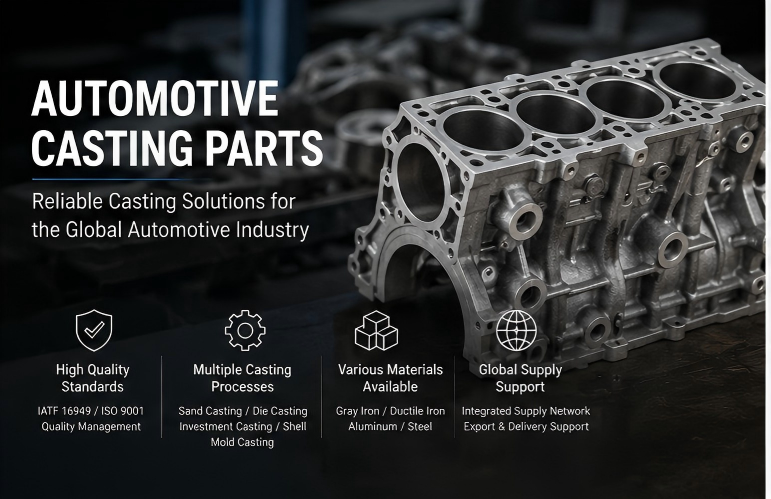
When engineers and procurement teams talk about automotive part manufacturing, they are really talking about dozens of overlapping processes — stamping, machining, injection molding, forging, and more. But one process sits at the foundation of nearly every vehicle ever built: casting.
Casting accounts for over 40% of automotive parts manufacturing volume in the Asia-Pacific region alone, and the global automotive casting market was valued at approximately $89 billion in 2025, projected to exceed $150 billion by 2034. Engine blocks, brake discs, transmission housings, steering knuckles, pump bodies — the load-bearing, heat-managing, and pressure-handling components that determine vehicle safety and longevity are overwhelmingly cast, not stamped or printed.
So what does automotive part manufacturing actually involve — and how do you source cast components reliably from China? This guide walks through the casting processes used in automotive manufacturing, the materials that define part performance, the quality standards that separate reliable suppliers from risky ones, and what buyers worldwide need to know before placing an order.
What Automotive Parts Are Made by Casting?
Before choosing a process or supplier, buyers need to understand which vehicle components are routinely cast — and why casting is the right manufacturing method for them.
Casting excels at producing complex internal geometries, thick-walled pressure-bearing shapes, and parts where the inherent properties of iron or aluminum alloys (vibration damping, thermal mass, compressive strength) matter as much as the final form.
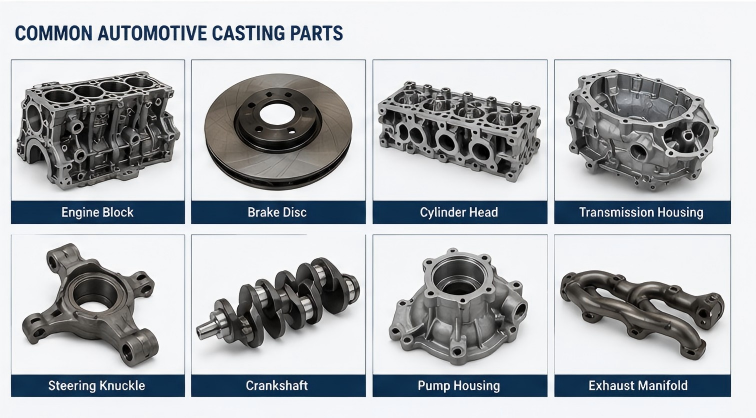
Powertrain and engine components are the classic casting territory: engine blocks, cylinder heads, exhaust manifolds, crankshafts, camshafts, and flywheel housings. These parts must survive high heat, high pressure, and millions of load cycles — conditions that favor cast iron and aluminum alloys.
Brake system components — brake discs, brake drums, and caliper housings — are almost universally made from grey cast iron, which combines high thermal mass, wear resistance, and the ability to dissipate heat rapidly.
Transmission and drivetrain housings (gearboxes, differential cases, transfer case housings) are cast from grey iron or aluminum alloy depending on weight targets and application.
Steering and suspension components — steering knuckles, wheel hubs, control arm brackets, and spindles — are increasingly made from ductile (nodular) iron, where the higher tensile strength and elongation of ductile iron prevents the catastrophic brittle failure mode of grey iron.
Fluid system components — pump casings, valve bodies, hydraulic fittings, and filter housings — require pressure tightness and precise internal geometry that casting achieves efficiently at scale.
Agricultural and construction equipment parts — counterweights, gear housings, axle cases, and hydraulic manifolds — follow the same logic, and Chinese foundries supplying the global automotive sector often serve these adjacent markets with identical processes.
The Main Casting Processes in Automotive Manufacturing
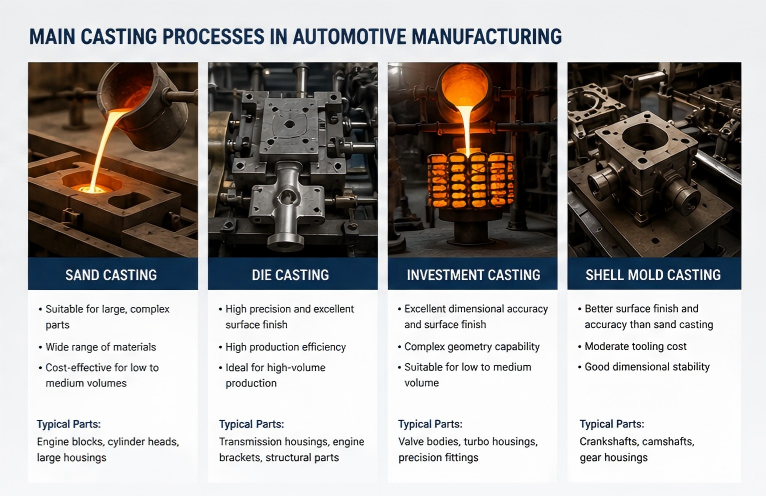
Not all casting is the same. The process determines wall thickness capability, surface finish, dimensional tolerance, volume economics, and which materials can be used. Here is how the major casting methods map to automotive applications:
Sand Casting
Sand casting is the oldest and most widely used casting process for automotive components. A pattern of the desired part is used to form a cavity in compacted sand; molten metal is poured in, cooled, and the sand mold is broken away. Sand casting handles large, complex parts with internal cavities (achieved with sand cores) that other processes cannot replicate economically.
Engine blocks and cylinder heads are the canonical sand casting products — large, geometrically complex, and produced in volumes that justify the per-cycle tooling cost of steel patterns but not the massive investment of die casting tooling. Sand casting also accepts the widest range of alloys, including grey iron, ductile iron, carbon steel, and stainless steel.
Best for: Engine blocks, cylinder heads, large housing components, low-to-medium volume production runs.
Die Casting
Die casting forces molten metal into a hardened steel mold under high pressure, producing parts with tight dimensional tolerances and excellent surface finish — but at high tooling cost that only makes sense at high volumes. Aluminum dominates automotive die casting, producing transmission housings, engine brackets, intake manifolds, oil pans, and structural components where lightweighting is a priority.
Zinc die casting is used for smaller precision parts — door handles, fuel system components, and interior hardware where the low melting point and excellent dimensional accuracy of zinc alloys offer advantages.
Best for: High-volume aluminum or zinc parts, thin-walled housings, components requiring tight tolerances and smooth surfaces.
Investment Casting (Lost-Wax Casting)
Investment casting builds a ceramic shell around a wax pattern of the desired part, melts out the wax, and fills the shell with molten metal. The result is exceptional surface finish and dimensional accuracy for complex, thin-walled parts — at the cost of slow cycle times that limit it to lower-volume, higher-value components.
In automotive, investment casting produces valve bodies, turbocharger housings, exhaust components, and precision fittings where geometry is too complex for sand casting and volumes are too low for die casting.
Best for: Complex precision parts, valve bodies, turbocharger components, small-to-medium volume high-accuracy applications.
Shell Mold Casting
Shell mold casting uses a thin resin-bonded sand shell rather than a full sand mold, producing better surface finish and tighter tolerances than conventional green sand casting — at moderate tooling cost. Crankshafts, camshafts, and gear blanks are common shell mold products in automotive foundries.
Best for: Medium-volume production of crankshafts, camshafts, and precision grey or ductile iron components.
Casting Process Comparison
| Process | Typical Materials | Surface Finish | Tolerance | Best Volume | Typical Automotive Parts |
|---|---|---|---|---|---|
| Sand Casting | Grey iron, ductile iron, steel | Moderate | ±1–3mm | Low–Medium | Engine blocks, cylinder heads, large housings |
| High-Pressure Die Casting | Aluminum, zinc, magnesium | Excellent | ±0.1–0.3mm | High | Transmission housings, engine brackets, structural parts |
| Investment Casting | Steel, alloy iron, stainless | Excellent | ±0.1–0.25mm | Low–Medium | Valve bodies, turbo housings, precision fittings |
| Shell Mold Casting | Grey iron, ductile iron | Good | ±0.5–1mm | Medium | Crankshafts, camshafts, gear housings |
Tolerances are indicative; actual specifications depend on part geometry and foundry capability.
Need help matching your part to the right casting process? Talk to Tiegu — we'll identify the right process and foundry for your specific application.
Cast Iron vs Aluminum: Which Material for Which Automotive Part?
The material decision in automotive casting comes down to the application's mechanical demands, weight constraints, and cost targets.
Grey cast iron remains the dominant material for engine blocks, brake discs, brake drums, and flywheel assemblies in internal combustion engine vehicles. Its compressive strength, vibration damping, excellent machinability, wear resistance, and cost-effectiveness at scale are properties that aluminum cannot match at comparable cost — particularly for high-heat, high-wear components. Grey iron's graphite microstructure (flake graphite) gives it superior thermal conductivity and damping, which is exactly what a brake disc or engine block needs.
Ductile iron (nodular iron) is the upgrade when a part needs both cast iron's economy and significantly higher tensile strength and elongation. Steering knuckles, wheel hubs, crankshafts, and suspension brackets increasingly specify ductile iron because it provides a safety margin against brittle fracture that grey iron cannot offer. The tensile strength of ductile iron (typically 400–900 MPa depending on grade) versus grey iron (150–350 MPa) makes it the default for structural safety-critical components.
View : Gray Iron vs Ductile Iron: A Complete Material Selection Guide
Aluminum alloys are chosen when weight reduction is the overriding priority — EV battery housings, electric motor housings, transmission cases for passenger vehicles, and engine brackets. Aluminum's density (roughly one-third of iron) and good strength-to-weight ratio support the lightweighting requirements of electric vehicles and fuel efficiency regulations. However, aluminum costs more per kilogram than cast iron, requires die casting tooling with higher capital cost, and does not match grey iron's performance in high-heat friction applications like brake discs.
| Grey Cast Iron | Ductile Iron | Aluminum Alloy | |
|---|---|---|---|
| Tensile strength | 150–350 MPa | 400–900 MPa | 150–350 MPa |
| Weight | Heavy | Heavy | Light (~⅓ of iron) |
| Machinability | Excellent | Good | Good |
| Brake/heat applications | Excellent | Good | Poor |
| Structural safety parts | Not recommended | Excellent | Good |
| Cost | Low | Low–Medium | Medium–High |
| Best for | Engine blocks, brake discs | Crankshafts, knuckles, hubs | EV housings, brackets |
Quality Standards That Matter in Automotive Casting
Automotive casting is one of the most quality-intensive sectors in manufacturing. The consequence of a casting defect in a brake component or steering part is not a warranty claim — it is a safety incident. Global buyers sourcing from Chinese foundries need to verify the following before committing to production:
IATF 16949 is the international quality management standard specific to the automotive supply chain. It covers process control, traceability, FMEA, measurement system analysis, and Production Part Approval Process (PPAP) documentation. Any foundry supplying OEM-tier automotive parts should hold active IATF 16949 certification.
ISO 9001 is the baseline quality management system certification and the minimum for aftermarket or industrial casting customers who do not require full IATF compliance.
Mill Test Certificates (MTC) are batch-specific chemical analysis documents confirming the composition of the metal poured for a given order. A reputable supplier provides MTCs matched to the shipment batch — not a generic "typical analysis" from a previous test.
Third-party pre-shipment inspection (SGS, Bureau Veritas, or equivalent) provides independent verification of dimensional accuracy, visual quality, and chemical composition before the container ships. Buyers with large orders or new supplier relationships should insist on this.
PPAP (Production Part Approval Process) documentation is required when supplying Tier 1 automotive manufacturers. A complete PPAP package includes design records, process flow diagrams, control plans, measurement system analysis, and sample parts. Chinese foundries with OEM export experience typically understand PPAP requirements; those without automotive export history often do not.
View : How to Verify a Casting Supplier's Production Capability
Why Global Automotive Buyers Source Cast Parts from China
Chinese foundries collectively represent the world's largest casting production base. China accounted for over 41% of Asia-Pacific casting output in 2025 and is the dominant supplier of grey iron, ductile iron, and steel castings to global OEMs, Tier 1 suppliers, and aftermarket distributors across North America, Europe, Southeast Asia, the Middle East, and beyond.
The practical advantages that keep global buyers returning:
Process breadth — A single Chinese foundry cluster can cover sand casting, shell mold casting, investment casting, and die casting, often within proximity of machining, heat treatment, and surface treatment operations. Buyers can consolidate a complex bill of materials with fewer supplier relationships.
Grey iron and ductile iron expertise — Chinese foundries have decades of experience with the iron grades most commonly specified for automotive parts. Batch-to-batch consistency in carbon equivalent, silicon, and nodularity (for ductile iron) is well-established in certified export foundries.
Scale and capacity flexibility — Chinese foundries can handle both prototype quantities and high-volume production orders, and an experienced export trading agent can aggregate capacity across multiple foundry partners to fulfill large or mixed-grade orders.
Export logistics infrastructure — Established export routes from major Chinese ports to global destinations, including container-ready packing for cast components, export documentation, and customs compliance experience.
Competitive pricing — Supported by lower energy, labor, and raw material costs relative to European or North American foundries, Chinese cast parts typically offer significant price advantages on equivalent specifications.
How to Vet a Foundry Before You Order
Automotive casting failures almost always trace back to inadequate supplier qualification before the first order. Before committing to a Chinese foundry for automotive parts, verify:
Relevant casting process capability — Confirm the foundry has production experience with your specific part type (not just the general process). A foundry that casts counterweights is not automatically qualified to cast brake discs.
Active IATF 16949 or ISO 9001 certification — Request the current certificate with validity dates. Lapsed or unverified certificates are a red flag.
Batch-specific MTC availability — Ask for a sample MTC from a previous comparable order. If they cannot provide one, chemical traceability is absent.
Third-party inspection acceptance — Reputable foundries accept SGS or BV inspection without hesitation. Resistance to third-party inspection before shipment should end the qualification process.
Export track record — Ask for references from buyers in your region or industry. A foundry with established export relationships to markets with demanding quality requirements (Europe, Japan, North America) has already passed qualification hurdles comparable to yours.
Working with an experienced export trading agent rather than approaching foundries directly reduces qualification risk significantly. A trading agent with a vetted foundry network has already screened for process capability, certification status, export documentation capability, and quality consistency — and bears commercial accountability for supplier performance.
Frequently Asked Questions
What is the most common casting process used in automotive part manufacturing?Sand casting is the most widely used casting process for automotive parts by volume, particularly for grey iron and ductile iron components such as engine blocks, cylinder heads, and housing assemblies. Die casting (primarily aluminum) is the dominant process for high-volume lightweight components such as transmission housings and engine brackets.
What is the difference between grey iron and ductile iron in automotive casting?Grey iron contains graphite in a flake structure, giving it excellent compressive strength, vibration damping, machinability, and thermal properties — making it ideal for engine blocks, brake discs, and brake drums. Ductile (nodular) iron has graphite in a spheroidal structure achieved through magnesium treatment, resulting in significantly higher tensile strength and elongation. Ductile iron is specified for safety-critical structural parts like steering knuckles, crankshafts, and wheel hubs where resistance to fracture under impact is essential.
How are automotive engine blocks manufactured?Engine blocks are manufactured predominantly through sand casting using grey cast iron or aluminum alloy. A sand mold is formed around a pattern of the block, with internal sand cores creating the cylinder bores, coolant passages, and oil galleries. Molten metal is poured into the mold, cooled, and the casting is then machined to final tolerances for bore dimensions, gasket surfaces, and bearing seats.
Is cast iron or aluminum better for brake discs?Grey cast iron is the standard material for automotive brake discs and drums in the vast majority of passenger vehicles, commercial vehicles, and trucks. Cast iron's high thermal mass, thermal conductivity, wear resistance, and friction characteristics under repeated high-temperature cycling make it superior to aluminum for brake applications. Aluminum brake rotors exist in motorsport and specialty applications but require ceramic composite faces and are not used in standard production vehicles.
How do I source cast automotive parts from Chinese foundries?Direct foundry sourcing requires significant qualification effort: verifying IATF 16949 certification, auditing process capability, confirming chemical traceability, and navigating export logistics. Many global buyers work with Chinese export trading agents who maintain vetted foundry networks, handle supplier qualification, negotiate pricing, coordinate third-party inspection, and manage export documentation — reducing sourcing risk and lead time for buyers without in-country resources.
What certifications should a Chinese foundry have for automotive casting?At minimum, ISO 9001 for quality management. For OEM and Tier 1 supply, IATF 16949 is the required standard. Additional certifications that signal quality capability include ISO 14001 (environmental management) and, for specific markets, compliance with customer-specific requirements documented in the PPAP submission.
Tiegu sources grey iron, ductile iron, steel, and aluminum cast automotive parts from a vetted network of certified Chinese foundries, managing supplier qualification, chemical certification, third-party inspection, and export logistics on behalf of buyers worldwide. Because we work across multiple foundry partners rather than a single production line, we can cover diverse part types, casting processes, and order volumes — including mixed orders that a single factory could not fulfill.
Looking for a reliable source of cast automotive parts from China?
Tell us your part type, material specification, and annual volume — we'll match you with the right foundry and process, with full export documentation support.