
 en
en  fra
fra  de
de  ru
ru  ara
ara  gle
gle  it
it  jp
jp  kor
kor  th
th  zh
zh GB/T 13295-2026 Officially Released: A New Era for Ductile Iron Pipe Industry
2026-06-09 16:21:31 hits:0
Introduction
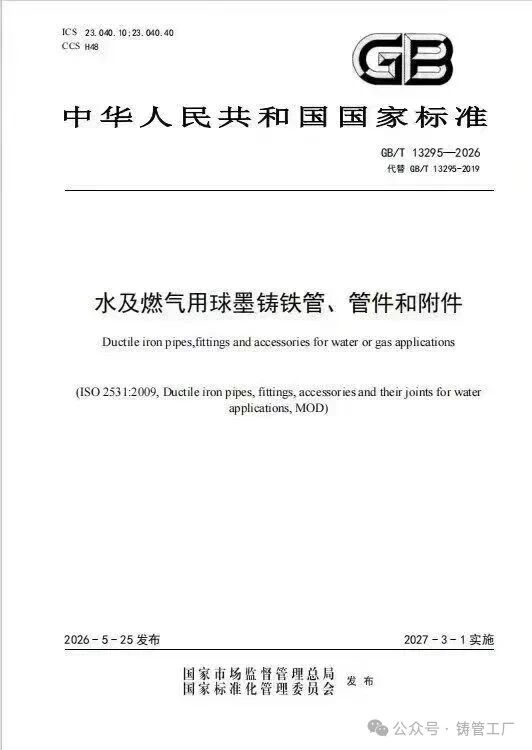
China's revised national standard GB/T 13295-2026 "Ductile Iron Pipes, Fittings and Accessories for Water and Gas Applications" has been officially released and will come into effect on March 1, 2027.
The new standard will fully replace the previous version and become the primary technical specification for water supply and gas pipeline systems. Its implementation marks a significant step forward in improving product quality, engineering safety, resource efficiency, and industry standardization.
Major Change: Transition from K-Class to C-Class System
One of the most significant updates in GB/T 13295-2026 is the complete removal of the traditional K-Class classification system.
Why Was K-Class Removed?
The K-Class system was primarily based on pipe wall thickness. While widely used for many years, it had several limitations:
Excessive focus on wall thickness rather than actual operating pressure
Potential material waste due to overdesign
Difficulty matching pipe performance to specific project requirements
Coexistence of K-Class and C-Class standards created confusion in the market
The new standard eliminates all K-Class-related provisions and establishes a unified technical framework based on the C-Class system.
Expansion of C-Class Applications
The revised standard significantly expands the application range of C-Class pipes:
Maximum nominal diameter increased from DN2600 to DN3000
Suitable for ultra-large water transmission projects
Introduction of thinner wall classifications down to C20
Improved material utilization while maintaining safety and reliability
This update supports both infrastructure development and national goals for energy conservation and carbon reduction.
Enhanced Quality Control Requirements
The new standard introduces stricter quality inspection requirements.
Previously, wall thickness compliance could be indirectly verified through weight control methods. Under GB/T 13295-2026:
Pipe wall thickness must be directly inspected
Weight-based verification methods are removed
Manufacturing consistency requirements are strengthened
Quality control standards become more rigorous
These measures are expected to improve the overall reliability and safety of underground pipeline systems.
Improved Drinking Water Safety with Epoxy Seal Coating
Public health protection is another key focus of the revised standard.
For smaller diameter pipelines commonly used in distribution networks, particularly DN300 and below, the standard recommends the use of epoxy seal coatings as an alternative to traditional cement mortar linings.
Benefits of Epoxy Seal Coatings
Compared with conventional lining systems, epoxy coatings provide:
Excellent corrosion resistance
Improved sealing performance
Reduced risk of bacterial growth
No impact on drinking water quality
Enhanced protection against secondary contamination
These improvements contribute to safer and more hygienic water delivery in the final stages of municipal distribution networks.
Positive Impact on the Industry
The implementation of GB/T 13295-2026 is expected to generate several long-term benefits.
Standardized Market Competition
By establishing unified technical requirements, the new standard will:
Reduce market confusion
Eliminate substandard products
Raise industry entry thresholds
Encourage fair competition based on quality
Lower Project Costs
The pressure-based C-Class system allows engineers to select pipes more accurately according to actual operating conditions.
This helps:
Reduce unnecessary material usage
Avoid overdesign
Lower overall construction costs
Supporting Green Development
The introduction of thinner-wall C20 designs and wider adoption of environmentally friendly coating systems aligns with China's carbon reduction and sustainable development objectives.
Enhanced International Competitiveness
The updated technical framework is more closely aligned with international engineering practices.
This will help Chinese ductile iron pipe manufacturers:
Improve product competitiveness
Expand export opportunities
Strengthen participation in international infrastructure projects
Looking Ahead
Underground pipeline networks are often referred to as the "lifelines" of modern cities.
Thanks to their high strength, excellent toughness, corrosion resistance, and reliable sealing performance, ductile iron pipes continue to play a critical role in:
Municipal water supply systems
Natural gas transmission networks
Irrigation and water transfer projects
Urban infrastructure development
The implementation of GB/T 13295-2026 provides a stronger technical foundation for the future of pipeline engineering in China.
As the industry transitions toward wider adoption of the C-Class system, manufacturers, engineers, and project owners will benefit from improved efficiency, higher product quality, and more sustainable infrastructure solutions.
Conclusion
The release of GB/T 13295-2026 marks an important milestone for China's ductile iron pipe industry.
Key highlights include:
Complete transition from K-Class to C-Class classification
Expansion of C-Class applications up to DN3000
Introduction of C20 wall thickness class
Mandatory wall thickness inspection requirements
Promotion of epoxy seal coatings for improved drinking water safety
Stronger support for sustainable development and international competitiveness
With the implementation of the new standard in 2027, China's ductile iron pipe industry is expected to enter a new phase of high-quality, green, and technology-driven development.