
 en
en  fra
fra  de
de  ru
ru  ara
ara  gle
gle  it
it  jp
jp  kor
kor  th
th  zh
zh Gray Iron vs Ductile Iron for Custom CNC Parts: Which Material Should You Choose?
2026-01-09 15:28:27 hits:0
Understanding Gray Iron and Ductile Iron in Custom CNC Parts
Gray iron and ductile iron are the two most commonly used materials for custom cast iron components. While both are suitable for CNC machining, their mechanical properties, machinability, and application suitability differ significantly.
When selecting materials for custom CNC cast iron parts, understanding these differences helps engineers and buyers balance performance, cost, and manufacturability.
Mechanical Properties Comparison
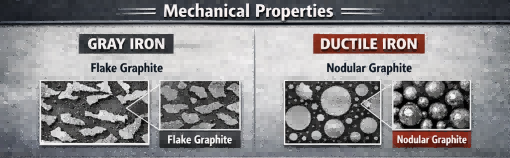
The most fundamental difference between gray iron and ductile iron lies in their graphite structure, which directly affects strength and toughness.
Gray Iron
Graphite appears in flake form
Excellent vibration damping
Lower tensile strength
Brittle under impact loads
Ductile Iron
Graphite appears in spherical (nodular) form
Higher tensile and yield strength
Superior impact resistance
Better fatigue performance
For load-bearing or safety-critical components, ductile iron is often preferred due to its mechanical reliability.
Machinability and CNC Processing Characteristics
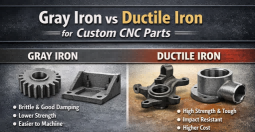
Both materials are widely used in CNC machining, but their behavior during cutting differs.
Gray iron is known for:
Excellent machinability
Lower cutting forces
Natural lubrication from graphite flakes
Reduced tool wear
Ductile iron, while still machinable, typically:
Requires more robust tooling
Generates higher cutting forces
Produces longer chips
Benefits from optimized CNC parameters
If your project involves extensive finishing operations, understanding CNC machining for cast iron components can help determine which material offers better efficiency and tool life.
Strength, Durability, and Application Suitability
Material selection should be driven by the functional requirements of the part.
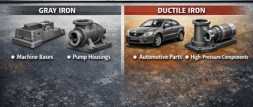
Gray iron is commonly used for:
Machine bases
Gear housings
Pump casings
Components requiring vibration absorption
Ductile iron is better suited for:
Pressure-containing parts
Structural components
Automotive and transportation parts
Applications requiring impact resistance
In many industrial projects, ductile iron provides a safety margin that gray iron cannot offer under dynamic loads.
Cost Considerations: Gray Iron vs Ductile Iron

Cost is often a deciding factor in material selection.
Gray iron generally:
Has lower raw material cost
Requires less complex metallurgy
Offers faster CNC machining
Ductile iron:
Has higher material and processing cost
Requires magnesium treatment during casting
May increase CNC machining time
However, for parts where failure risk is high, the higher initial cost of ductile iron may reduce long-term operational and maintenance costs.
Choosing the Right Material for Custom CNC Applications
Selecting between gray iron and ductile iron depends on several factors:
Load and stress conditions
Required mechanical strength
CNC machining complexity
Budget constraints
Service environment
Engineers often evaluate these factors early in the design phase to avoid costly redesigns or performance issues later in production.
Final Recommendation for Custom CNC Cast Iron Parts
There is no universal “better” material—only the right choice for a specific application. Gray iron offers excellent machinability and cost efficiency for stable, low-stress components, while ductile iron delivers superior strength and durability for demanding environments.
For a complete overview of material selection, machining, and production workflows, visit our Custom CNC Cast Iron Parts pillar page, where all related topics are explained in detail.
Related Resources
To further explore this topic, you may also find these guides helpful:
CNC Machining for Cast Iron Components – machining capabilities and tolerances
Tolerance & Surface Finish in CNC Cast Iron Parts – understanding precision limits
Design Guidelines for Custom CNC Cast Iron Parts – best practices for manufacturable designs