
 en
en  fra
fra  de
de  ru
ru  ara
ara  gle
gle  it
it  jp
jp  kor
kor  th
th  zh
zh Custom Cast Components for Vehicle Chassis: Materials, Processes & How to Order from China
2026-07-03 10:29:27 hits:0
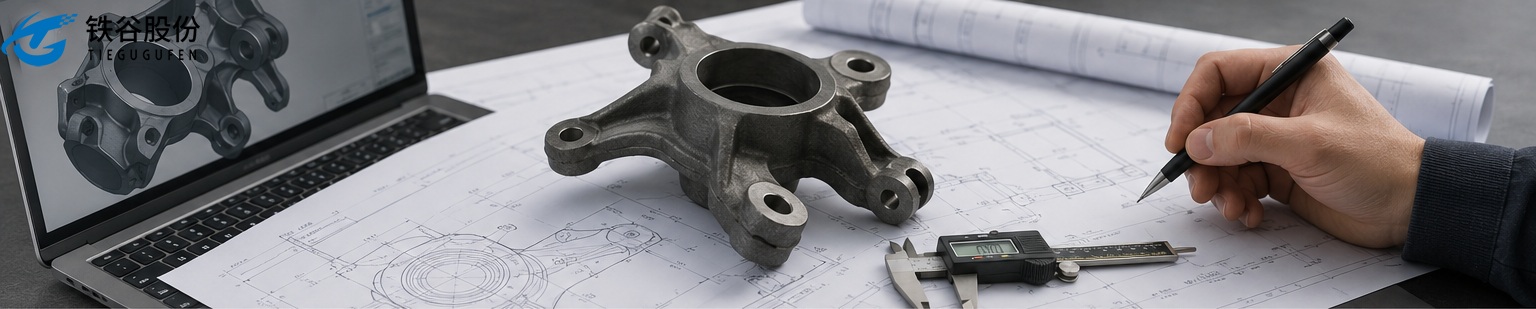
Custom cast components for vehicle chassis are cast parts manufactured according to customer-supplied drawings, material specifications, and engineering requirements. Buyers typically need guidance on selecting the right casting process, preparing technical documents, understanding the sampling and approval workflow, and choosing a qualified supplier before committing to full production.
Whether you are developing a new chassis component from scratch, sourcing a replacement part based on an existing sample, or simply purchasing cast blanks for in-house machining, this guide walks through every step of the process — from drawing preparation to shipment.
Tiegu maintains sourcing relationships with thousands of Chinese foundries across casting disciplines and screens for process capability, certification, and export experience matched to each buyer's specific component and drawing requirements.
For a full overview of which chassis components are typically cast and which materials are used, see our guide to Automotive Chassis Castings.
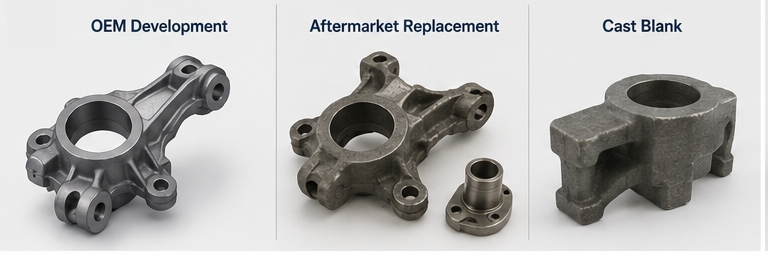
Three Types of Custom Chassis Casting Buyers
Before diving into materials and processes, it helps to identify which type of buyer you are — because the information you need to provide, the approval process you will go through, and the timeline you should expect are different for each.
OEM / New Product DevelopmentYou are designing a new chassis component and need a foundry to produce it from your engineering drawings. This path typically requires full tooling development, Design for Manufacturability (DFM) review, first article inspection, and in many cases a formal Production Part Approval Process (PPAP) or APQP (Advanced Product Quality Planning) before serial production begins. Lead time from drawing to approved sample is longest in this category — typically 8 to 16 weeks depending on complexity and casting process.
Replacement / Aftermarket PartsYou have an existing component — either a drawing, a 3D scan, or a physical sample — and need a Chinese foundry to reproduce it. Reverse engineering from sample is common in this segment. Full OEM certification is not required; the focus is dimensional accuracy, material match, and consistent batch quality. This is one of the most active segments for Chinese chassis casting exports, with established workflows for matching existing parts to the right foundry and process.
Cast Blanks for In-House MachiningYou need the casting itself, and you handle all post-casting machining, heat treatment, and finishing in-house. Buyers in this category typically specify material grade, net shape dimensions with casting allowances, and surface condition (as-cast, shot-blasted, or with machining reference pads). This is particularly common among European and North American buyers who have machining capacity but want to move the raw casting supply to China. Drawing requirements are simpler, and the approval process is shorter.
Choosing the Right Material: A Buyer Decision Guide
At the custom ordering stage, material selection is a procurement decision as much as an engineering one. Here is how buyers typically think through the choice:
Ductile iron is the most common material for custom chassis castings — steering knuckles, control arms, wheel hubs, differential carriers, and subframe brackets. When buyers choose ductile iron, they are typically balancing low tooling cost (sand and shell mold tooling is a fraction of die casting tooling), good machinability, high strength, and the ability to produce mid-range annual volumes economically. For safety-critical components, ductile iron's elongation (6–18%) provides the ductile failure mode that grey iron cannot offer.
Grey iron is the choice when a buyer needs the lowest possible unit cost for a non-safety-critical chassis component — brake drums, caliper brackets, structural mounts. Grey iron tools faster and machines more easily than ductile iron, but it is not suitable for components under dynamic tensile or bending loads.
ADI (Austempered Ductile Iron) enters the picture when buyers need to reduce component weight without changing the casting process. Because ADI achieves tensile strength of 800–1400 MPa, section thickness can be reduced to achieve the same load capacity as a heavier standard ductile iron part. Buyers choosing ADI are usually in premium vehicle or commercial vehicle programs where the additional heat treatment cost is justified by weight savings.
Aluminum alloy is chosen when lightweighting is the overriding requirement — typically in EV or premium passenger vehicle programs. The trade-off buyers accept is significantly higher tooling cost (die casting tooling vs. sand or shell mold tooling) and longer prototype lead time. For buyers who need aluminum chassis castings in small annual volumes, low-pressure die casting or sand casting in aluminum alloy is worth considering over high-pressure die casting.
| Material | Tooling Cost | Sample Lead Time | Best Volume | Typical Chassis Parts |
|---|---|---|---|---|
| Ductile Iron | Low | 3–5 weeks | Low–High | Knuckles, arms, hubs, carriers |
| Grey Iron | Low | 3–4 weeks | Low–High | Brake drums, brackets, mounts |
| ADI | Low–Medium | 5–7 weeks | Medium–High | High-performance suspension parts |
| Aluminum Alloy | High (HPDC) / Medium (LPDC) | 6–10 weeks | High (HPDC) / Medium (LPDC) | Lightweight structural parts, EV components |
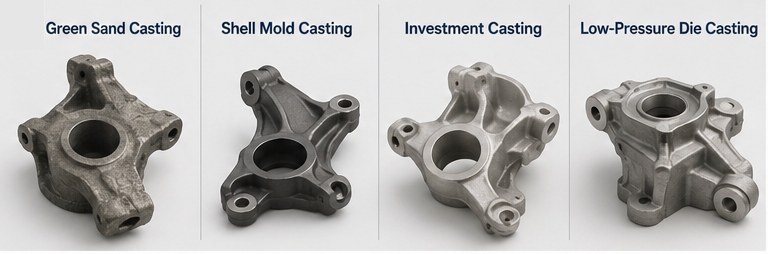
Casting Process Selection for Custom Chassis Components
The casting process determines tooling cost, dimensional accuracy, surface finish, and minimum order quantity. For custom chassis casting orders from China, here is the decision logic buyers most commonly apply:
Shell Mold Casting is the default recommendation for most custom ductile iron chassis castings — steering knuckles, control arms, and wheel hubs — where dimensional consistency across production batches is critical. Shell mold tooling costs more than green sand patterns but significantly less than die casting tooling, and the surface finish and tolerance capability are substantially better than green sand. Most Chinese foundries with automotive export experience use shell mold casting for these component types.
Green Sand Casting is the right choice when tooling cost must be minimized — for first prototype runs, large and geometrically complex parts, or components where surface finish and tight tolerances are handled downstream by machining. Green sand patterns are the fastest and cheapest to produce, making them ideal for cast blank buyers and first-article validation before committing to shell mold tooling.
Investment Casting serves precision small chassis components — sensor brackets, actuator housings, precision fittings — where complex geometry, tight tolerances, and excellent surface finish are needed in low-to-medium volumes. Not the right process for large load-bearing chassis parts, but appropriate for the smaller precision components that attach to the chassis system.
Low-Pressure Die Casting (LPDC) is the standard process for custom aluminum alloy suspension components in medium-to-high volumes. Better internal soundness than gravity die casting, lower tooling cost than high-pressure die casting, and capable of the wall thicknesses needed for structural chassis parts.
Process Decision Guide
| Priority | Recommended Process |
|---|---|
| Lowest tooling cost / first prototype | Green Sand Casting |
| Best dimensional tolerance in iron | Shell Mold Casting |
| Lightweight aluminum structural part | Low-Pressure Die Casting |
| Complex small precision component | Investment Casting |
| Maximum volume, tightest tolerance, aluminum | High-Pressure Die Casting |
Before You Send Your Drawing: Preparation Checklist
Incomplete drawings are the single most common cause of delayed quotations and avoidable back-and-forth with suppliers. Before submitting a drawing for quotation, confirm you have provided:
☐ 2D engineering drawing (PDF) with all critical dimensions and GD&T tolerances marked
☐ 3D CAD file (STEP or IGES format) for DFM review and tooling design
☐ Material specification — grade and applicable standard (e.g., EN-GJS-500-7, ASTM A536 Grade 65-45-12)
☐ Surface condition requirement — as-cast / shot-blasted / machining reference pads / fully machined
☐ Heat treatment requirement (if applicable — annealing, normalizing, austempering for ADI)
☐ Annual volume estimate — this determines whether shell mold, green sand, or die casting is most cost-effective
☐ Application description — what vehicle system and load conditions the part operates under
☐ Certification requirement — ISO 9001 / IATF 16949 / customer-specific quality plan
Providing all of the above in the first submission typically reduces quotation time from two weeks to three to five business days.
Common Drawing Mistakes That Delay Quotation
Even experienced buyers make these errors when submitting chassis casting drawings to Chinese foundries for the first time:
Missing or incomplete tolerances — A drawing that marks critical bore diameters but leaves all other dimensions as "general tolerance" forces the foundry to make assumptions that may not match your intent. Specify tolerances on every dimension that affects fit, function, or assembly.
Material specified by trade name only — "Ductile iron" without a grade and standard leaves the foundry unable to confirm mechanical properties. Always specify the grade (e.g., GJS-500-7) and the applicable standard (EN 1563, ASTM A536, or equivalent).
No machining allowance indicated — If you need a fully machined component, the casting drawing must show which surfaces will be machined and include the machining allowance (typically 2–5mm depending on surface and process). Without this, the foundry cannot design the mold correctly.
Datum references missing or ambiguous — Chassis components with multiple precision interfaces (bore centers, mounting face relationships) require clearly defined datums for CMM inspection. Without them, the foundry and buyer will measure the same part from different references and reach different conclusions.
No surface finish specification — "Smooth finish" is not a specification. Specify Ra values on surfaces where finish matters, and identify which surfaces are as-cast versus post-processed.

The 8-Step Custom Casting Workflow
Step 1 — Prepare Technical DocumentsAssemble your complete drawing package using the checklist above. The more complete your initial submission, the faster and more accurate the quotation you will receive.
Step 2 — Engineering Review (DFM)Before quotation, the foundry or sourcing agent conducts a Design for Manufacturability review of your drawing. DFM identifies issues that affect castability: insufficient draft angles (the taper that allows the pattern to release from the mold), wall sections too thin or too thick for the chosen process, parting line placement that affects dimensional accuracy, shrinkage compensation requirements, and machining allowance adequacy. DFM feedback at this stage prevents expensive tooling modifications later and is one of the most valuable services an experienced sourcing partner provides.
Step 3 — Supplier MatchingThis step is where working with a sourcing agent provides the greatest value over approaching foundries directly. Rather than going straight to a single foundry quotation, Tiegu evaluates the component requirements and matches them to the most suitable foundry from our network based on: casting process capability for your specific component type, production scale appropriate to your annual volume, certification status (ISO 9001 or IATF 16949 as required), track record with similar chassis components, and export documentation experience. Multiple foundries are evaluated before a recommendation is made.
Step 4 — QuotationThe formal quotation covers all cost elements: tooling cost (pattern or die, charged separately from unit price), unit casting price at stated annual volume, lead time for tooling and first samples, inspection scope and documentation included, Incoterms, and payment terms. Review the quotation against all five elements before accepting — a low unit price with high tooling cost may not represent the best total cost of ownership for your volume.
Step 5 — Tooling ProductionOnce the quotation is accepted and tooling payment is confirmed, the foundry begins tooling production. Green sand patterns: 2–3 weeks. Shell mold tooling: 3–5 weeks. Low-pressure die casting tooling: 5–8 weeks. High-pressure die casting tooling: 8–14 weeks. Tooling complexity and cavity count affect these timelines. Your tooling drawings should be retained and the tooling agreement should specify ownership clearly.
Step 6 — Sample Production and InspectionFirst article samples are cast, heat-treated (where applicable), and inspected before shipment. The inspection package for chassis castings should include: full dimensional report against drawing, material mill test certificate (MTC) with chemical composition, mechanical property test report (tensile strength, yield strength, elongation), and for ductile iron components, microstructure report confirming nodularity percentage and graphite form. ADI samples additionally require hardness testing confirming austempering result.
Step 7 — Sample ApprovalBuyer reviews the sample inspection package and physical samples. OEM buyers submit formal PPAP documentation at this stage. Aftermarket and cast blank buyers confirm dimensional and material compliance and advise whether samples are approved for production or require modification. If tooling modification is needed, the cycle from Step 5 repeats for the affected features — typically 2–3 weeks for minor modifications.
Step 8 — Mass Production and ShipmentApproved samples trigger production release. Production inspection follows the agreed quality plan — typically including dimensional check of a statistical sample per batch, MTC per melt, and visual inspection 100%. Third-party pre-shipment inspection (SGS or Bureau Veritas) can be arranged before container loading for new supplier relationships or high-value orders. Export documentation (commercial invoice, packing list, bill of lading, certificate of origin, inspection certificate) is prepared and coordinated by the trading agent.
Have a drawing ready? Send it to Tiegu — we'll run a DFM review and recommend the right foundry and process at no obligation.
How to Verify a Chinese Foundry Before Ordering
Submitting a drawing and receiving a quotation is not the same as qualifying a supplier. Before approving tooling investment for a custom chassis casting, verify the following:
Process capability match — Confirm the foundry has documented production experience with your specific component type and casting process, not just the general category. A foundry that casts counterweights in green sand is not automatically qualified to produce shell mold ductile iron steering knuckles.
Certification status — Request the current ISO 9001 or IATF 16949 certificate with validity dates. Ask whether the certificate scope covers the specific casting process and material grade you require. Lapsed certificates or certificates that exclude the relevant process are disqualifying.
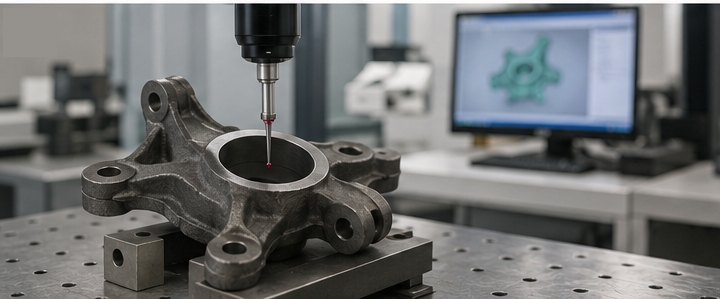
Inspection equipment on site — A foundry supplying automotive chassis castings should have spectrometer for chemical analysis, tensile testing equipment or a third-party testing arrangement, metallographic examination capability for nodularity verification, and CMM or equivalent for dimensional inspection. Ask for evidence of each.
Sample inspection records from comparable orders — Request a sample MTC and dimensional report from a previous order of a similar component type and material. This confirms not just that the equipment exists, but that the documentation system works.
Export track record — Ask for references from buyers in your region or industry who have placed repeat orders. A foundry with established export relationships to demanding markets (Europe, North America, Japan) has already passed qualification hurdles comparable to yours.
Communication and project management capability — For custom chassis castings, the ability to communicate clearly on DFM issues, tooling status, sample results, and production scheduling is as important as casting quality. Evaluate responsiveness and technical depth in early exchanges before committing to tooling.
Third-party audit — For OEM or Tier 1 supply, consider a pre-qualification audit by SGS, Bureau Veritas, or a specialist automotive supplier auditor before tooling approval.
Why Source Custom Chassis Castings from China
China offers one of the world's most complete casting supply ecosystems, allowing buyers to select foundries based on process capability, production scale, certification status, and export experience — rather than being limited to a single manufacturer's available capacity and processes.
For custom chassis castings specifically, Chinese foundries offer several practical advantages: shell mold and green sand tooling costs significantly below equivalent European or North American tooling; foundry clusters with decades of automotive casting export experience in provinces such as Shandong, Jiangsu, Zhejiang, and Liaoning; integrated post-casting services including heat treatment, CNC machining, CMM inspection, and surface treatment within compact supply chains; and the ability to produce both prototype quantities and full production volumes from the same tooling and supplier relationship.
Tiegu coordinates supplier matching across thousands of foundry relationships rather than operating as a single manufacturing facility, helping international buyers reduce sourcing risk through structured project management — DFM review, foundry qualification, inspection coordination, and export documentation — in a single point of contact.
Frequently Asked Questions
What information do I need to provide to order custom cast chassis components?
At minimum: a 2D engineering drawing with dimensions and tolerances, a 3D CAD file (STEP or IGES), material grade and applicable standard, surface condition requirement, annual volume estimate, and any certification requirements (ISO 9001 or IATF 16949). The more complete your initial submission, the faster and more accurate the quotation. See the preparation checklist earlier in this guide for the full list.
What drawing format is preferred for submitting to Chinese foundries?
PDF for 2D drawings and STEP or IGES for 3D files are universally accepted by Chinese export foundries. DXF is acceptable for 2D only. Native CAD formats (SolidWorks, CATIA, NX) can usually be accommodated but STEP is the safest common format. Always provide both 2D and 3D — the 2D drawing is the legal specification document; the 3D file is used for DFM review and tooling design.
Can I order prototypes only, without committing to mass production?
Yes. Green sand prototype runs with temporary patterns are a standard offering from Chinese foundries for chassis casting development. Prototype tooling costs significantly less than production tooling, with the understanding that dimensional consistency and surface finish will be lower than shell mold production parts. Many buyers run a prototype phase in green sand to validate design before investing in shell mold tooling for production.
How is tooling charged, and who owns the tooling?
Tooling is typically charged as a one-time upfront cost separate from unit price. Ownership should be specified in the purchase order — standard practice in Chinese foundry export is that the buyer owns the tooling after full payment, and the tooling remains at the foundry for production use. Ensure your purchase order states that tooling is buyer-owned and may be transferred to another facility on written request.
How do I protect my drawings when sharing with Chinese foundries?
A Non-Disclosure Agreement (NDA) should be signed before sharing drawings. Reputable Chinese export foundries and trading agents routinely sign NDAs as a standard step in the quotation process. Additionally, consider removing your company name and customer references from drawings before submission to new suppliers — share technical content only. Working through a trading agent adds a layer of contractual protection, as the agent holds commercial accountability for confidentiality compliance.
How much do custom cast chassis components cost from China?
Cost depends on material grade, part weight, casting process, complexity, post-casting requirements (machining, heat treatment, NDT), and annual volume. Tooling is a one-time cost ranging from a few hundred USD for a simple green sand pattern to several thousand USD for production shell mold tooling. Unit prices for ductile iron chassis castings are most competitive at annual volumes above a few hundred pieces per year. The most accurate way to understand your cost is to submit your drawing for a factory-matched quotation.
Can I choose ductile iron or steel for a chassis component that currently uses forged steel?
Ductile iron is a common and cost-effective replacement for forged steel in chassis components that do not require the absolute maximum tensile strength of a steel forging. For steering knuckles, control arms, and hub carriers that currently use steel forgings, ductile iron Grade 600-3 or 700-2 (or ADI for higher strength requirements) can typically match the load requirements at lower per-unit cost and with more design flexibility from a casting process. The decision should involve a structural analysis comparing the mechanical properties of the current forged steel part against the proposed ductile iron grade — something a DFM review can initiate.
Can the foundry machine the casting after casting?
Yes. Most Chinese foundries producing export-grade automotive chassis castings have CNC machining capability on site or through closely integrated machining partners. Buyers can specify which surfaces require machining, target tolerances, and surface finish requirements on the drawing. Supplying semi-finished or fully machined chassis castings is a standard service in China's automotive casting export supply chain.
Tiegu sources custom ductile iron, grey iron, ADI, and aluminum chassis castings from a network of thousands of Chinese foundries, screening for process capability, certification, and export track record matched to each buyer's specific drawing and quality requirements. We manage DFM review, supplier matching, sample inspection, and export logistics — from drawing submission to delivery.
Submit Your Drawing for a Free Custom Casting Quote
Share your component drawing, material grade, annual volume, and certification requirements. Tiegu will review manufacturability, match the right foundry, and provide a complete quotation covering tooling, unit price, and lead time.