
 en
en  fra
fra  de
de  ru
ru  ara
ara  gle
gle  it
it  jp
jp  kor
kor  th
th  zh
zh Steel Casting Foundry Guide: Processes, Material Grades & How to Source from China
2026-07-02 10:01:04 hits:0
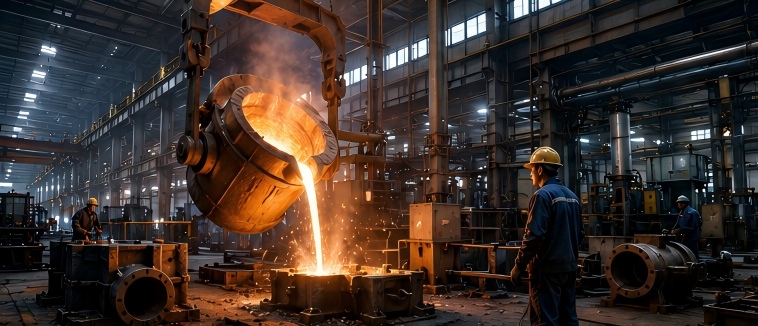
A steel casting foundry manufactures steel components by pouring molten carbon steel, alloy steel, stainless steel, or manganese steel into molds to produce high-strength parts for mining, valves, pumps, heavy equipment, and a wide range of industrial applications. Unlike cast iron, steel castings offer significantly higher tensile strength, impact resistance, and weldability — making them the default choice wherever components must survive dynamic loading, shock, or corrosive service conditions.
So which steel grade and casting process is right for your application, and how do you source reliably from China without unnecessary risk? This guide covers the full picture.
For international buyers sourcing steel castings from China, Tiegu works with qualified Chinese foundries covering carbon steel, alloy steel, stainless steel, and manganese steel casting production — managing supplier qualification, quality verification, and export logistics on your behalf.
Steel Casting vs Cast Iron: When Does Steel Win?
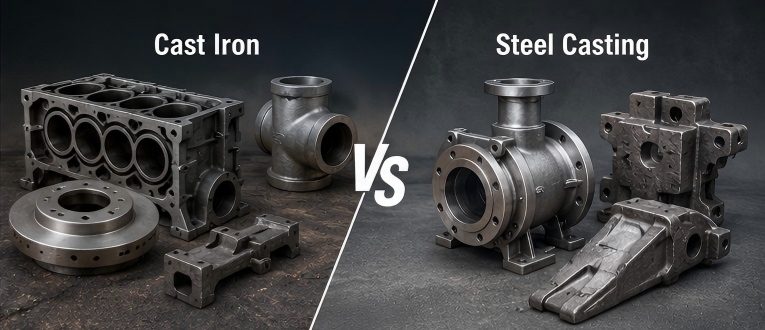
Steel castings and iron castings are often grouped together in supplier catalogs, but they are metallurgically distinct products with meaningfully different performance profiles.
Cast iron — grey iron and ductile iron — dominates applications where compressive strength, vibration damping, machinability, and low cost are the priorities: engine blocks, brake discs, pipe fittings, and general machinery housings. But cast iron has a fundamental limitation: it is brittle under tensile stress and impact loading, and generally has limited weldability, requiring specialized procedures when repair welding is necessary.
Cast steel fills the gap where iron falls short. Steel castings offer significantly higher tensile strength, far greater toughness and impact resistance, and full weldability — making them the default choice for components that must absorb shock, operate under dynamic loads, or be repaired and modified in the field.
| Cast Steel | Grey Cast Iron | Ductile Iron | |
|---|---|---|---|
| Tensile strength | 400–1000+ MPa | 150–350 MPa | 400–900 MPa |
| Impact resistance | Excellent | Poor | Good |
| Weldability | Good | Poor | Limited |
| Elongation (ductility) | High | Near zero | Moderate–High |
| Machinability | Moderate | Excellent | Good |
| Cost | Higher | Low | Medium |
| Typical applications | Mining, valves, heavy equipment | Engine blocks, brake discs | Pipes, crankshafts |
The practical rule: if your part must survive impact, dynamic loading, high-pressure service, or field welding repair — specify cast steel. If it operates primarily under compression or steady thermal load, cast iron is likely the more cost-effective choice.
Steel Casting Material Grades Explained
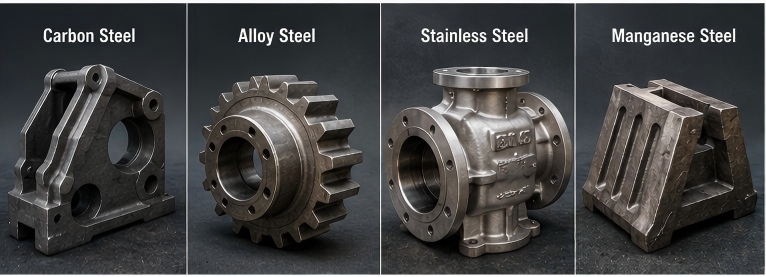
Within cast steel itself, the grade selection determines the final mechanical properties, corrosion resistance, and wear performance of the finished part. Chinese foundries producing for global export work with four principal steel casting families:
Carbon Steel Castings
Carbon steel is the baseline of the steel casting world — iron alloyed primarily with carbon (typically 0.2–0.5% C), with small additions of manganese and silicon. It offers a reliable combination of strength, toughness, and weldability at the lowest cost within the steel casting category.
Low-carbon steel castings (below 0.25% C) prioritize toughness and weldability: structural components, hook blocks, lifting equipment. Medium-carbon grades (0.25–0.45% C) balance strength and toughness for general industrial machinery. High-carbon grades (above 0.45% C) are harder but less tough, used for wear-facing applications.
Common applications: Structural and load-bearing components, pipe fittings, valve bodies for general service, construction equipment parts, rail components.
Common standards: ASTM A216 (carbon steel for high-temperature service), ASTM A352 (low-temperature service). Chinese steel casting suppliers commonly produce carbon steel castings to ASTM A216, A352, EN 10293, and equivalent DIN/JIS specifications, with full mill test certificate documentation.
Alloy Steel Castings
Alloy steel castings add deliberate quantities of chromium, nickel, molybdenum, vanadium, or other elements to the base carbon steel composition to achieve targeted performance improvements: higher hardenability, better high-temperature strength, improved toughness at low temperatures, or enhanced wear resistance.
Chromium-molybdenum (Cr-Mo) steels are the workhorse of the energy and pressure vessel industry — elevated temperature strength, creep resistance, and good weldability after proper heat treatment. Nickel-alloy steels deliver superior low-temperature impact resistance for Arctic and LNG applications. Chromium-alloyed steels serve high-abrasion environments where carbon steel wears too quickly.
Common applications: Mining equipment components, oil and gas pressure-containing parts, power generation turbine housings, automotive transmission and drivetrain components, heavy crane components.
Common standards: ASTM A148 (high-strength structural), ASTM A356 (alloy steel for pressure service). Chinese foundries with export experience regularly supply alloy steel castings to ASTM A148, A217, and EN equivalent grades, covering Cr-Mo, Ni-alloy, and wear-resistant alloy compositions.
Stainless Steel Castings
Stainless steel castings contain a minimum of 10.5% chromium, which forms a passive oxide layer on the surface that resists corrosion in wet, chemical, and marine environments. The addition of nickel, molybdenum, and other elements further tailors corrosion resistance, high-temperature performance, and mechanical properties.
The most widely specified grades in global foundry supply are:
304 / CF8 — general-purpose austenitic, food processing, architectural, mild chemical service
316 / CF8M — molybdenum-enhanced, superior chloride and acid resistance, marine and chemical processing
17-4 PH / CD4MCu — precipitation-hardened grades for applications needing both high strength and corrosion resistance: pump impellers, valves in aggressive media
Common applications: Pump and valve bodies for chemical and water treatment plants, marine hardware and offshore equipment, food and beverage processing machinery, pharmaceutical and biotech components.
Common standards: ASTM A351 (austenitic stainless steel castings for pressure service), ASTM A743/A744 (corrosion-resistant castings). Stainless steel casting foundries in China are among the most export-active in the global market, routinely supplying CF8, CF8M, CA6NM, and CD4MCu grade castings to buyers in North America, Europe, and the Middle East under ASTM A351, A743, and A744.
Manganese Steel Castings
Manganese steel (typically 11–14% Mn, 1–1.4% C) is one of the most distinctive engineering materials in the casting industry. Its defining property is work hardening under impact: the surface becomes progressively harder as it absorbs blows, while the core retains toughness. This means a manganese steel liner or wear part actually improves its resistance to abrasion the harder it is struck — a property no other common casting material shares.
The trade-off is that manganese steel cannot be machined or welded easily after casting, and it must be solution-treated (water quenched from approximately 1050°C) to achieve its optimal properties. But for components in high-impact, high-abrasion environments, nothing performs comparably at equivalent cost.
Common applications: Crusher liners and jaw plates, grinding mill liners, excavator bucket teeth, railway crossings and frogs, impact hammer heads.
Common standards: ASTM A128 (austenitic manganese steel castings). Chinese foundries supplying mining and aggregate processing equipment manufacturers worldwide are major producers of ASTM A128 manganese steel castings, with established experience in solution treatment, water quenching, and dimensional verification for wear part applications.
Main Casting Processes Used in Steel Foundries
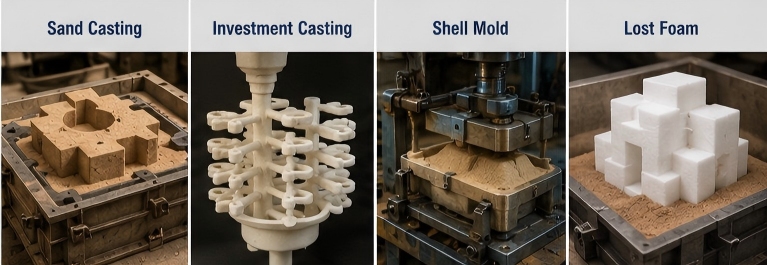
The steel grade specifies what the part is made of — the casting process determines how it is made, which controls surface finish, dimensional accuracy, internal soundness, and production economics.
Sand Casting
Sand casting is the dominant process for steel castings by volume. A compacted sand mold is formed around a pattern of the desired part, molten steel is poured in, and the sand is broken away after solidification. Sand casting handles the widest range of part sizes (from a few kilograms to several tonnes), accepts all steel grades including manganese steel, and offers the lowest tooling cost — making it the practical choice for medium and large components across mining, oil and gas, and heavy equipment applications.
Best for: Large and complex steel components, low-to-medium volume production, manganese steel wear parts, structural and pressure-containing parts. For buyers sourcing heavy steel castings from China, sand casting is usually the first choice — Chinese foundries handle large casting weights, custom patterns, and low-to-medium production volumes economically, with integrated heat treatment and machining on the same site.
Investment Casting (Lost-Wax Casting)
Investment casting builds a ceramic shell around a wax pattern, melts out the wax, and pours molten steel into the ceramic mold. The result is exceptional surface finish and dimensional accuracy for complex, thin-walled parts — without the draft angles and wall-thickness constraints of sand casting. Stainless steel investment casting is particularly well-established in Chinese foundries serving global pump, valve, and fluid control markets.
Best for: Precision stainless steel and alloy steel components, complex geometries, small-to-medium volumes, parts requiring near-net-shape accuracy that reduces post-cast machining. China is one of the world's leading sources of investment cast stainless steel parts, with extensive foundry clusters experienced in supplying CF8M valve bodies, pump impellers, and marine fittings to global buyers.
Shell Mold Casting
Shell mold casting uses a thin resin-bonded sand shell instead of a full sand mold, delivering better surface quality and tighter dimensional tolerances than conventional sand casting at moderate tooling cost. It is well-suited to medium-volume production of steel components where surface finish and consistency matter more than the lowest possible per-unit tooling investment.
Best for: Medium-volume carbon and alloy steel parts, pipe fittings, valve components, and gear-related housings requiring consistent quality across batches. Chinese foundries using shell mold casting commonly serve buyers requiring repeatable dimensional accuracy across multi-shipment contracts — particularly for pipe fittings and valve bodies exported to ASTM-specified markets.
Lost Foam Casting
Lost foam casting uses an expendable polystyrene foam pattern left in the mold — the molten steel vaporizes the foam as it fills the cavity. This allows highly complex internal geometries without sand cores, making it efficient for components with intricate internal passages that would require expensive coring in conventional sand casting.
Best for: Complex carbon and low-alloy steel parts with internal passages, medium-to-large production volumes, components where eliminating internal core sand reduces defect risk. Buyers sourcing complex steel housings or manifold-type components from China will find lost foam casting offers cost advantages over sand casting with cores, particularly at medium production volumes.
Casting Process Selection at a Glance
| Process | Steel Grades | Surface Finish | Dimensional Accuracy | Volume Range | Best For |
|---|---|---|---|---|---|
| Sand Casting | All grades incl. Mn steel | Moderate | ±1–3mm | Low–Medium | Large heavy parts, wear components |
| Investment Casting | Stainless, alloy steel | Excellent | ±0.1–0.25mm | Low–Medium | Precision valves, pumps, complex geometry |
| Shell Mold Casting | Carbon, alloy steel | Good | ±0.5–1mm | Medium | Pipe fittings, valve bodies, consistent batches |
| Lost Foam Casting | Carbon, low-alloy steel | Moderate–Good | ±0.5–1.5mm | Medium–High | Complex internal geometry, reduced core cost |
Industries That Rely on Steel Castings
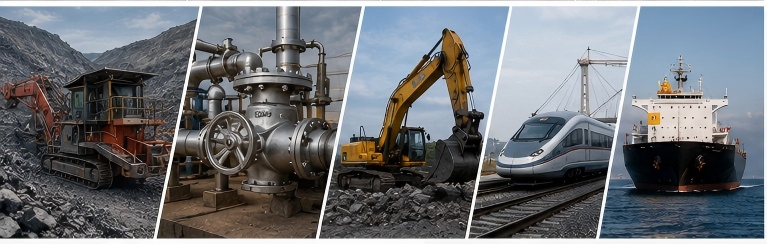
Steel castings appear wherever service conditions demand toughness, weld repairability, or resistance to impact and corrosion that cast iron cannot provide. The industries that drive global demand from Chinese foundries include:
Mining and quarrying is the single largest end market for steel castings by weight. Crusher liners, jaw plates, grinding mill liners, excavator bucket teeth, and chute wear liners are typically manganese steel or chromium-alloy steel — wear parts that must be replaced regularly and are sourced in large recurring volumes.
Oil, gas, and petrochemical applications require pressure-tight castings in alloy and stainless steel: valve bodies and bonnets, pump casings and impellers, manifold blocks, and structural components for offshore platforms. ASTM compliance and third-party inspection are standard requirements in this sector.
Power generation relies on alloy steel castings for turbine housings, valve bodies for steam service, and structural components in both conventional and renewable energy infrastructure. High-temperature Cr-Mo alloy steel grades dominate this segment.
Heavy equipment and construction — crane hooks, counterweights, support brackets, hydraulic cylinder end caps, and earthmoving attachment components — are predominantly carbon or alloy steel sand castings, valued for strength, weldability, and cost-effectiveness.
Marine and offshore environments demand corrosion-resistant stainless steel castings for hardware, fittings, and fluid control components, alongside carbon steel structural castings for mooring and anchoring systems.
Rail and transportation — coupler bodies, brake rigging components, bogie frames, and crossings — are among the most demanding steel casting applications for impact resistance, typically specified in medium-carbon or alloy steel grades with mandatory non-destructive testing.
Quality Standards for Steel Casting Procurement
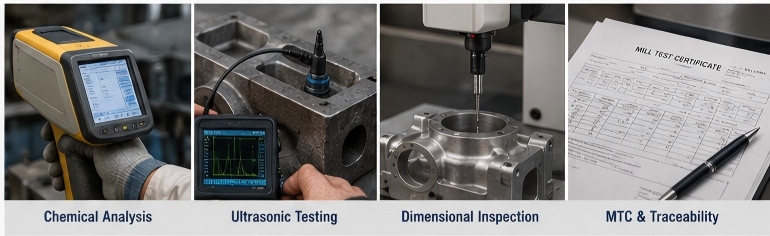
Steel castings serve in pressure-bearing, load-bearing, and safety-critical roles across most of their end markets. Quality verification is not optional — it is the foundation of a viable supplier relationship.
Material standards define the chemical and mechanical requirements of the casting. The most globally recognized are the ASTM family: A216 for carbon steel in high-temperature service, A351 for austenitic stainless steel, A128 for manganese steel, and A148 for high-strength structural grades. Chinese foundries supplying export markets routinely cast to ASTM, EN, DIN, and JIS equivalents — always specify the standard and grade at the inquiry stage.
ISO 9001 certification is the baseline quality management requirement. For oil and gas applications, API Q1 or customer-specific quality plans are often additionally required.
Heat treatment documentation is mandatory for most steel casting grades. Carbon and alloy steels require normalizing, quenching, or tempering to achieve their specified mechanical properties; manganese steel requires solution treatment and water quenching; stainless steels require solution annealing. A supplier unable to provide heat treatment records should not be qualified for structural or pressure service.
Non-destructive testing (NDT) is the standard method for verifying internal soundness without destroying the part. Magnetic particle inspection (MPI) detects surface and near-surface defects in carbon and alloy steels; ultrasonic testing (UT) finds subsurface porosity and shrinkage; radiographic testing (RT/gamma ray) provides the most detailed picture of internal casting quality. Specify which NDT methods are required at the drawing stage.
Third-party pre-shipment inspection (SGS, Bureau Veritas, or equivalent) provides independent verification before the container ships. For new supplier relationships or high-value orders, pre-shipment inspection is a standard risk management step.
Need guidance on which standards and inspection requirements apply to your specific steel casting? Talk to Tiegu — we coordinate specification review, mill test certificates, and third-party inspection on behalf of buyers at no additional sourcing complexity.
Why Global Buyers Source Steel Castings from China

China is the world's largest producer of steel castings, accounting for a dominant share of global output across all grades — carbon, alloy, stainless, and manganese steel. This is not simply a cost story: Chinese foundries have developed genuine process depth across all four major casting methods, integrated post-casting capabilities (heat treatment, CNC machining, NDT, surface treatment), and the export documentation experience to supply buyers in North America, Europe, the Middle East, and Asia-Pacific simultaneously.
The practical advantages that bring global buyers back:
Grade and process breadth. A Chinese foundry network covers carbon steel sand castings for mining wear parts, stainless steel investment castings for valve bodies, and alloy steel shell mold castings for energy components — often within a short supply radius, allowing a trading agent to consolidate a complex bill of materials across foundry partners.
International standard compliance. Established Chinese export foundries cast to ASTM, EN, DIN, and JIS material specifications and produce the chemical and mechanical test documentation that global buyers require. Buyers in Europe and North America have been successfully qualifying Chinese steel casting suppliers to these standards for over two decades.
Integrated post-casting services. Heat treatment, CNC machining, NDT, and protective coating are increasingly available within the same supplier relationship in China, reducing the number of vendor handoffs between raw casting and finished component.
Working through a vetted trading agent rather than approaching foundries directly reduces the qualification burden significantly. A trading agent with an established foundry network has already screened for process capability, certification status, export documentation ability, and quality consistency — and maintains commercial accountability for delivery and conformance across multiple factory partners. For buyers without in-country audit resources, this is the most practical path to reliable Chinese sourcing.
Frequently Asked Questions
What is the difference between a steel casting foundry and a cast iron foundry?A steel casting foundry melts steel alloys (carbon steel, alloy steel, stainless steel, or manganese steel) and casts them into shaped parts. A cast iron foundry works with grey iron or ductile iron — lower-carbon iron alloys with different mechanical properties. Steel castings offer higher tensile strength, toughness, and weldability; cast iron foundries produce parts with better compressive strength, vibration damping, and machinability at lower cost. Many Chinese foundries serve both markets, but the furnace technology, mold design, and heat treatment processes differ between steel and iron casting lines.
What steel grades can Chinese foundries produce?Established Chinese export foundries routinely produce carbon steel (ASTM A216, A352), low and high alloy steel (ASTM A148, A217), austenitic stainless steel (ASTM A351, A743, A744 — grades CF8, CF8M, CA6NM, and others), and manganese steel (ASTM A128). Material compliance is verified by spectrometer chemical analysis and mechanical testing on each production batch, documented in mill test certificates.
What casting process is best for stainless steel parts?Investment casting (lost-wax casting) is the preferred process for most stainless steel castings requiring complex geometry, smooth surface finish, and tight dimensional tolerances — pump impellers, valve bodies, marine hardware, and precision fittings. Sand casting is used for larger, simpler stainless steel components where surface finish requirements are less demanding and part weight makes investment casting impractical.
What is manganese steel casting used for?Manganese steel castings are used where extreme abrasion and repeated impact are the dominant service conditions. The material's unique work-hardening property — its surface becomes progressively harder as it absorbs blows — makes it the standard choice for crusher liners, grinding mill liners, excavator bucket teeth, jaw plates, and railway crossings. Manganese steel is not suitable for applications requiring machining after casting or field welding repair.
How do I verify quality when sourcing steel castings from China?Quality verification for Chinese steel castings should include: a batch-specific mill test certificate (MTC) confirming chemical composition and mechanical properties; heat treatment records matched to the shipment batch; NDT reports (MPI, UT, or RT as specified); and, for new supplier relationships or high-value orders, third-party pre-shipment inspection by SGS or Bureau Veritas. Working with an export trading agent who manages quality verification on your behalf is the most practical approach for buyers without in-country audit resources.
Can Chinese steel casting foundries meet ASTM standards?Yes. Established Chinese export foundries have been supplying ASTM-compliant steel castings to North American, European, and Middle Eastern buyers for over two decades. They produce to ASTM material grades, conduct spectrometer chemical analysis and mechanical testing on each batch, issue mill test certificates in the format required by international buyers, and accept third-party inspection before shipment. The key is supplier qualification: not all Chinese foundries have export-oriented quality systems, which is why verifying certifications and inspection practices before the first order matters.
How much do steel castings cost when sourced from China?Steel casting cost depends on several factors: material grade (carbon steel is the most economical; stainless and high-alloy grades cost significantly more per kilogram), casting weight and complexity, required surface finish and dimensional tolerances, post-casting requirements (heat treatment, machining, NDT), and order volume. Large carbon steel sand castings are generally the most cost-competitive product category from Chinese foundries. Stainless steel investment castings and alloy steel pressure parts carry higher base costs but still offer significant price advantages over equivalent Western production. The best approach is to share your drawing and specification for a factory-matched quote.
How do I find a reliable steel casting supplier in China?Finding a reliable Chinese steel casting supplier involves verifying ISO 9001 or IATF 16949 certification, confirming the foundry has experience with your specific material grade and casting process, requesting batch-specific mill test certificates from previous comparable orders, and insisting on third-party pre-shipment inspection for new relationships. Many global buyers work with an experienced Chinese export trading agent rather than approaching foundries directly — this provides access to a pre-qualified foundry network, professional quality coordination, and commercial accountability without requiring in-country audit resources.
Tiegu sources carbon steel, alloy steel, stainless steel, and manganese steel castings from a vetted network of certified Chinese foundries, managing supplier qualification, material certification, third-party inspection coordination, and export logistics on behalf of buyers worldwide. Because we work across multiple foundry partners, we can cover diverse steel grades, casting processes, and order volumes — including mixed-grade orders that a single foundry could not fulfill.
Send Your Steel Casting Drawing for a Free Supplier Match
Share your part drawing, material grade, quantity, and required standards. Tiegu will identify the right Chinese foundry for your application, coordinate quality verification before production, and handle export documentation from factory to your port.
Submit Your Inquiry → Contact Tiegu
Looking to order custom chassis castings made to your own drawing? See our step-by-step guide to Custom Cast Components for Vehicle Chassis.