
 en
en  fra
fra  de
de  ru
ru  ara
ara  gle
gle  it
it  jp
jp  kor
kor  th
th  zh
zh Why Do Ductile Iron Pipe Joints Allow Angular Deflection?
2026-02-21 07:40:46 hits:0
Managing Uneven Settlement in Real Underground Conditions
Buried pipelines rarely operate in perfectly stable soil conditions.
Even in well-prepared trenches, long-term ground movement is inevitable.
For this reason, ductile iron pipe systems are not designed as rigid structural lines.
Instead, their joints are engineered to accommodate controlled angular movement.
But how much movement is acceptable — and what should engineers do when settlement becomes uneven?
This article examines the structural role of joint deflection and practical response strategies in variable ground conditions.
For an overview of different joint structures and flexibility characteristics, refer to the technical explanation of ductile iron pipe connection systems available in our joint section.
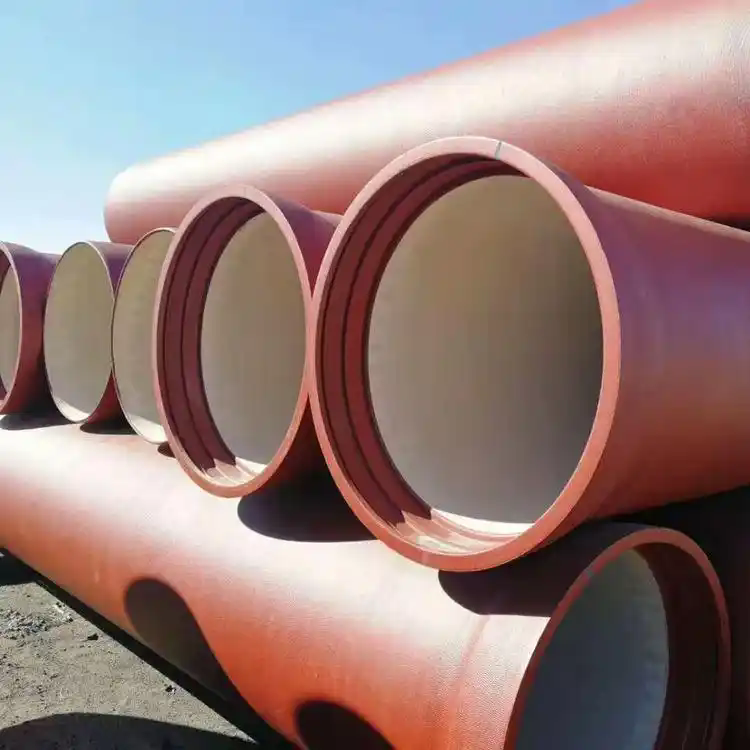
1. Deflection Is a Designed Structural Behavior — Not an Installation Error
In mechanical terms, a buried pipeline behaves more like a segmented chain than a continuous beam.
If every connection were rigid:
Settlement would induce bending stress
Stress concentration would occur at specific points
Cracks or leakage risk would increase
To prevent this, ductile iron push-on joints allow a limited angular rotation between adjacent pipes.
The exact allowable deflection depends on:
Pipe diameter
Joint configuration
Manufacturer design specifications
Smaller diameters typically tolerate slightly greater angular deviation, while larger pipes have tighter limits.
The purpose is not to compensate for poor alignment, but to absorb small structural movements over time.
2. Engineering Meaning of Controlled Angular Movement
Allowable deflection serves three main structural functions:
Stress Redistribution
Minor rotation prevents localized bending stress in the pipe barrel.
Sealing Stability
The gasket maintains circumferential compression even under slight angular displacement.
Movement Accommodation
Small soil shifts, traffic loads, or thermal expansion are absorbed without joint failure.
This flexibility reduces the likelihood that external ground movement will translate directly into structural damage.
In short, angular deflection acts as a built-in safety margin.
3. Performance Under Uneven Foundation Settlement
In complex soil environments, uneven settlement may occur due to:
Soft or layered soil strata
Inconsistent compaction
High groundwater conditions
Surface load variation
When one section of pipe settles more than another, rotational displacement occurs at the joint.
Because ductile iron joints are flexible:
Small rotations can be tolerated
Gasket compression remains active
Sealing integrity is preserved within design limits
However, excessive settlement beyond allowable angular range may reduce long-term sealing reliability.
For a deeper comparison of flexible and restrained joint systems used in settlement-prone areas, see the detailed joint configuration guide in our ductile iron pipe connection overview.
4. What Should Be Done When Uneven Settlement Is Expected?
In areas where settlement risk is higher than normal, engineering measures should focus on prevention and control.
Improve Subgrade Preparation
Level and compact trench bottoms carefully
Avoid point loading beneath joints
Ensure uniform bedding material distribution
Monitor and Limit Angular Deviation
Field crews should:
Check alignment during installation
Confirm that angular displacement remains within specified limits
Avoid forcing pipes into position using excessive leverage
Select Appropriate Joint Types in High-Risk Zones
In areas such as:
Sloped terrain
High-pressure transmission lines
Regions with known ground instability
Restrained or specially designed joint systems may provide additional axial stability.
Choosing the appropriate connection type is as important as installation quality.
5. Practical Field Observations
From construction experience:
Minor settlement is usually absorbed safely by flexible joints
Most leakage issues are linked to poor bedding rather than joint design
Excessive reliance on joint flexibility often indicates insufficient ground preparation
The joint’s ability to deflect is a protective feature — but it is not a substitute for proper foundation engineering.
Technical Summary
Ductile iron pipe joints allow controlled angular deflection to:
Reduce stress concentration
Maintain sealing compression
Adapt to real underground movement
When uneven settlement occurs, proper bedding preparation, deflection control, and appropriate joint selection ensure long-term system stability.
Flexibility is not a weakness — it is a structural strategy for underground durability.