
 en
en  fra
fra  de
de  ru
ru  ara
ara  gle
gle  it
it  jp
jp  kor
kor  th
th  zh
zh How Does a Ductile Iron Pipe Joint Achieve Sealing?
2026-02-19 07:20:49 hits:0
Ductile iron pipes are widely used in municipal water supply, drainage, and pressurized pipeline systems.
One of their most important technical advantages lies in the reliability of their joint sealing mechanism.
But how exactly does a ductile iron pipe joint prevent leakage under pressure?
This article explains:
The mechanical relationship between socket, spigot, and rubber gasket
Why higher internal pressure can improve sealing performance
Why flexible joints are considered safer in real engineering conditions
For a detailed overview of different ductile iron pipe joint types and connection systems, you can refer to our dedicated joint and connection section.
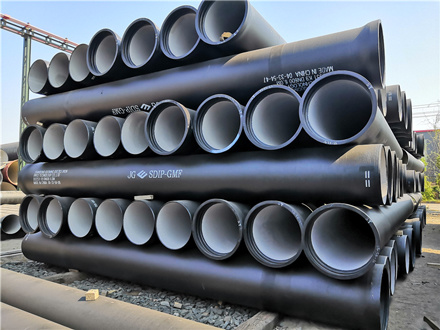
1. Structural Relationship: Socket, Spigot and Rubber Gasket
A typical push-on ductile iron pipe joint consists of three essential components:
Socket (bell end) – designed with a gasket groove
Spigot (plain end) – inserted into the socket
Rubber gasket – positioned inside the groove to create compression
During assembly:
The gasket is seated in the socket groove.
Lubricant is applied evenly.
The spigot is pushed into the socket.
The gasket becomes radially compressed between the two metal surfaces.
Core Sealing Principle
The joint achieves sealing through elastic radial compression of the rubber gasket.
This compression creates:
Continuous circumferential contact
Uniform sealing pressure
Compensation for minor dimensional tolerances
Unlike rigid metal-to-metal sealing, this system relies on stored elastic energy within the compressed gasket.
2. Why Higher Internal Pressure Can Enhance Sealing
Within the design pressure range, ductile iron push-on joints demonstrate a self-enhancing sealing behavior.
When internal water pressure increases:
The pressure pushes the spigot outward slightly
The gasket is pressed more firmly against the sealing surfaces
Contact stress increases proportionally
This phenomenon is often described as a self-energizing sealing effect.
In simplified engineering logic:
Higher internal pressure → Increased gasket contact force → Improved sealing tightness
As long as installation is correct and deflection limits are respected, internal pressure supports rather than weakens sealing performance.
3. Why Flexible Joints Provide Greater Safety
Ductile iron pipe joints are designed as flexible connections rather than rigid mechanical couplings.
This flexibility allows:
Controlled angular deflection
Minor axial displacement
Adaptation to soil settlement
In real engineering environments:
Ground conditions are rarely perfectly stable
Thermal expansion and contraction occur
Minor alignment deviations are common
If joints were rigid, these movements could generate stress concentration, potentially leading to cracking or leakage.
Flexible joints absorb small movements while maintaining gasket compression, significantly improving long-term operational safety.
For comparison between different joint structures, including flexible and restrained designs, refer to the ductile iron pipe joint configuration overview.
4. Installation Still Determines Final Performance
Although the joint design supports pressure-assisted sealing, performance depends on proper installation:
Correct gasket seating
Clean sealing surfaces
Verified insertion depth
Controlled joint deflection
The sealing mechanism functions optimally when mechanical alignment and compression conditions are accurately achieved during construction.
Technical Summary
A ductile iron pipe joint achieves sealing through:
Elastic compression of a rubber gasket
Internal pressure-assisted sealing behavior
Flexible structural design that accommodates movement
This combination of elasticity, pressure response, and adaptability explains why ductile iron pipe joints are widely used in modern water infrastructure systems.
If you want to explore detailed specifications of various joint structures and connection methods, consult the comprehensive ductile iron pipe joint and connection section available on our website.