
 en
en  fra
fra  de
de  ru
ru  ara
ara  gle
gle  it
it  jp
jp  kor
kor  th
th  zh
zh Manhole Cover Load Class Selection: How to Choose Correct Class for Different Applications? Complete Guide
2026-06-24 17:29:04 hits:0
⚡ Quick Answer: To select the correct manhole cover load class, match the expected traffic load to the EN124 classification: A15 (1.5t) for pedestrian zones, B125 (12.5t) for car parks, C250 (25t) for road edges, D400 (40t) for urban roadways, E600 (60t) for heavy docks, and F900 (90t) for airports. Use ductile iron (GGG50) for D400-F900. Verify local municipal standards and calculate wheel load before ordering. Incorrect selection causes premature failure or cost waste.
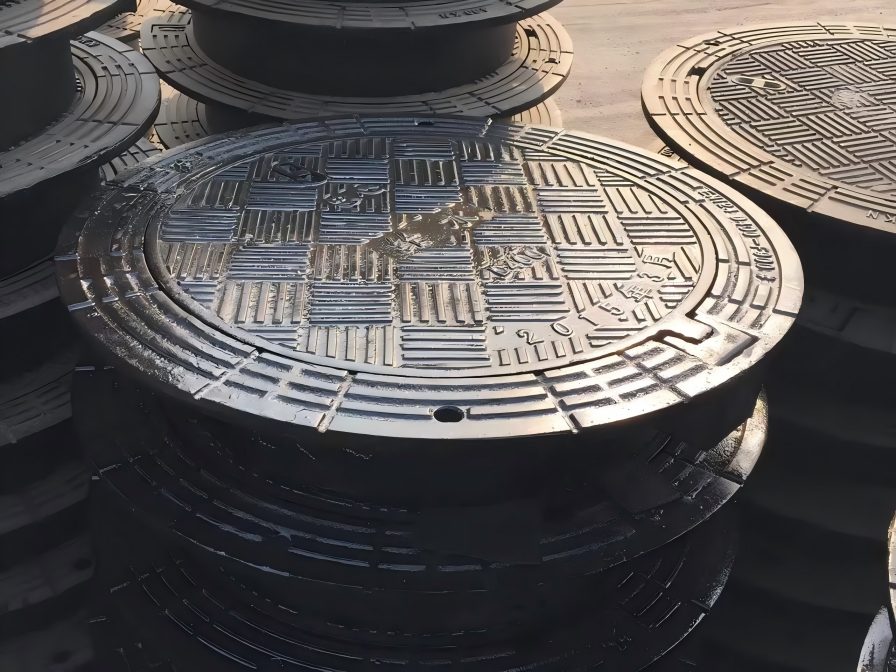
Manhole Cover Load Class Selection: Why Does It Matter?
Selecting the correct manhole cover load class is critical for safety, compliance, and cost efficiency. Under-specifying leads to cracking, deformation, and safety hazards. Over-specifying increases procurement costs by 20-50% unnecessarily.
Common consequences of wrong manhole cover load class selection:
Premature cracking — Using B125 on roadways causes cover failure within 6-12 months under truck traffic.
Frame deformation — Repeated overloading bends the frame, causing covers to become loose, noisy, or stuck.
Cost waste — Specifying F900 on sidewalks increases cost by 30-50% with no benefit.
Compliance failure — Municipal inspections reject covers that don't meet local standards, causing project delays.
Always match the manhole cover load class to actual traffic conditions and local regulations. Consult a structural engineer for heavy-duty or specialized applications.
How to Select Correct Manhole Cover Load Class for Pedestrian Areas?
For pedestrian zones, parks, and gardens, select A15 manhole covers:
Load rating — 1.5 tons (15 kN test load)
Application — Sidewalks, parks, gardens, pedestrian plazas
Material — Ductile iron, gray iron, or composite
Thickness — 30-50mm
Key consideration — No vehicle traffic allowed. If occasional light vehicle access is needed, upgrade to B125.
Common mistake: Specifying A15 for areas that may receive maintenance vehicle access. Always verify with the project engineer whether light vehicle traffic is possible.
How to Select Correct Manhole Cover Load Class for Car Parks?
For car parks and light vehicle areas, select B125 manhole covers:
Load rating — 12.5 tons (125 kN test load)
Application — Car parks, pedestrian zones with occasional light vehicle traffic
Material — Ductile iron (GGG50)
Thickness — 50-70mm
Key consideration — Not suitable for roadways or truck traffic. If delivery trucks or fire engines may access, upgrade to C250 or D400.
Common mistake: Using B125 for residential streets where delivery trucks and garbage trucks operate. Upgrade to C250 or D400 for any area with truck access.
How to Select Correct Manhole Cover Load Class for Urban Roads?
For urban roadways and highways, select D400 manhole covers:
Load rating — 40 tons (400 kN test load)
Application — Urban roads, highways, industrial areas, truck traffic
Material — Ductile iron (GGG50 / EN-GJS-500-7)
Thickness — 90-120mm
Key consideration — The most common class for municipal projects. Verify local standards; some municipalities mandate D400 for all roadways.
Common mistake: Specifying C250 for urban roads to save cost. C250 (25t) is only suitable for road edges where cars drive over occasionally. For main roadways with truck traffic, D400 is mandatory.
→ Read more: What Are EN124 Manhole Cover Load Classes? Complete Guide
How to Select Correct Manhole Cover Load Class for Heavy Industrial Areas?
For ports, docks, and heavy industrial yards, select E600 or F900 manhole covers:
E600 load rating — 60 tons (600 kN test load)
E600 application — Heavy vehicle docks, container terminals, industrial yards
F900 load rating — 90 tons (900 kN test load)
F900 application — Airports, military zones, heavy industrial areas
Material — Ductile iron (GGG50) or steel-reinforced
Thickness — 120-150mm (E600), 150mm+ (F900)
For heavy industrial projects, calculate the maximum wheel load of the heaviest vehicle (e.g., container loader, aircraft). Add a 20% safety margin and select the corresponding load class.
How to Avoid Common Manhole Cover Load Class Selection Mistakes?
Avoid these common manhole cover load class selection mistakes:
| Mistake | Consequence | Correct Approach |
|---|---|---|
| Using B125 on roads | Premature cracking, safety hazard | Specify D400 for all roadways |
| Using D400 on sidewalks | 30-50% cost increase | Match load class to actual traffic |
| Ignoring local standards | Project rejection, rework | Verify municipal regulations before ordering |
| Not calculating wheel load | Under-specification for heavy vehicles | Calculate max wheel load + 20% safety margin |
| Using gray iron for D400 | Fragile, cracks under impact | Specify ductile iron (GGG50) for D400-F900 |
Always request EN 124 type test reports from the manufacturer. Verify the cover is marked with the correct load class stamp.
How to Select Correct Manhole Cover Load Class: Step-by-Step Guide?
Follow these steps for manhole cover load class selection:
Identify application area — Pedestrian zone, car park, residential street, urban road, highway, port, or airport.
Determine expected traffic — Pedestrians, cars, light trucks, heavy trucks, or aircraft.
Check local regulations — Municipal standards may mandate specific load classes.
Calculate wheel load — Use EN 124 methodology. Add 20% safety margin.
Select material — Ductile iron (GGG50) for D400-F900. Composite/gray iron for A15-C250 (if permitted).
Verify certification — Request EN 124 type test report and CE marking.
For municipal road projects, D400 is the standard choice. For heavy industrial projects, specify E600 or F900 based on calculated wheel load.
Final Recommendation: How to Select Correct Manhole Cover Load Class?
To select the correct manhole cover load class:
✅ Match traffic — A15 (pedestrian), B125 (car park), C250 (road edge), D400 (roadway), E600 (heavy dock), F900 (airport)
✅ Standard choice — D400 for urban roads and highways (40 tons)
✅ Material — Ductile iron (GGG50) for D400-F900
✅ Verify standards — Check local municipal regulations
✅ Certification — Request EN 124 type test report
✅ Safety margin — Add 20% to calculated wheel load
Never under-specify load class to save cost. The 10-20% cost premium for the correct class is negligible compared to replacement costs and safety risks.
Summary: How to Select Correct Manhole Cover Load Class?
✅ A15 — 1.5t, pedestrian zones
✅ B125 — 12.5t, car parks
✅ C250 — 25t, road edges
✅ D400 — 40t, roadways (most common)
✅ E600 — 60t, heavy docks
✅ F900 — 90t, airports
✅ Material — Ductile iron (GGG50) for D400-F900
✅ Verification — EN 124 type test report, CE marking
Frequently Asked Questions (FAQ)
Can B125 manhole covers be used on residential streets?
No. B125 manhole covers are rated for 12.5 tons and are only suitable for car parks. Residential streets require C250 (25t) or D400 (40t) to withstand delivery trucks and garbage trucks.
What is the difference between C250 and D400 manhole covers?
C250 is rated for 25 tons and is suitable for road edges where cars drive over occasionally. D400 is rated for 40 tons and is required for main roadways with truck traffic. D400 covers are thicker (90-120mm vs 70-90mm) and use more ductile iron.
How to verify manhole cover load class?
Verify manhole cover load class by:
✅ Requesting EN 124 type test report from an accredited laboratory
✅ Checking load class stamp on the cover (e.g., "D400")
✅ Verifying material certificate (ductile iron GGG50)
✅ Conducting third-party inspection before shipment
Why do manhole covers crack prematurely?
Premature cracking is usually caused by:
✅ Under-specifying load class — Using B125 or C250 on roadways
✅ Poor material quality — Using gray iron instead of ductile iron
✅ Installation errors — Uneven bedding, insufficient concrete support
✅ Overloading — Traffic exceeding specified load class
Why Choose Tiegu for Manhole Covers?
Tiegu operates a modern foundry with complete manhole cover manufacturing capabilities:
Ductile iron (GGG50) — EN 1563 compliant, spectrometric analysis on every batch
Sand casting + precision machining — 400x400 to 1000x1000mm sizes
EN 124 certified — A15 to F900 load classes, type tested
Anti-theft design — Hinge or bolted options available
Anti-noise design — Rubber gasket or machined contact surface
Full inspection — Load testing, dimensional check, coating thickness
ISO 9001 certified — Documented quality management system
For municipal projects and infrastructure developers:
✅ 30-50% cost savings — Same EN 124 quality as European foundries, fraction of price
✅ Full documentation — Type test reports, material certificates, CE marking
✅ Size range — 400x400mm to 1000x1000mm, custom sizes available
✅ Custom designs — OEM/ODM with logo, pattern, and surface text
✅ Direct foundry pricing — No middleman markup
📋 Get Free Manhole Cover Quotation
Share your manhole cover specifications (size, load class, material, quantity). We'll provide competitive quotes within 48 hours with full specifications and EN 124 certification documents.
📞 Contact Us for Manhole Cover Inquiry
WhatsApp/WeChat: +86 152 5613 5588
Email: zbw@tiegu.net
Website: www.tieguexport.com
Response time: Within 12 hours (working hours)