
 en
en  fra
fra  de
de  ru
ru  ara
ara  gle
gle  it
it  jp
jp  kor
kor  th
th  zh
zh Why Do Casting Suppliers Quote Different Prices for the Same Drawing: Complete Cost Analysis Guide
2026-03-30 11:10:13 hits:0
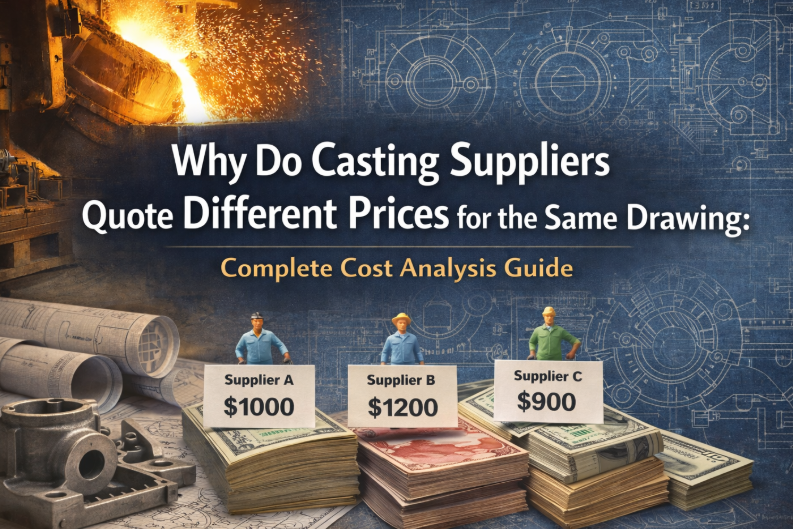
Quick Answer: Casting suppliers quote different prices for the same drawing due to variations in material sourcing costs (50-70% of total cost), production efficiency, quality standards, overhead structures, and profit margin expectations. Price variations of 20-40% between suppliers are common for identical specifications. Additional factors include geographic labor rates, equipment automation level, order volume assumptions, and whether secondary operations are included.
Table of Contents
Overview: Why Price Variation Is Normal
Key Factors Causing Quotation Differences
Material Cost Variations
Production Efficiency Differences
Quality Standard Assumptions
Overhead Structure Variations
Profit Margin Expectations
Hidden Factors Affecting Quotations
How to Compare Quotations Properly
Red Flags in Casting Quotations
How Tiegu Supports Quotation Analysis
Summary: Key Takeaways
Overview: Why Price Variation Is Normal
Price variation in casting quotations is expected and reflects genuine differences in cost structures, not just profit margin adjustments. Understanding these differences enables buyers to identify which quotations represent genuine value versus hidden risks.
Typical price variation range for identical casting specifications:
| Variation Level | Price Range | Typical Cause |
|---|---|---|
| Moderate variation | 15-30% | Different material sources, efficiency levels |
| High variation | 30-50%+ | Quality differences, scope misunderstandings, or unrealistic pricing |
Variations above 50% typically indicate fundamental differences in scope understanding, quality assumptions, or potentially problematic pricing strategies.
Key Factors Causing Quotation Differences
Material Cost Variations
Raw material costs represent 50-70% of total casting cost, making this the largest source of price variation.
Material sourcing differences:
| Factor | Impact on Price | Explanation |
|---|---|---|
| Scrap steel quality | 3-8% variation | Prime scrap vs. mixed scrap affects melt yield and quality |
| Alloy sourcing | 5-12% variation | Branded alloys (Elkem, Sorelmetal) vs. generic alternatives |
| Purchase volume | 3-10% variation | Large foundries get better material pricing from suppliers |
| Material yield calculation | 2-5% variation | Different assumptions on machining allowance and shrinkage |
Material specification interpretation:
Same material standard can have different cost implications:
EN-GJS-450-10 can be achieved with different charge mixes
Some foundries use more expensive low-phosphorus pig iron for better consistency
Others use cheaper charge with more extensive treatment and testing
Alloy addition strategies vary (conservative vs. minimal addition)
A foundry using premium raw materials may quote 10-15% higher but achieve better consistency and lower rejection rates.
Production Efficiency Differences
Labor and overhead costs vary significantly based on automation level and operational efficiency.
Automation level impact:
| Production Type | Labor Cost % | Typical Price Position |
|---|---|---|
| Semi-automatic line | 12-18% | Mid-range pricing |
| Manual molding (jobbing foundry) | 18-25% | Higher price, flexible for low volumes |
Efficiency metrics that affect pricing:
Melt yield — kg of good castings per kg of metal melted (typically 60-75%)
First-pass yield — percentage of castings passing inspection without rework (85-95% typical)
Pattern life — affects pattern amortization cost per piece
Cycle time — faster cycles reduce unit cost for high-volume production
A foundry with 70% melt yield vs. 60% melt yield has 10% material cost advantage on the same casting weight.
Quality Standard Assumptions
Different quality levels require different process controls and testing, directly affecting cost.
Quality level variations:
| Quality Level | Testing Included | Price Impact |
|---|---|---|
| Standard industrial | Visual + dimensional + hardness | +5-10% |
| Critical application | Full NDT + chemical + mechanical | +15-25% |
| Automotive/aerospace | PPAP + full traceability + enhanced testing | +25-40% |
Common quality assumption differences:
Some suppliers quote for visual inspection only
Others include dimensional inspection with CMM
Chemical analysis frequency varies (per heat vs. per day vs. per week)
NDT requirements may be excluded or priced as optional
The same drawing quoted with different quality assumptions can vary by 20-30%.
Overhead Structure Variations
Foundry overhead costs differ based on location, facility age, and business model.
Geographic labor rate differences:
| Region | Hourly Labor Rate | Overhead Impact |
|---|---|---|
| Northern China (Hebei, Shandong) | $3-5/hour | Lower |
| Central/Western China | $2-4/hour | Lowest |
| Southern China (Guangdong) | $5-7/hour | Higher |
Facility and equipment factors:
Newer facilities have higher depreciation but better efficiency
Older facilities have lower depreciation but higher maintenance costs
Environmental compliance costs vary (some foundries have invested more in pollution control)
Energy costs differ by region and contract arrangements
Profit Margin Expectations
Different suppliers target different profit margins based on their business strategy.
Typical margin structures:
| Supplier Type | Target Margin | Pricing Strategy |
|---|---|---|
| Medium-volume industrial foundry | 10-15% | Balanced pricing, relationship-focused |
| Low-volume specialty foundry | 15-25% | Premium pricing, flexibility-focused |
| Trading company | 8-15% markup | Adds margin on top of foundry price |
Strategic pricing considerations:
Some foundries quote lower margins to enter new markets
Established suppliers may quote higher margins reflecting proven track record
Suppliers with idle capacity may quote aggressively to fill production slots
Suppliers at full capacity may quote higher to discourage marginal orders
Hidden Factors Affecting Quotations
Order Volume Assumptions
Suppliers may assume different order quantities when quoting, significantly affecting unit price.
Volume-based pricing tiers:
| Annual Volume | Price Position | Reason |
|---|---|---|
| 100-500 pieces | +20-40% | Moderate setup frequency |
| 500-2000 pieces | Baseline | Standard production runs |
| 2000-10000 pieces | -10-20% | Extended runs, better material pricing |
| > 10000 pieces | -20-30% | Dedicated production, optimized processes |
Important: Always specify expected annual volume when requesting quotations. A quote based on 100 pieces vs. 1000 pieces can differ by 30-40%.
Scope Inclusions and Exclusions
Quotations may include or exclude various cost elements, creating apparent price differences.
Common scope variations:
| Cost Element | Sometimes Included | Sometimes Excluded |
|---|---|---|
| Heat treatment | Included for standard specs | Extra charge |
| Machining | Included for turnkey suppliers | Excluded, subcontracted |
| Surface treatment/painting | Included | Extra charge |
| Packaging | Standard export packaging | Custom packaging extra |
| Inspection | Basic inspection included | Third-party inspection extra |
| Documentation | Standard MTR included | Enhanced documentation extra |
| Freight | FOB price (most common) | EXW or CIF depending on supplier |
Best practice: Request detailed breakdown showing what is included and what is excluded.
Payment Terms Impact
Different payment terms affect supplier risk and financing costs, reflected in pricing.
Payment term impact on price:
| Payment Terms | Price Impact | Reason |
|---|---|---|
| 50% advance, 50% before shipment | Baseline | Standard terms |
| 30% advance, 70% against documents | +2-3% | Extended credit period |
| Letter of credit | +1-2% | Bank charges, documentation complexity |
| Open account (net 30-60 days) | +5-10% | Financing cost, credit risk |
Suppliers may quote different prices based on their standard payment terms or your requested terms.
How to Compare Quotations Properly
Create Standardized Comparison Matrix
Enable apples-to-apples comparison by structuring quotations consistently.
Quotation comparison template:
| Factor | Supplier A | Supplier B | Supplier C |
|---|---|---|---|
| Material specification | EN-GJS-450-10 | EN-GJS-450-10 | EN-GJS-450-10 |
| Quality level | Visual + dimensional | Full inspection | Visual only |
| Testing included | Chemical per heat | Chemical per day | On request |
| Pattern cost | Amortized in price | $X,XXX separate | Amortized |
| Lead time | X weeks | Y weeks | Z weeks |
| Payment terms | 50/50 | 30/70 | 50/50 |
| Validity period | 30 days | 60 days | 15 days |
Request Detailed Cost Breakdown
Understanding cost structure enables better comparison and negotiation.
Recommended breakdown categories:
Material cost: $X.XX (based on XX kg finished weight, XX% yield)
Labor cost: $X.XX (XX hours × $X/hour rate)
Overhead: $X.XX (facility, utilities, management allocation)
Heat treatment: $X.XX (if applicable)
Surface treatment: $X.XX (if applicable)
Pattern amortization: $X.XX (pattern cost ÷ expected quantity)
Testing/QC: $X.XX (inspection and testing costs)
Packaging: $X.XX (export packaging)
Profit margin: $X.XX
Total unit price: $X.XX
Suppliers willing to provide breakdown typically have more confidence in their pricing.
Clarify Assumptions Before Comparing
Eliminate scope misunderstandings that cause apparent price differences.
Key clarification questions:
"What material yield assumption was used for this quotation?"
"What quality inspection level is included in this price?"
"Are heat treatment and surface treatment included?"
"What order quantity is this price based on?"
"What is included in packaging?"
"Are pattern costs included or separate?"
"What is the validity period of this quotation?"
"What payment terms is this price based on?"
Getting consistent answers enables meaningful comparison.
Red Flags in Casting Quotations
Prices Significantly Below Market
Warning signs:
| Red Flag | Potential Issue | Verification Action |
|---|---|---|
| Cannot explain pricing basis | May not understand requirements | Ask for cost breakdown |
| Unwilling to specify quality level | May quote commercial grade for industrial application | Require written quality specification |
| No material traceability included | May use uncertified materials | Require MTR with quotation |
| Extremely short lead time | May not have realistic production schedule | Verify capacity with production records |
Rule of thumb: If a price seems too good to be true, it usually is. Investigate before proceeding.
Vague or Incomplete Quotations
Missing elements that should be clarified:
Material specification not explicitly stated
Quality inspection scope not defined
Testing frequency not specified
Packaging details not described
Validity period not mentioned
Payment terms not stated
Delivery terms (Incoterms) not specified
Professional suppliers provide complete quotations with clear scope definition.
How Tiegu Supports Quotation Analysis
Because we supply raw materials to 3000+ foundries and track material costs at the source, this allows us to provide transparent cost breakdowns and identify pricing anomalies that may indicate scope misunderstandings or unrealistic assumptions. This means that buyers can avoid suppliers who quote unrealistically low prices to win orders, then cut corners on quality or request change orders for excluded items.
For quotation analysis specifically, this translates to several concrete benefits:
Cost benchmarking: We can validate whether quoted material costs align with current market prices for pig iron, scrap steel, and alloys. This reduces the risk of accepting quotations based on unrealistic cost assumptions that cannot be sustained through production.
Scope clarification: We help identify what is and isn't included in each quotation, enabling apples-to-apples comparison. Export documentation including material test reports and inspection certificates complies with destination country requirements including customs valuation and country-of-origin certification.
Submit your casting drawings and received quotations to receive an independent cost analysis and identify potential risks in supplier pricing.
Summary: Key Takeaways
20-40% price variation is normal — Reflects genuine differences in material costs, efficiency, quality levels, and overhead structures
Material costs drive most variation — Raw material sourcing and yield assumptions account for 50-70% of total cost differences
Quality assumptions vary significantly — Visual-only inspection vs. full NDT can create 20-30% price differences
Always compare scope, not just price — Clarify what is included/excluded before making decisions
Request detailed breakdowns — Suppliers confident in their pricing will provide cost structure transparency
Beware of extremely low quotes — Prices 30%+ below market often indicate excluded scope or unrealistic assumptions
Further reading topics:
How to compare casting quotations from different suppliers
What hidden costs exist in casting procurement
How to estimate the cost of custom castings