
 en
en  fra
fra  de
de  ru
ru  ara
ara  gle
gle  it
it  jp
jp  kor
kor  th
th  zh
zh What Are the Risks of Sourcing Castings from China: Complete Guide for International Buyers
2026-03-30 11:11:14 hits:0
Risks of sourcing castings from China include quality inconsistency, supplier reliability issues, intellectual property concerns, logistics delays, communication barriers, and compliance challenges. These risks can be effectively mitigated through systematic supplier verification, clear technical specifications, third-party inspection, protective contract terms, and diversified supply chain strategy. Many international buyers successfully source from China by implementing proper risk management processes.
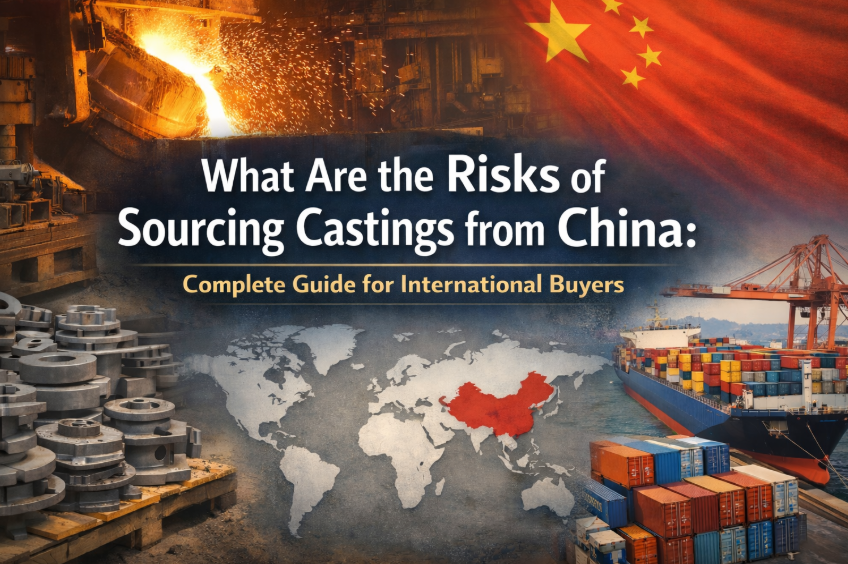
Overview of China Casting Sourcing Risks
China is the world's largest casting producer, accounting for approximately 50% of global casting output. The market offers significant cost advantages, complete supply chains, and increasing technical capability. However, international buyers face distinct risks that require active management.
Common risk categories include supplier selection risks, quality control risks, intellectual property risks, logistics and shipping risks, payment and financial risks, and regulatory compliance risks. Understanding these risks enables buyers to implement appropriate mitigation strategies.
Risk severity varies significantly based on supplier qualification, product complexity, order volume, and buyer's risk management capability. Well-qualified buyers with systematic processes achieve successful outcomes comparable to domestic sourcing.
Supplier and Quality Risks
Supplier Qualification Risk
Risk of selecting unqualified or unreliable suppliers:
| Risk Factor | Probability | Impact | Mitigation |
|---|---|---|---|
| Exaggerated capability claims | High | Medium | Reference checks, sample evaluation |
| Financial instability | Medium | High | Credit checks, payment term protection |
| Management changes | Low | High | Contract continuity clauses |
Supplier qualification risk is more suitable for mitigation through systematic verification than price-based selection. Lowest-price suppliers carry highest qualification risk.
Verification requirements:
Business license and legal existence verification
Quality management certification (ISO 9001, IATF 16949)
Production capability assessment through audit
Customer reference checks
Sample quality evaluation
Raw material variation (different pig iron or scrap sources)
Process parameter drift (melting temperature, cooling time)
Personnel changes (operators, quality inspectors)
Equipment degradation without maintenance
Subcontracting to unqualified facilities
Assembly problems due to dimensional variation
Performance issues from material property variation
Increased incoming inspection costs
Customer complaints and warranty claims
Production line disruptions
No formal incoming material inspection
Missing in-process inspection at critical operations
Inadequate final inspection before shipment
No calibration program for testing equipment
Missing non-conformance tracking and corrective actions
No continuous improvement program
Review quality manual and procedures
Examine actual quality records
Observe inspection operations during audit
Verify equipment calibration status
Check corrective action effectiveness
Supplier sharing drawings with other customers
Supplier selling same products to your competitors
Supplier using your designs for other projects
Drawings leaked through supply chain
Tooling used for unauthorized production
Non-disclosure agreements (NDA) before sharing drawings
Clear IP ownership clauses in contracts
Watermark drawings with customer-specific identifiers
Limit drawing distribution to need-to-know basis
Regular monitoring for unauthorized products
Supplier claiming tooling ownership after buyer payment
Tooling used for unauthorized production runs
Tooling not maintained properly, affecting quality
Tooling held hostage during disputes
Tooling location unknown when changing suppliers
Clear tooling ownership clause in contract
Tooling identification marks showing ownership
Regular tooling inspection and maintenance records
Tooling insurance for high-value molds
Photos and documentation before leaving supplier
Register trademarks in China (first-to-file system)
Record trademarks with Chinese Customs
Include brand protection clauses in supplier contracts
Monitor market for counterfeit products
Take enforcement action against violations
Weekly production status updates from supplier
Milestone-based progress tracking
Third-party inspection during production
Shipping schedule visibility through forwarder
Early warning triggers for potential delays
Rust from inadequate corrosion protection
Physical damage from insufficient padding
Container damage from improper loading
Water damage from container leaks
Loss from inadequate securing
Rust preventive coating for ferrous castings
Wooden crates or pallets for heavy items
Protective padding for machined surfaces
Desiccant packets for moisture control
Clear handling and lifting instructions
Commercial invoice with accurate valuation
Packing list with item details and weights
Bill of lading from shipping line
Certificate of origin from trade authority
Material test reports if required
Inspection certificates if required
Inconsistent product descriptions across documents
Incorrect HS codes causing duty issues
Value discrepancies triggering customs review
Missing or incorrect certificates
Name and address inconsistencies
Link payments to verifiable milestones
Retain portion until after acceptance
Use escrow services for new suppliers
Verify bank account matches company name
Avoid payments to personal accounts
USD/CNY exchange rate volatility
Timing difference between quote and payment
Long production cycles increasing exposure
No hedging by small suppliers
Price in buyer's currency (USD, EUR)
Include currency adjustment clauses for long lead times
Use forward contracts for large exposures
Build currency buffer into budget planning
Tooling modifications not included in quote
Additional testing requested by customer
Expedited shipping due to delays
Rework or sorting for quality issues
Customs duties and taxes miscalculated
Bank charges and currency conversion fees
Detailed quotations with explicit inclusions/exclusions
Change order process for modifications
Clear responsibility matrix for each cost type
Contingency budget for unexpected costs
Specify applicable standards in purchase order
Request compliance certificates before production
Verify certificates with issuing bodies
Include compliance warranty in contract
Test samples at accredited laboratories
Factory shutdown for environmental violations
Production restrictions during pollution alerts
Increased costs from environmental upgrades
Reputational risk from association with violators
Verify environmental permits during audit
Check for environmental violations in public records
Include environmental compliance in supplier code of conduct
Monitor news for supplier environmental issues
Tariff increases on Chinese products
Export control restrictions
Sanctions on specific companies or regions
Customs valuation rule changes
Monitor trade policy developments
Diversify supply chain geographically
Include tariff adjustment clauses in contracts
Maintain relationships with suppliers in other regions
Technical specifications misinterpreted
Drawing requirements misunderstood
Quality standards interpreted differently
Email communication ambiguities
Time zone delays in problem resolution
Use clear, simple English in specifications
Include drawings and photos with written descriptions
Confirm understanding through written summaries
Employ bilingual technical liaison if needed
Use video calls for complex discussions
Relationship emphasis vs. contract emphasis
Indirect communication style
Face-saving affecting problem disclosure
Different urgency perceptions
Hierarchy affecting decision speed
Build personal relationships with key contacts
Understand indirect communication signals
Create safe environment for problem disclosure
Set clear expectations with deadlines
Identify actual decision makers
Incoming inspection at buyer facility
Third-party inspection at supplier facility
In-process inspection during production
Pre-shipment inspection before loading
Laboratory testing for material verification
Clear specifications and acceptance criteria
Inspection rights and rejection procedures
Delivery dates with delay penalties
Warranty terms and claim procedures
IP protection and confidentiality
Dispute resolution and governing law
Qualify 2-3 suppliers for critical components
Split orders between qualified suppliers
Maintain relationships even during low periods
Consider suppliers in different regions
Develop backup suppliers for contingency
How to evaluate a casting factory before placing an order
How to avoid unreliable casting suppliers
Third-party inspection for casting exports
Quality Inconsistency Risk
Variation in quality between batches or over time:
Common causes:
Impact on buyers:
Quality inconsistency risk is more suitable for mitigation through ongoing monitoring than one-time qualification. Continuous performance tracking detects emerging issues before failures occur.
Quality Control System Gaps
Inadequate quality management systems:
Common gaps in Chinese foundries:
Verification methods:
Factories with systematic quality control systems produce more consistent quality than factories relying on final inspection alone.
Intellectual Property Risks
Design and Drawing Protection
Risk of unauthorized use or distribution of proprietary designs:
Potential IP violations:
Protection strategies:
NDA enforcement in China requires proper execution under Chinese law. NDAs should be in Chinese and English, specify Chinese jurisdiction, and include liquidated damages for violations.
Tooling Ownership and Control
Risks related to mold and pattern ownership:
Common issues:
Protection measures:
Tooling ownership risk is more suitable for prevention through contract terms than recovery after disputes arise. Clear documentation prevents ownership ambiguity.
Trademark and Brand Protection
Risk of counterfeit or unauthorized branded products:
Protection requirements:
China operates on first-to-file trademark system. Brands not registered in China may find their trademarks already registered by others, preventing legal enforcement.
Logistics and Shipping Risks
Delivery Delay Risks
Production and shipping delays affecting supply continuity:
Common delay causes:
| Cause | Probability | Typical Impact | Mitigation |
|---|---|---|---|
| Port congestion | Medium | 1-2 weeks | Alternative ports, flexible scheduling |
| Customs clearance | Low-Medium | 3-7 days | Complete documentation, experienced forwarder |
| Weather events | Low | 1-2 weeks | Seasonal planning, safety stock |
| Political disruptions | Low | Variable | Supply chain diversification |
Delivery delay risk is more suitable for mitigation through proactive monitoring than reactive response. Early warning enables contingency activation before critical shortages.
Monitoring methods:
Packaging and Damage Risks
Product damage during ocean freight:
Common damage types:
Packaging requirements for castings:
Packaging specifications should be included in purchase orders with photos of approved packaging methods.
Documentation Errors
Shipping documentation problems causing customs delays:
Required documents:
Common errors:
Documentation accuracy is more suitable for prevention through checklist than correction after customs holds. Review all documents before shipment departs.
Payment and Financial Risks
Payment Security Risks
Financial loss from supplier default or fraud:
Payment method risk ranking:
| Method | Risk Level | Recommended Use |
|---|---|---|
| 70/30 advance T/T | High | Maximum 50% advance |
| 50/50 T/T | Medium | Acceptable for new suppliers |
| 30/70 T/T against documents | Low | Preferred structure |
| Letter of Credit | Low | For large orders ($100K+) |
| Trade assurance | Low | For orders under $50K |
Payment security risk is more suitable for mitigation through structured payment terms than trust-based arrangements. Payment leverage decreases after funds are transferred.
Protective measures:
Currency Exchange Risk
Financial impact of currency fluctuations:
Risk factors:
Mitigation approaches:
Currency risk is more suitable for allocation through contract terms than absorption by one party. Clear agreement prevents disputes during significant fluctuations.
Hidden Cost Risks
Unexpected costs emerging during order execution:
Common hidden costs:
Prevention methods:
Hidden cost risk is more suitable for prevention through detailed quotations than negotiation after costs are incurred.
Regulatory and Compliance Risks
Product Compliance Risks
Castings failing to meet destination market requirements:
Common compliance requirements:
| Market | Requirements | Casting Types Affected |
|---|---|---|
| USA | ASTM standards, NSF, UL | Water contact, electrical, pressure |
| UK | UKCA marking, PED | Pressure equipment |
| Australia | AS/NZS standards | Pressure equipment, water |
Compliance verification:
Product compliance risk is more suitable for prevention through specification than correction after shipment. Non-compliant products may be rejected at customs or recalled from market.
Environmental Compliance Risks
Supplier environmental violations affecting supply:
Potential impacts:
Due diligence:
Environmental compliance risk is increasingly significant as China tightens environmental enforcement. Factories without proper permits face shutdown risk.
Trade Regulation Risks
Changes in trade policies affecting sourcing:
Potential changes:
Mitigation:
Trade regulation risk is more suitable for diversification than prediction. Geographic supply chain diversity provides flexibility during trade disruptions.
Communication and Cultural Risks
Language and Technical Communication
Misunderstandings from language barriers:
Common issues:
Mitigation approaches:
Communication risk is more suitable for mitigation through redundancy (written + visual + verbal) than single-channel communication.
Business Culture Differences
Different expectations and practices:
Cultural differences affecting business:
Adaptation strategies:
Cultural risk is more suitable for adaptation than resistance. Understanding Chinese business culture improves communication effectiveness and problem resolution.
Risk Mitigation Strategies
Systematic Supplier Qualification
Prevention through careful supplier selection:
Qualification process:
1. Desktop research and initial screening
2. Document review and verification
3. On-site or third-party audit
4. Sample evaluation and testing
5. Trial order with enhanced inspection
6. Performance monitoring and rating
Systematic qualification is more suitable for risk prevention than price-based selection. Qualification cost is small compared to failure cost.
Quality Control Implementation
Ongoing quality verification:
Quality control methods:
Quality control investment typically returns 5-10x in avoided failure costs.
Contract Protection
Legal protection through contract terms:
Essential contract clauses:
Contract protection is more suitable for prevention than litigation after disputes. Clear contracts prevent misunderstandings.
Supply Chain Diversification
Risk distribution through multiple sources:
Diversification approaches:
Diversification is more suitable for critical components than single-source cost optimization. Supply continuity often worth premium cost.
Risk Mitigation Strategy for Casting Imports
Sourcing castings from China involves multiple risk categories — quality, delivery, IP, payment, and compliance risks all require specific mitigation strategies. Tiegu works with a network of qualified foundries across different regions in China. We track quality metrics across production runs to identify stability patterns.
This helps buyers avoid common sourcing failures and reduces the risk of quality disputes and delivery delays.
---
📋 CTA - Submit Your Requirements
If you are concerned about quality consistency across production batches, supplier selection and process control are key factors.
We support specification review, supplier evaluation, and production monitoring to minimize quality disputes and delivery delays.
Contact us for structured sourcing support and pre-qualified supplier recommendations.
---
Summary: Key Takeaways
1. Supplier qualification is critical — Invest in systematic verification before placing orders, use audit and reference checks
2. Implement quality control — Third-party inspection returns 5-10x in avoided failure costs
3. Protect intellectual property — Use NDAs, clear contracts, and trademark registration in China
4. Structure payments safely — Avoid 100% advance, link payments to milestones, retain until acceptance
5. Diversify supply chain — Multiple qualified suppliers reduce disruption risk for critical components
Further reading topics: