
 en
en  fra
fra  de
de  ru
ru  ara
ara  gle
gle  it
it  jp
jp  kor
kor  th
th  zh
zh How to Install Ductile Iron Pipe Joints Correctly: Field Problems Engineers Often Overlook
2026-02-11 06:30:07 hits:0
How to Install Ductile Iron Pipe Joints Correctly: Field Problems Engineers Often Overlook
In water supply and transmission projects, ductile iron pipe joints are designed to be reliable and durable.
However, in real projects, joint leakage or displacement still occurs — even when qualified pipes are used.
This leads to a common question:
“If the pipe quality is fine, why do ductile iron pipe joints still fail after installation?”
Based on site observations, the answer is simple: joint performance depends more on installation behavior than on pipe specifications.
This article explains key ductile iron pipe joint installation risks and how they can be controlled on site.
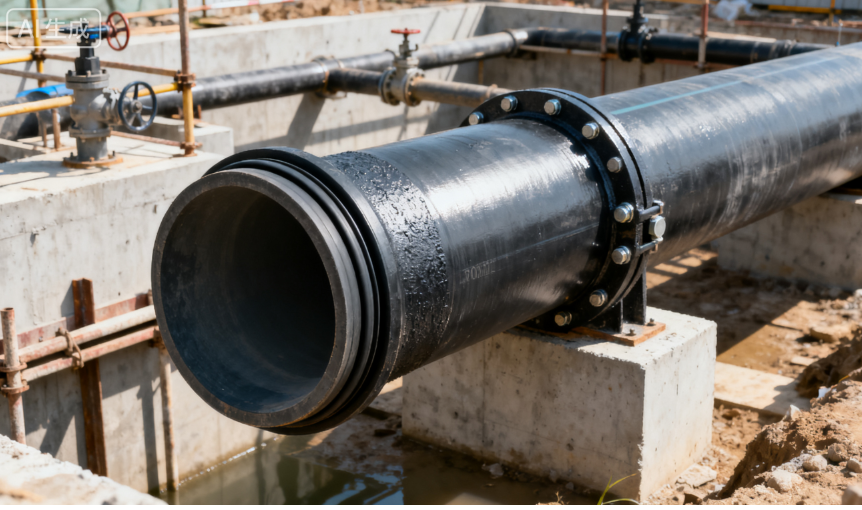
Which Installation Steps Have the Greatest Impact on Joint Performance?
1. Gasket Placement Errors Before Assembly
Many joint issues begin before the pipe is even pushed together.
Typical problems include:
Gasket not fully seated in the groove
Uneven gasket positioning around the circumference
Gasket contaminated during storage or handling
Why this matters:
An incorrectly seated gasket cannot distribute sealing pressure evenly, leading to early leakage once the pipeline is pressurized.
Field advice:
Inspect the gasket position along the full circumference before inserting the spigot.
2. Joint Assembly Without Confirming Full Engagement
A joint that “looks connected” is not always correctly assembled.
Common causes:
No insertion depth mark
Pipe stops moving but is not fully home
Obstruction inside the socket
Why this causes risk:
Insufficient engagement prevents the gasket from working within its designed compression range.
Field advice:
Always verify insertion depth visually or by measurement, not by feel.
3. Contamination at the Contact Surfaces
Joint sealing surfaces are sensitive to small contaminants.
Common site conditions:
Sand or soil entering the socket
Rust flakes on the spigot end
Excess lubricant mixed with debris
Why this leads to leakage:
Contaminants interrupt gasket contact and accelerate local wear.
Field advice:
Clean socket and spigot surfaces immediately before lubrication and assembly.
4. Misuse of Joint Deflection Capability
Ductile iron pipe joints allow limited angular movement, but this feature is often misunderstood.
Common mistakes:
Using joint deflection to compensate for poor alignment
Exceeding recommended deflection limits
Applying deflection at multiple consecutive joints
Why this increases failure risk:
Excessive deflection concentrates stress on one side of the joint, reducing sealing reliability.
Field advice:
Use joint deflection only for fine adjustment, not for correcting alignment errors.
5. Insufficient Support Around the Joint Area
Joint integrity depends heavily on pipe support conditions.
Typical problems:
Uneven bedding beneath joints
Voids under the pipe barrel near the joint
Poor compaction around the joint zone
Why joints are affected first:
Differential settlement transfers stress directly to the joint instead of the pipe body.
Field advice:
Ensure uniform bedding and proper compaction, especially within the joint zone.
6. Underestimating Axial Forces in Pressurized Pipelines
Axial forces generated by internal pressure are often underestimated during installation.
Common oversights:
Missing thrust blocks
Assuming all joints provide axial restraint
Ignoring pressure testing conditions
Why this matters:
Uncontrolled axial movement can cause joint separation or gradual leakage over time.
Field advice:
Confirm restraint requirements during design and verify them during installation.
How Can Contractors Reduce Joint-Related Problems?
Successful projects usually share three common practices:
Installation steps are followed systematically
Joint limits are respected on site
Foundation and alignment receive as much attention as the pipe itself
These practices are more effective than relying on pipe strength alone.
Are Installation Issues More Critical Than Material Quality?
In most ductile iron pipe projects, yes.
High-quality pipes cannot compensate for:
Incorrect gasket installation
Poor alignment
Inadequate support conditions
Joint reliability is ultimately achieved on site, not on paper.
Practical Takeaway for Site Engineers
Most ductile iron pipe joint failures are installation-related.
Clean assembly, correct alignment, and proper support are the real safeguards.
For reference on ductile iron pipe joint designs and connection options, see:
👉 http://www.ductileironpipe2600.com/index.php?c=category&id=29